
How well do you understand the laws behind your digital contracts? 82% of compliance failures arise from a misunderstanding of digital laws. One invalid contract can cost you millions—and your business reputation.
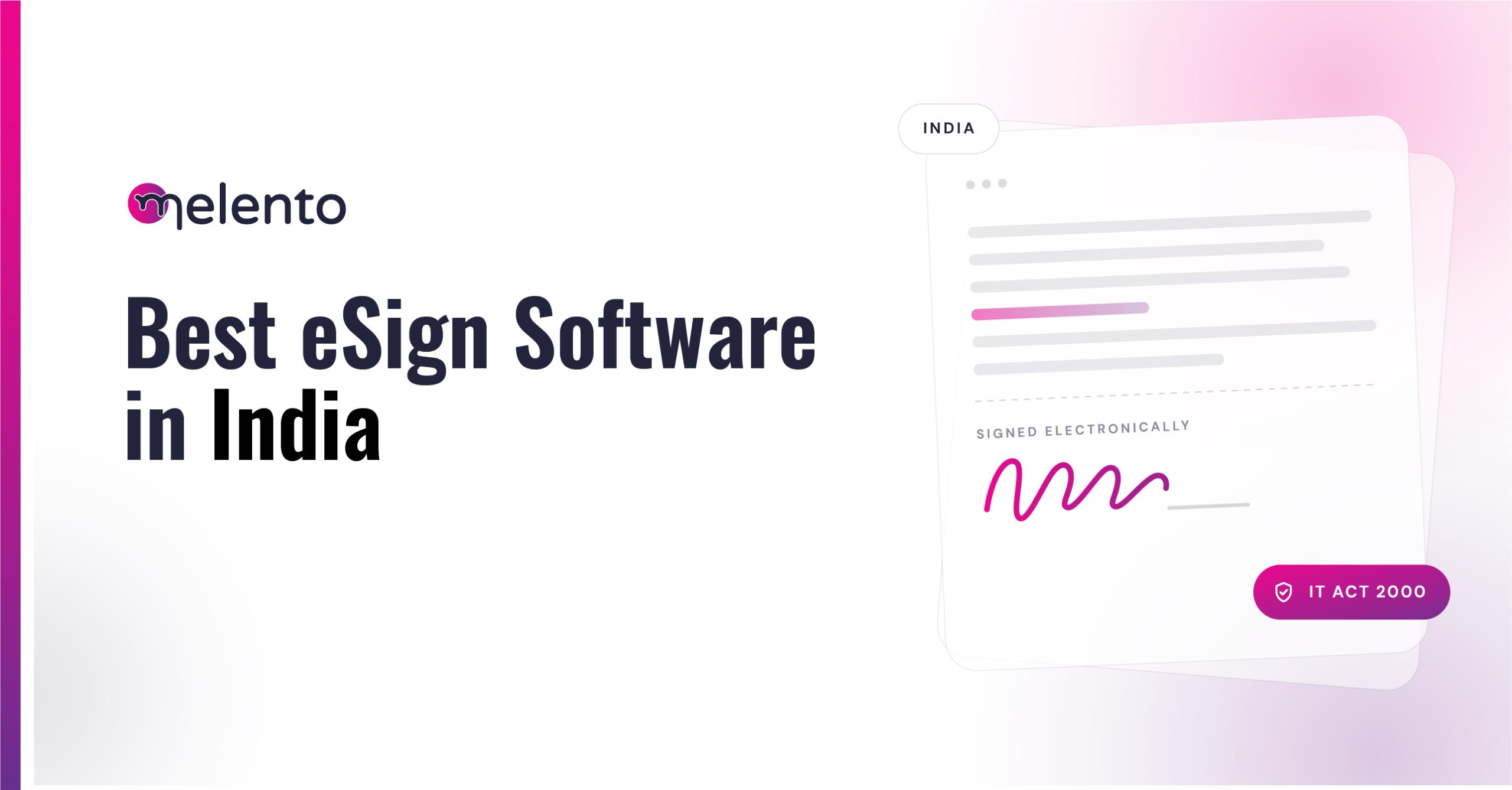
The Information Technology Act 2000 governs every digital document you sign. India is the world’s second-largest internet user base. Indian enterprises are rapidly embracing digital transformation. The IT Act 2000 safeguards this digital transition, regulating digital signatures, data, and contract security.
But how do you ensure your workflows meet compliance standards? To stay audit-ready, your enterprise needs tech that’s legally aligned with your operations. That’s where digital solutions come in.
As India’s leading document automation platform, Melento powers court-valid eSign workflows. Every document signed via Melento is fully compliant with the IT Act 2000. This blog highlights compliance with the IT Act 2000 and how Melento assists enterprises in staying compliant.
Is Your Contract Legally Binding?
IT Act 2000: What Does It Mean for Businesses?
India’s Information Technology Act, 2000, is the legal foundation for digital-first business. The IT Act recognizes the legal enforceability of digital transactions, contracts, and signatures.
There are 94 sections in 13 chapters of the IT Act. The modifications to the Indian Penal Code 1860 are covered in the final four parts, which are outlined in sections 91 to 94.
What Are the Global Roots of India’s IT Act 2000?
The Information Technology Act 2000 was enacted to regulate e-commerce. In 1996, UNCITRAL introduced a legislative model to standardize electronic transaction laws worldwide. The UN General Assembly urged nations to adopt this framework. India responded by introducing the IT Act in 2000, becoming the 12th country to enact cyber laws.
What Does the IT Act 2000 Legally Recognize?
|
Area |
✅ Legal Recognition |
|
Electronic Records |
Digital files are legally equivalent to physical documents |
|
Electronic Contracts |
Online contracts are enforceable like handwritten agreements |
|
Digital Signatures |
Legally valid signatures using DSC or Aadhaar eSign |
|
Secure Digital Processes |
Validates integrity, authenticity, and non-repudiation of digital transactions |
💡 Contracts without IT Act-compliant eSignatures are invalid in court.
How Does the IT Act 2000 Safeguard Businesses?
|
Area of Protection |
💼 Relevance to Enterprises |
|
Cybercrime |
Protects digital infrastructure from hacking, phishing, and ransomware. |
|
Unauthorized Access |
Criminalizes breaches and theft of digital information. |
|
Tampering with Documents |
Ensures that electronic records remain unchanged and traceable. |
What Are the Key Additions via the IT (Amendment) Act 2008?
The 2008 Amendment expanded the law’s scope and strengthened data protection:
|
Provision |
⚙️ Business Impact |
|
Intermediary Liability |
Platforms must ensure user content doesn’t violate laws (e.g., WhatsApp, AWS). |
|
Cyber Terrorism |
Criminalizes digital threats to national security & enterprise infrastructure. |
|
Personal Data Handling |
Sets expectations for lawful and fair use of user data. |
✅ Compliant platforms, such as Melento, ensure that your workflows comply with these provisions.
Why Is the IT Act 2000 Crucial for Business Operations?
Indian enterprises lose ₹9.3 Cr annually to contract invalidity & audit risk (Source: PwC, 2023). Every digital-first enterprise needs a legal spine. The IT Act 2000 is that spine. It validates every byte you sign. As workflows move online, the legal defensibility of contracts becomes mission-critical.
Here’s what the IT Act ensures for modern businesses:
- Enforceable Digital Signatures
- Digital signatures under the IT Act carry the same weight as handwritten signatures.
- Aadhaar eSign and Class 2/3 DSCs are fully court-admissible.
- 90% of enterprises now use digital signatures for internal approvals (Deloitte, 2024).
👉 Without IT Act-compliant eSign, your contracts may be inadmissible.
- Legally Valid e-Contracts
- The Act recognizes clickwrap, Aadhaar-signed, and digitally executed contracts.
- Section 10A confirms that no physical presence is required for contract validity.
- This enables cross-border and remote agreements that are legally enforceable in India.
- Legal backing for e-records under the RBI Act of 1934 and the Evidence Act of 1891.
👉 eContract adoption has increased 3.5 times since 2020 (BCG Report, 2023).
- Evidence & Audit Trail Validity (Section 65B – Indian Evidence Act)
- Electronic records are valid in court only if they are 65B-compliant.
- Section 65B ensures audit logs, email trails, and metadata are admissible.
- Without a 65B-compliant certificate, digital evidence may be excluded from consideration.
👉 Melento embeds 65B compliance into every digital signing workflow.
Checklist: Is Your Workflow IT Act-Ready?
Run a Compliance Health Check – Talk to SignDesk’s Legal Experts |
How Does the IT Act 2000 Define a Valid Digital Signature?
Not all eSignatures are legally equal. The IT Act 2000 clearly defines what constitutes a valid digital signature in India. Using unverified tools or basic image-based signatures can lead to contract nullification.
t complies with the MCA21 e-Government initiative. Therefore, all filings made by firms or limited liability partnerships (LLPs) must be signed by an authorized signatory using a digital signature.
Under the Act, two types of digital signatures are legally recognized:
1. Digital Signature Certificate (DSC)
- Issued by licensed Certifying Authorities (CAs) under the Controller of Certifying Authorities (CCA), India
- Comes in Class 3 or eSign DSC formats, with stronger encryption and identity proofing
- Mandatory for high-risk filings: ROC, GST, tenders, and enterprise contracts
- Uses PKI-based asymmetric cryptography for non-repudiation and integrity
✅ Used widely by banks, insurers, NBFCs, and listed companies for security assurance.
2. Aadhaar-Based eSign (Section 3A Recognition)
- Legally valid under Section 3A of the IT Act
- Facilitated by UIDAI-authorized ASPs (Application Service Providers)
- Signer identity is verified via OTP or biometrics linked to Aadhaar
- Common in fintech, telecom, HR, and customer onboarding due to speed & scale
✅ Over 70 crore Aadhaar eSigns have been executed since 2015 (UIDAI, 2024).
What is a Valid Digital Signature Under the IT Act?
|
✅ Requirement |
💼 Why It Matters for Enterprises? |
|
Issued by a Licensed CA or ASP |
Ensures legal enforceability under Indian law |
|
Unique to Signer |
Prevents impersonation or signature misuse |
|
Secure Authentication |
OTPs, biometrics, or certificates validate signer identity |
|
Audit Trail & Hashing |
Supports Section 65B compliance in courts |
|
Timestamped |
Proves when the document was signed |
How Section 4 of the IT Act Determines Legal Recognition of E-Contracts?
Section 4 of the Information Technology Act, 2000, is the cornerstone of digital legality. It gives electronic records the same legal recognition as paper-based documents.
What Section 4 Legally States?
“Where any law provides that information or any other matter shall be in writing or in the typewritten or printed form, then, notwithstanding anything contained in such law, such requirement shall be deemed to have been satisfied if such information or matter is…”-
- rendered or made available in an electronic form; and
- accessible so be usable for a subsequent reference.
|
A digital contract is legally valid if:
|
Legal Risk Alert: How the IT Act 2000 Penalties Impact Your Business?
The Information Technology Act 2000 also enforces strict penalties for businesses and individuals. Breaches of data privacy, misuse of digital signatures, or failure to secure systems can result in fines and reputational damage.
Penalties & Business Impact
|
Section |
Offense |
Penalty + Business Impact |
|
43 |
Unauthorized access, deletion, or modification of systems |
Financial compensation to the affected party. Data tampering can lead to lawsuits & audit failures. |
|
43A |
Mishandling sensitive personal data without security measures |
Compensation to the harmed party. Non-compliance with data protection affects trust & legal standing. |
|
66 |
Hacking with fraudulent intent |
3 years in jail, or ₹5,00,000 fine, or both. Network breaches can halt critical operations & trigger legal action. |
|
66B/C/D |
Identity theft or impersonation using digital info |
3 years in jail, or ₹1,00,000 fine, or both. Misuse of digital credentials threatens customer data & brand credibility. |
|
66E |
Privacy violations (unauthorized circulation of private images) |
3 years in jail, or ₹2,00,000 fine, or both. Breach of customer privacy damages brand reputation & trust. |
|
66F |
Cyberterrorism or compromising national digital security |
Life imprisonment. Can shut down digital infrastructure and cause irreversible legal exposure. |
How Does Melento Ensure Compliance With the IT Act 2000?
Melento is built for enterprises that can’t afford legal gaps. Our platform automates IT Act compliance at every stage of documentation—from creation to court readiness.
Here’s how Melento makes your documentation airtight:
Legally Recognized Digital Signatures
- Aadhaar eSign (Section 3A) + DSC (Class 3) integrations
- Backed by UIDAI-approved ASPs and CCA-licensed Certifying Authorities
- Enables secure, identity-verified signing with OTPs, biometrics, or token-based auth
✅ Melento eliminates signature fraud with court-valid digital verification with 100% compliance.
Automated eStamping Per State Jurisdiction
- Instant eStamping in 25+ states & UTs
- State-specific stamping rules are auto-applied with value computation
- No delays, no franking, no manual paperwork
✅ Slash contract closure time by 70% with Melento’s real-time eStamping.
Section 65B-Ready Audit Trails & Digital Evidence
- Auto-generates hash-based, tamper-proof audit logs
- Captures signer IP, device ID, location, and time
- Produces pre-built 65B certificates for court admissibility
✅ Documents signed via Melento are always court-prepared and audit-ready.
Legally Aligned Workflow Automation
- Templates aligned with the Indian Contract Act + IT Act 2000
- Smart workflows ensure mandatory fields, consent, and validation
- CLM modules such as Melento CLM software ensure every contract passes legal scrutiny
✅ Reduce human errors up to 88% and enforce compliance with smart templates.
Why Melento Is Better Than Other Compliance Tools?
|
Feature |
Compliance Assurance |
|
eStamp + eSign Integration |
Ensures contracts are both signed & stamped |
|
Aadhaar eSign & DSC Options |
Legally recognized under Sections 3 & 3A |
|
Document Storage & Retrieval |
Meets Section 4’s “reproducibility” requirement |
|
65B-Compliant Evidence Generation |
Prepares contracts for court admissibility |
|
Real-Time Audit Trails |
Tracks signer actions with timestamps and IP logs |
Empower Your Business Workflows With Melento’s IT-Act Ready Document Automation
Non-compliant documents cost more than just delays. They cost deals. The IT Act 2000 is your enterprise’s first line of legal defense. But without the right tools, even well-intended digital workflows can fail audits.
Melento’s digital stamping tool ensures every signature, contract, and workflow is built on compliance. From Axis Securities to Fyers, Melento helps compliance-first brands sign smarter.
Why India’s Leading Regulated Enterprises Trust Melento?
|
Enterprise Impact |
Real Results Delivered by Melento |
|
3,000+ Clients |
Across BFSI, telecom, logistics, legal, and NBFCs |
|
50M+ Documents |
Executed securely with IT Act compliance |
|
Global Compliance |
Supporting India, UAE & US workflows |
|
8 Compliance Certs |
Including ISO 27001, SOC2, and UIDAI ASP |
Ensure full compliance in your eSign and contract workflows with Melento.
Worried About Compliance Gaps? Let’s Fix Them.