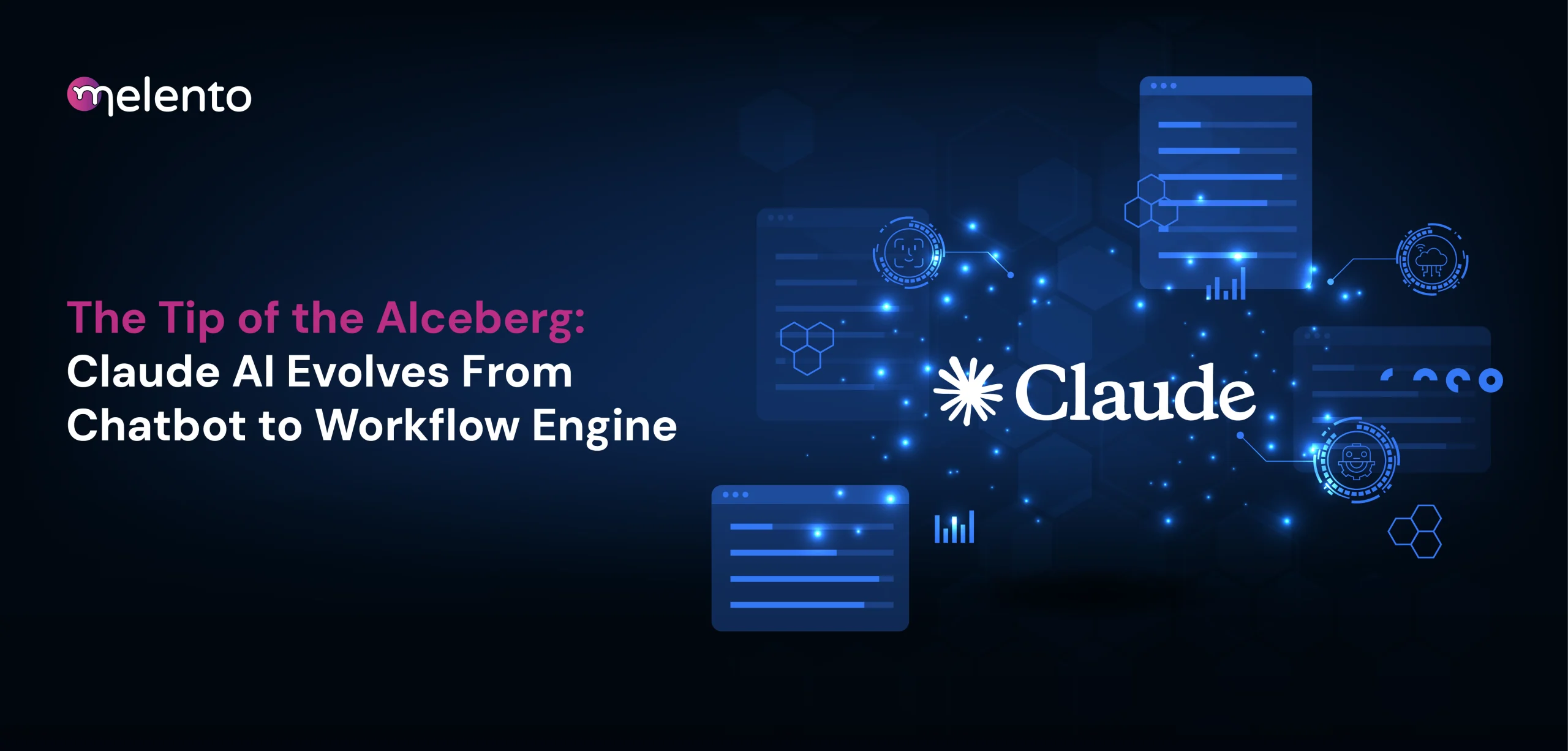

Why last week’s AI announcements should make every software founder pause — and every startup refocus.
Last week, Anthropic announced a set of new agentic capabilities and domain-specific plugins — including legal workflows that sent visible ripples through the US software market. Stocks tied to legal tech, enterprise SaaS, data and knowledge work flinched. The so-called market analysts rushed to declare winners, losers, and the “death” of entire categories.
That reaction, while dramatic, misses the real story.
What we saw last week was not the disruption itself. What we saw wasn’t a crack in the ice.
It was a glacier breaking away, while most were still looking for fractures — it was a real shift which is going to reshape the software and start-up landscape.
What Just Happened (And Why the Market Reacted So Fast)
February 3, 2026 was the day when Vertical Software companies ‘Felt the Ground Move’.
Anthropic announced a major update to Claude Cowork, introducing a set of agentic plugins that tailor Claude for real business workflows. These plugins enable Claude to go beyond simple chat and execute multi-step tasks specific to roles like sales, legal, marketing, customer support, finance, data analysis, and more.
This development was significant, there was a brutal sell-off in the markets – hundreds of billions ($) in combined market cap volatility, legal tech and financial services stocks in a single trading session in the US market alone. And the significance of Anthropic’s announcement wasn’t that a legal plugin suddenly became better than lawyers or enterprise software overnight.
This development represents a shift from general language capabilities toward domain-aware, action-oriented AI, signaling a new phase where Large Language Model providers are no longer gathering content and supplying intelligence. They are starting to ship products and outcomes.
When an LLM stops being a horizontal assistant and starts behaving like a legal analyst,
a sales ops coordinator, a compliance reviewer, or a finance analyst, it begins to collide directly with existing software value chains.
Markets understand this instinctively, but we’ve seen this movie before.
- Chegg didn’t collapse because ChatGPT was a perfect tutor. It collapsed because investors realized that generic, high-margin knowledge layers are fragile once reasoning becomes commoditized.
- Atlassian has embraced AI deeply, but the fear remains: if agents can reason across Jira, Confluence, Slack, email, and code, where does the “tool boundary” really live?
- Salesforce didn’t lose relevance — but Einstein’s evolution into autonomous agents signals a quiet admission: the CRM UI itself may no longer be the center of gravity.
In fact, it’s been a year since Marc Benioff, CEO Salesforce suggested that “Agentic AI is a new labor model, new productivity model, and a new economic model”. So Anthropic’s plugins simply made this uncomfortable truth harder to ignore.
The Iceberg Beneath the Surface
What’s visible today — plugins, copilots, agents — is the smallest part of what’s coming.
Frontier model companies have been explicit about one thing: they are no longer competing on prompts or model quality — they’re competing to become the execution layer of software, embedding reasoning, memory, tools, and actions into cohesive systems. And what the public sees is a constrained subset of the innovation that these companies have internally.
The real shift is structural.
The plugins, copilots and agents are not the breakthrough — they are the disclosure boundary. Markets react not because the revenue disappeared overnight, but because the direction of capability became unmistakable.
This is why incumbents are nervous.
This is why investors react before revenue moves.
And this is why the phrase “AI is just a feature” is aging badly.
Now comes the uncomfortable truth — especially for startups.
“If your AI product only exists because today’s LLMs aren’t good enough yet, you don’t have a moat — you have a countdown timer.”
Because this is not a level playing field. This is a compute-heavy, data-hungry, energy-intensive, distribution-driven race, and the advantages sit squarely with hyperscalers, frontier model labs, and extremely well-funded enterprises with access to data and global reach.
The danger for startups isn’t that some of them will fail immediately. The danger is that they will succeed just long enough to believe they have a moat — until the glacier shifts again.
So this means the bar for differentiation has fundamentally changed.
Where Startups Still Win
Meta’s CEO Zuckerberg confirmed that their focus will be to build out AI infrastructure in the near future and are going to spend hundreds of billions of dollars.
Recently, NVIDIA’s CEO Jensen Huang pushed back on the notion of software companies becoming irrelevant.
So yes, the focus of the large infra and LLM providers will be different and they will not win everywhere. They won’t — because they can’t. They are structurally disincentivized from:
- deeply bespoke workflows,
- messy, cross-functional enterprise processes,
- ownership of regulated processes,
- long-tail integrations, and
- domain pain that requires months of co-creation with customers.
This is why startups must go back – to first principles.
Not “What can this model do?” But
- What is the real pain point, what breaks inside real organizations?
- What workflows are too complex, too political, or too unglamorous for hyperscalers?
- What outcomes matter more than model capability?
The Melento Point of View
At Melento, we always believed that
You cannot build a lasting company by arbitraging LLM pricing.
You cannot defend “AI-first” positioning if your product disappears when the model gets better.
“The real competition is happening below the waterline — in automated workflows, controls, accountability, and domain trust. That’s where lasting companies will be built.”
Our focus with Melento’s Collaborative Intelligence Platform (CIP) and CLM Software has always been clear:
- Not copilots that sit on the side
- Not workflows and plugins that automate a single step
- But end-to-end orchestration and ownership of workflows, where AI agents operate with context, guardrails, and accountability, while addressing deep domain centric problem statements
In regulated domains like BFSI, value is not created by “better prompts”. It’s created by embedding intelligence into approvals, controls, negotiations, compliance, and lifecycle governance—areas that require deep domain understanding and trust.
That’s why we believe startups don’t win by racing hyperscalers on breadth. They win by going deep. Because when the iceberg fully surfaces, deep domain expertise and execution—not just agentic intelligence—will be the real moat.