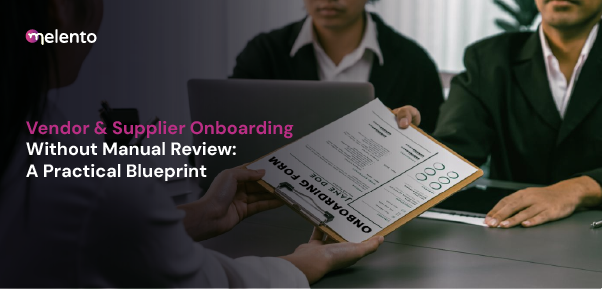

Procurement leaders rarely set out to build manual review factories. Yet that is what vendor onboarding becomes in many enterprises.
Suppliers upload documents. Teams validate tax registrations. Compliance screens sanction lists. Finance verifies bank accounts. Approvals move through layers. Emails circulate. Exceptions escalate.
By the time a vendor is activated, the process has touched multiple systems and several human reviewers.
Despite digitisation efforts, manual checkpoints persist. And at scale, those checkpoints slow procurement cycles, increase operational cost, and elevate compliance risk.
The question is no longer whether vendor onboarding can be digitised. It already has been. The real question is whether it can be executed without routine manual review.
The answer lies in rethinking architecture- not adding more reviewers.
Where Manual Review Still Dominates
Most procurement teams recognise the pain points:
- Incomplete submissions: Vendors submit forms with missing fields or outdated certificates. Internal teams chase clarifications.
- Document validation bottlenecks: Tax certificates, PAN records, bank proofs, contracts – each must be read, cross-checked, and verified manually.
- Compliance verification delays: Sanction checks, risk categorisation, and regulatory validations often require separate systems and manual interpretation.
- Approval inconsistencies: High-value vendors require escalation. Exceptions require secondary review. Routing logic is often embedded in policy documents rather than systems.
- Visibility gaps: Procurement, finance, and compliance lack shared dashboards. Vendors follow up repeatedly for status updates.
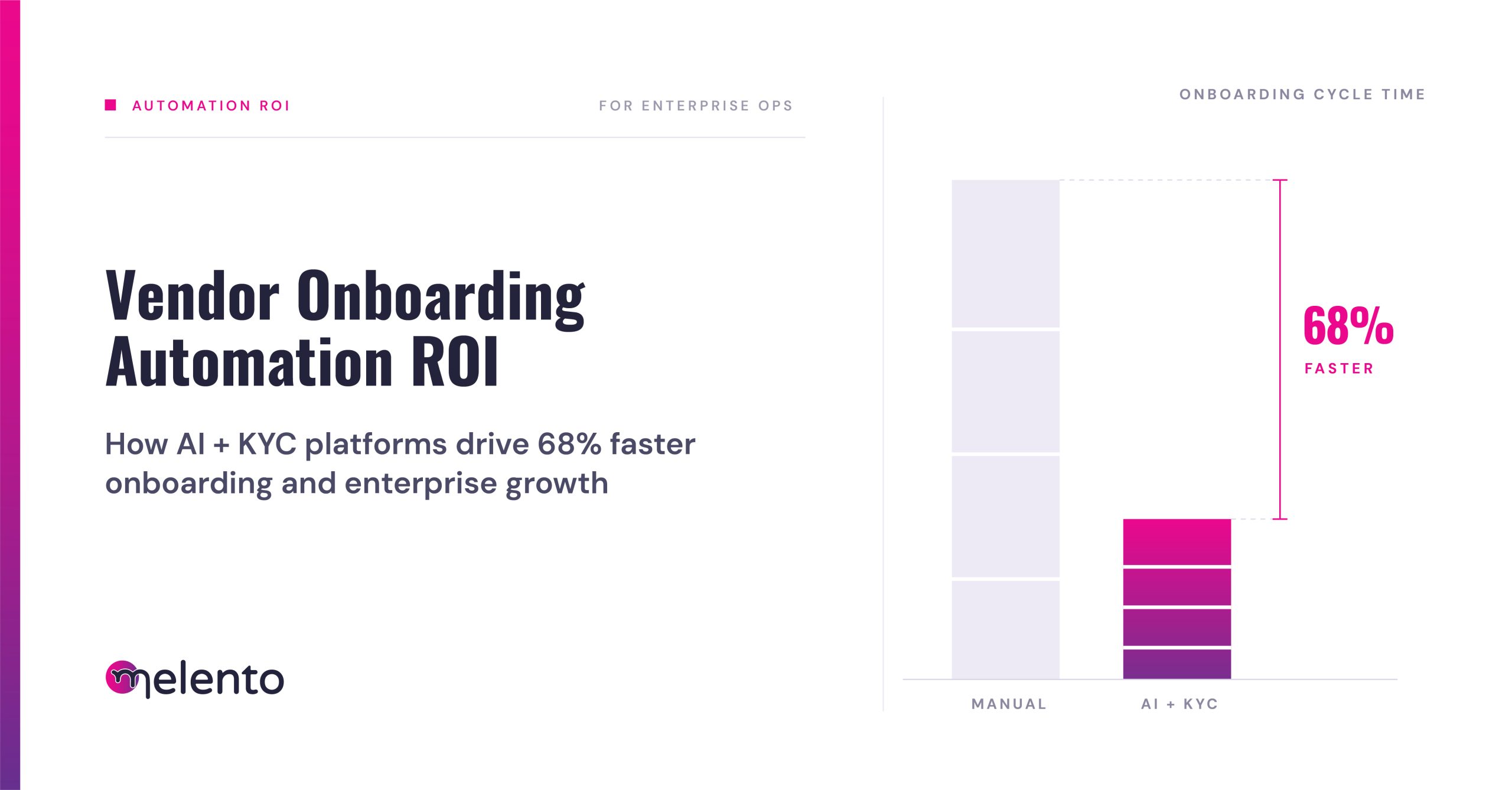
Each of these points extends the onboarding cycle time. Studies suggest that inefficient supplier onboarding can delay procurement activation by 20–30%. In regulated industries, fragmented validation processes also increase audit exposure.
The problem is not the absence of digital tools. It is the absence of orchestrated intelligence.
The Role and Limits of Intelligent Document Processing
Intelligent Document Processing (IDP) has meaningfully improved document-heavy processes. AI agents can now extract Tax numbers, bank account details, invoice metadata, and compliance identifiers within seconds. They classify documents by type and flag missing information.
This eliminates a significant portion of manual reading.
But IDP alone does not eliminate manual review.
Extraction answers, “What information is present?”
Procurement requires answering, “What decision should follow?”
Does a vendor operating in a high-risk jurisdiction require enhanced due diligence?
Does a bank account mismatch pause activation?
Does a transaction threshold require multi-level approval?
Should compliance and finance review run in parallel?
These are structured decisions that must be executed consistently and defensibly.
This is where MStream by Melento becomes central to the blueprint.
Designing Onboarding as an Orchestrated System
MStream enables enterprises to design vendor onboarding as a visual, governed workflow rather than a chain of disconnected tasks.
Through its low-code flowchart interface, procurement and operations teams can map policy into executable logic.
Structured intake begins with configurable forms. Vendors submit data through branded portals using Start and Continuous Form nodes, ensuring consistent capture from the outset. Webhook nodes allow document ingestion from email or API channels.
Once documents enter the system, AI agents embedded within the workflow extract and classify information automatically. Metadata is structured and stored within Melento’s MWork (intelligent process automation) Smart Space, eliminating redundant manual entry.
From there, the workflow governs decisions.
Conditional logic nodes, such as If and Switch Case, evaluate vendor type, geography, transaction value, and compliance status. Loop nodes validate multiple documents in sequence. Custom JavaScript logic supports complex policy enforcement.
Split nodes enable parallel processing. Compliance and finance teams can review simultaneously rather than sequentially, reducing bottlenecks.
Approval nodes route applications through multi-level hierarchies based on predefined thresholds. Assignment nodes ensure clear accountability at each stage.
The result is not automation layered onto manual review, but manual review reserved only for genuine exceptions.
Reducing Manual Review to Exception Handling
When IDP and risk agents operate inside governed workflows, routine review steps disappear.
For example:
- AI extracts tax and banking details automatically.
- HTTP integrations trigger sanction screening APIs in real time.
- Penny-drop verification confirms bank accounts through external services.
- Conditional logic routes low-risk vendors directly toward approval.
- High-risk vendors are escalated automatically.
Manual intervention becomes event-driven, not default-driven. Enterprises that deploy this model often report reductions of 60–80% in manual review effort – not because oversight is removed, but because it is intelligently targeted.
Workflow Meets Application: Visibility Without Friction
A common weakness of workflow tools is that they operate invisibly. They automate logic but fail to provide a unified application experience.
Vendor onboarding, however, requires transparency.
MStream integrates with the MWork platform to ensure that every workflow becomes a fully functional business application.
Procurement teams access dashboard views in list or Kanban formats. Managers see consolidated approval queues. Stage visualisation displays progress across milestones. Stakeholders collaborate directly within the application through contextual commenting.
Role-based access control ensures that each participant sees only relevant data. Vendors access branded portals to track their onboarding status in real time, reducing follow-up queries.
This shared visibility eliminates much of the friction that previously required manual coordination.
Data as Governance Infrastructure
In many organisations, onboarding data lives across multiple repositories. Approval histories are difficult to reconstruct. Reporting requires manual exports.
MStream treats data as a first-class citizen.
Through the Smart Space architecture, every submission, decision, approval, and integration event is automatically structured and stored. Native reporting capabilities provide real-time metrics on cycle time, exception rates, and SLA adherence. Historical analysis becomes straightforward.
Audit readiness is built into the process rather than retrofitted after the fact.
In regulated industries, this structured data backbone transforms vendor onboarding from a compliance vulnerability into a defensible system.
Dual Automation for Speed and Responsiveness
Vendor onboarding requires both structured orchestration and reactive triggers.
MStream manages sequential process logic – from intake to activation. In parallel MWork’s event-driven automation rules send notifications, update ERP systems, escalate SLA breaches, and flag high-value vendors for priority processing.
For instance, when an application status changes, automated rules can notify vendors instantly or update accounting systems in real time.
This layered automation ensures that speed does not compromise control.
A Practical Blueprint
Vendor onboarding without manual review is not achieved by eliminating oversight. It is achieved by embedding intelligence inside governed workflows:
- Standardise intake through structured forms and portals.
- Use AI agents for document extraction and classification.
- Apply conditional logic for risk-based routing.
- Automate approvals based on policy thresholds.
- Integrate external verification APIs within the workflow.
- Provide shared dashboards and real-time visibility.
- Store all data in a structured, audit-ready environment.
MStream by Melento delivers this architecture as a unified system.
From Administrative Burden to Strategic Lever
Procurement organisations do not need more reviewers. They need fewer review moments.
When IDP, risk agents, and visual workflow orchestration converge within a governed application layer, vendor onboarding shifts from manual scrutiny to intelligent execution.
Cycle times compress. Compliance strengthens. Operational transparency improves. Supplier activation accelerates.
Manual review becomes the exception – not the rule. That is the practical blueprint.