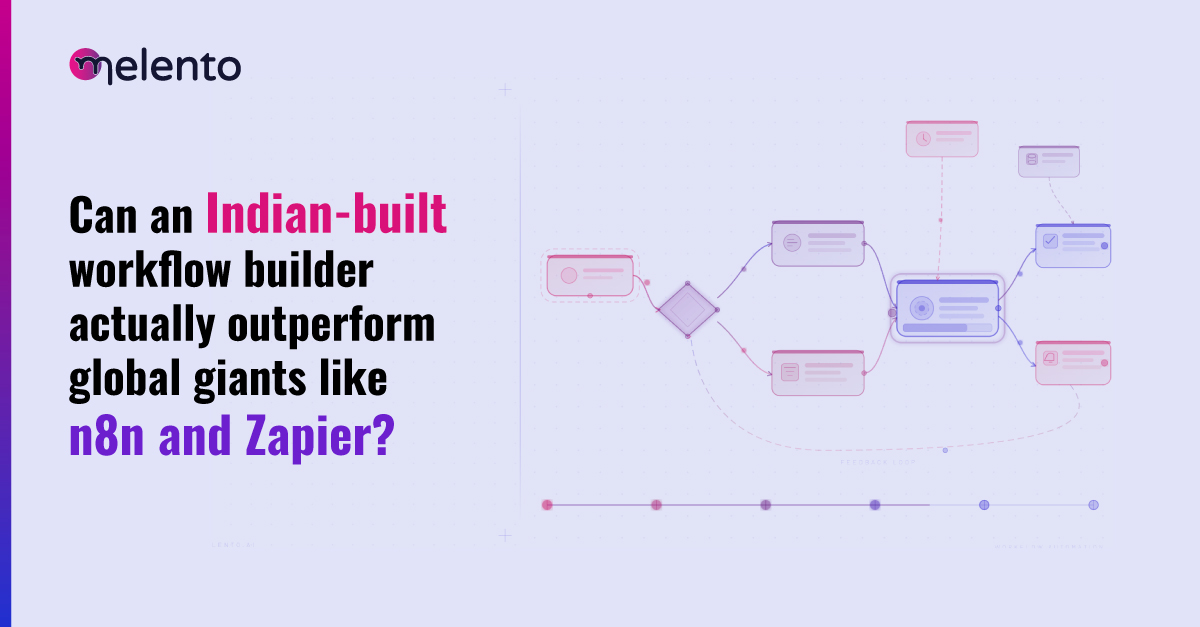

For over a decade, automation platforms like Zapier and n8n have democratized integration, enabling teams to connect apps using visual workflow builders. However, as enterprises scale, a critical truth emerges: simple integration is not the same as intelligent orchestration.
In India’s rapidly evolving digital economy, enterprises require more than app-to-app triggers; they need systems designed for governance, regulatory compliance, and massive scale. This is where the next generation of agent workflow builders, built specifically for enterprise complexity, comes into play.
What Are the Limits of Traditional Trigger-Based Agent Workflow Automation?
Platforms like Zapier operate on a linear “if this, then that” logic. While effective for simple tasks like updating a spreadsheet, this model fails when faced with mission-critical enterprise processes that involve loops, conditional logic, and approval hierarchies.
Gartner has repeatedly emphasized that automation initiatives fail when orchestration and governance are afterthoughts. What works for growth-stage startups often collapses under an enterprise-grade agent workflow builder.
Enterprises need an agent workflow builder that goes beyond one-way triggers. Mission-critical operations, such as invoice processing or compliance monitoring, require a platform that can handle:
- Extracting structured data from varied document formats.
- Performing complex three-way matching across POs and receipts.
- Intelligently routing exceptions to the right stakeholders.
- Enforcing strict policy and regulatory governance (e.g., RBI mandates).
What is the “Enterprise Gap” in Existing Agent Workflow Automation Tools?
While open-source tools like n8n offer greater flexibility and support for self-hosting, their architecture remains largely deterministic. They lack “cognition”, the ability to make intelligent decisions within a workflow.
The gap in modern automation isn’t about the number of connectors; it’s about embedded intelligence. An enterprise-grade agent workflow builder bridges this gap by:
- Interpreting Nuance: Instead of just flagging a high-value expense, an intelligent agent assesses the receipt’s context against evolving compliance policies.
- Reasoning Over Tickets: In customer support, the system doesn’t just route a ticket; it categorizes it, synthesizes knowledge base info, and escalates based on SLA awareness.
- Unified Architecture: Moving away from fragmented tools where AI is “bolted on,” to a system where AI reasoning is the core of the execution.
Why Does India Need a Specialized Agent Workflow Builder Alternative?
India is no longer merely a consumer of SaaS platforms. It is a producer of global digital infrastructure. From UPI to Aadhaar, the country has demonstrated its ability to design systems at a population scale.
Yet much of enterprise workflow automation continues to rely on foreign-built platforms optimized for smaller operational footprints.
A Made-in-India alternative is not about nationalism. It is about contextual design.
Indian enterprises operate in environments where:
- Rapid Regulatory Shifts: Instant adaptation to local compliance and data localization mandates.
- Vast Scale: Systems designed to handle millions of transactions, not just thousands.
- Adaptability: The ability to orchestrate work across diverse documentation formats and legacy systems through a scalable agent workflow builder.
How Does Melento’s MStream Solve Enterprise Orchestration Challenges?
How do you complete complex workflows without constant “human rescue” or manual intervention? Melento designed MStream as a collaborative-intelligence layer that operates end-to-end. It uses an advanced agent workflow builder to embed AI agents directly into the workflow nodes.
In MStream, invoice submissions can be entered via webhook or form, where AI agents extract vendor details, amounts, line items, and purchase order references. Three-way matching is not a rigid comparison but an intelligent loop that interprets discrepancies before escalating exceptions. Approval chains adapt based on dynamic thresholds. Integration into accounting systems occurs through secure HTTP nodes within governed environments.
Expense claims submitted via mobile forms can be processed through AI extraction of receipt data, policy compliance checks implemented via conditional logic, delegation rules for managerial approvals, and finance verification for high-value reimbursements – all within a unified orchestration layer.
Document management workflows classify incoming files by type (invoice, contract, compliance, HR), extract metadata, and route them using switch-case logic augmented by AI understanding. Compliance monitoring workflows schedule data collection, conduct impact assessments, assign tasks to officers, collect evidence, and manage review and sign-off processes while maintaining auditability.
Customer query resolution becomes a closed loop: intake via API, AI categorization, auto-assignment, SLA tracking, escalation rules, knowledge base synthesis, automated notifications, quality review sampling, and analytics dashboards.
This is not trigger chaining. It is intelligent orchestration.
How Should Leaders Evaluate a Modern Agent Workflow Builder?
When choosing an automation platform, the criteria must shift to “quality of execution.” Ask these direct questions:
- Can it handle complexity? Will the workflow break if a human doesn’t intervene, or can it handle exceptions autonomously?
- Is AI native or external? Is reasoning built into the execution node, or is it a separate plugin that adds latency and risk?
- Does it scale with governance? Can the platform manage the regulatory and operational complexity of a growth-stage enterprise?
India’s SaaS ecosystem is maturing. Growth-stage companies are moving from scrappy integrations to structured operations. Financial institutions and regulated enterprises demand systems that combine flexibility with governance.
The next decade of automation will not be won by platforms that simply connect APIs. It will be defined by systems that unify AI reasoning with workflow orchestration.
What is the Final Verdict?
The global SaaS narrative often assumes innovation flows one way. Increasingly, that assumption is outdated. India’s enterprise needs are distinct, sophisticated, and large-scale. Solutions designed within this context can compete globally – not as imitations, but as evolutions.
A Made-in-India alternative to Zapier and n8n is not merely a new entrant in the workflow builder category. It represents a rethinking of what automation must become in an AI-first era.
Not just connected. Not just automated – But intelligently executed.
And that shift may well redefine how enterprises, in India and beyond, get work done.