For most enterprises, onboarding begins after a business decision has already been made. A vendor is selected, a partnership is approved, or a customer is ready to move forward. Yet instead of accelerating execution, onboarding often becomes the point at which momentum slows.
The reason is that onboarding still relies on manual processes. Documents move across email threads, compliance teams chase missing information, and approvals wait in sequential queues. Verification happens across disconnected systems. What should be a structured business process becomes a collection of operational tasks.
A 2024 global study highlights that 67% of organizations lose clients due to slow onboarding, making it a direct revenue risk. Modern platforms like Melento transform onboarding into a revenue-driving function by:
- Reducing administrative effort by 50-80% through AI-driven workflows
- Cutting onboarding costs by 40-60%
- Delivering an average 5:1 ROI
- Accelerating time-to-value by 50-70%
The result is measurable business impact.
In complex onboarding scenarios, manual processes can cost enterprises more than $2,000 per client, making automation a strategic requirement rather than just an operational improvement.
|
“Vendor onboarding has traditionally been viewed as an operational necessity, but in today’s enterprise landscape, it is a critical driver of business velocity, compliance, and growth. AI-powered automation allows organizations to move beyond manual document chasing and fragmented processes to create intelligent onboarding ecosystems where every verification, approval, and agreement happens faster, smarter, and with complete visibility.” – Krupesh Bhat, CEO & Founder, Melento |
Why Vendor Onboarding Has Become an Enterprise Bottleneck
Despite advances in digital transformation, onboarding remains one of the slowest-moving enterprise processes.
Most organizations still operate through fragmented workflows that involve procurement teams, legal departments, compliance, finance, and external vendors. Each stakeholder manages a portion of the process, but no single system provides complete visibility.
This creates several challenges:
- Vendor, partner, and supplier activation gets delayed
- Business teams experience slower execution cycles
- Compliance risks increase due to incomplete information
- Leaders lack visibility into onboarding progress
Instead of enabling growth, onboarding becomes a hidden constraint on business velocity.
The Revenue Impact of Manual Verification and KYC Delays
One of the biggest contributors to onboarding delays is manual verification. For financial services, fintech, banking, and regulated industries, KYC requirements introduce multiple layers of document collection, identity validation, compliance checks, and approvals.
In practice, manual KYC processes often result in:
- Verification timelines stretching from weeks to months
- One in five KYC checks taking more than 24 hours, even for straightforward cases
- Customer and partner drop-offs due to onboarding friction
These delays directly impact revenue realization. Organizations may have demand, approved customers, or ready-to-sign partnerships, but operational delays prevent them from converting opportunities into active relationships.
Automation changes this equation. A payments firm that automated onboarding achieved 1.6x faster operations while reducing compliance costs, demonstrating how intelligent workflows can directly improve business outcomes.
Why Enterprise Onboarding Takes Weeks or Months to Complete
Large enterprises often underestimate how much time onboarding actually consumes. Vendor onboarding typically takes 30 to 90 days, with complex cases extending up to six months.
The delays usually come from three areas:
- Document collection:
Around 34% of onboarding time can be spent waiting for required documents, clarifications, and approvals.
- Risk assessment delays:
52% of companies take 31–60 days for risk assessments.
- Disconnected ownership:
Multiple teams manage different steps through emails, spreadsheets, and separate systems, increasing unnecessary waiting time.
The result is an onboarding process that moves slower than the business decisions it supports.
How Slow Onboarding Creates Customer and Vendor Drop-Off
In digital-first industries, onboarding speed directly influences conversion. Customers, vendors, and partners expect experiences similar to consumer applications: simple, transparent, and fast. However, manual processes introduce friction at every stage.
Common causes of drop-offs include:
- Repeated document submissions
- Manual data entry
- Lack of real-time validation
- Long approval cycles
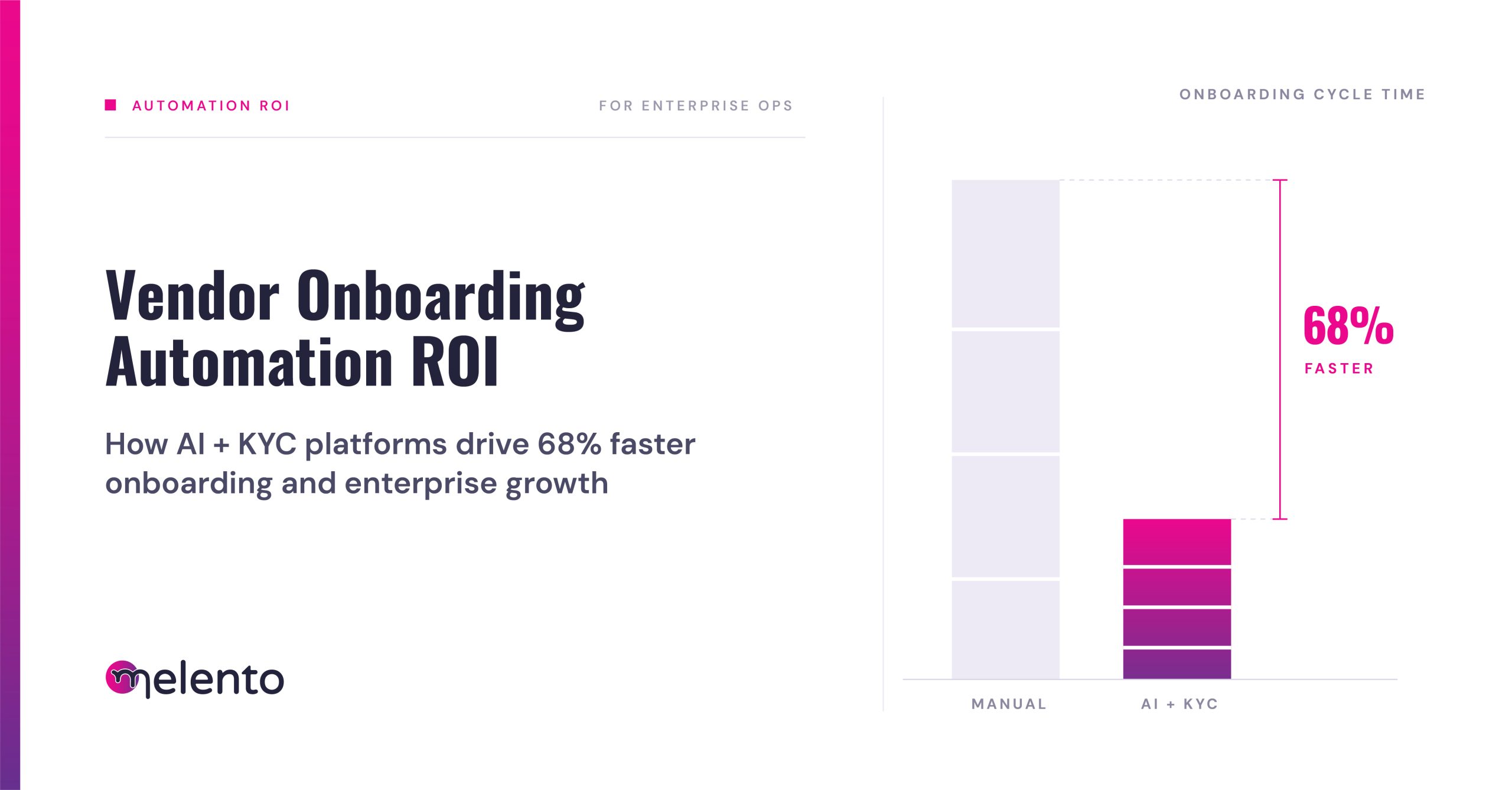
Industry data highlights that 68% of users abandon onboarding due to delays, while many institutions report KYC processes extending from one to six months. Also, as per another report, 70% of banks lose clients due to slow onboarding. Every delayed onboarding journey represents lost revenue, delayed partnerships, and reduced customer confidence.
The Compliance Challenge Behind Manual Onboarding
The problem with manual onboarding is not only speed. It also increases operational and regulatory pressure. Compliance teams often spend significant time collecting documents, following up with stakeholders, and correcting incomplete information, focusing instead on risk analysis.
Manual processes create:
- Higher operational costs
- Increased human error
- Rework caused by incomplete information
- Compliance team burnout
Compliance operating costs have risen by over 60% for retail and corporate banks since pre-financial-crisis levels. Compliance costs can absorb a substantial share of operating budgets, with some firms reporting levels as high as 25% of operations spend.
Fragmented Vendor Data Creates Regulatory Risk
As enterprises scale, vendor information often becomes distributed across procurement systems, spreadsheets, emails, and separate compliance tools. This fragmentation creates compliance blind spots.
Organizations struggle with:
- Outdated vendor information
- Missing compliance records
- Limited audit visibility
- Difficulty proving regulatory adherence
Without centralized and accurate data, enterprises increase their exposure to compliance failures and audit risks.
Moving from Manual Processes to Intelligent Vendor Onboarding
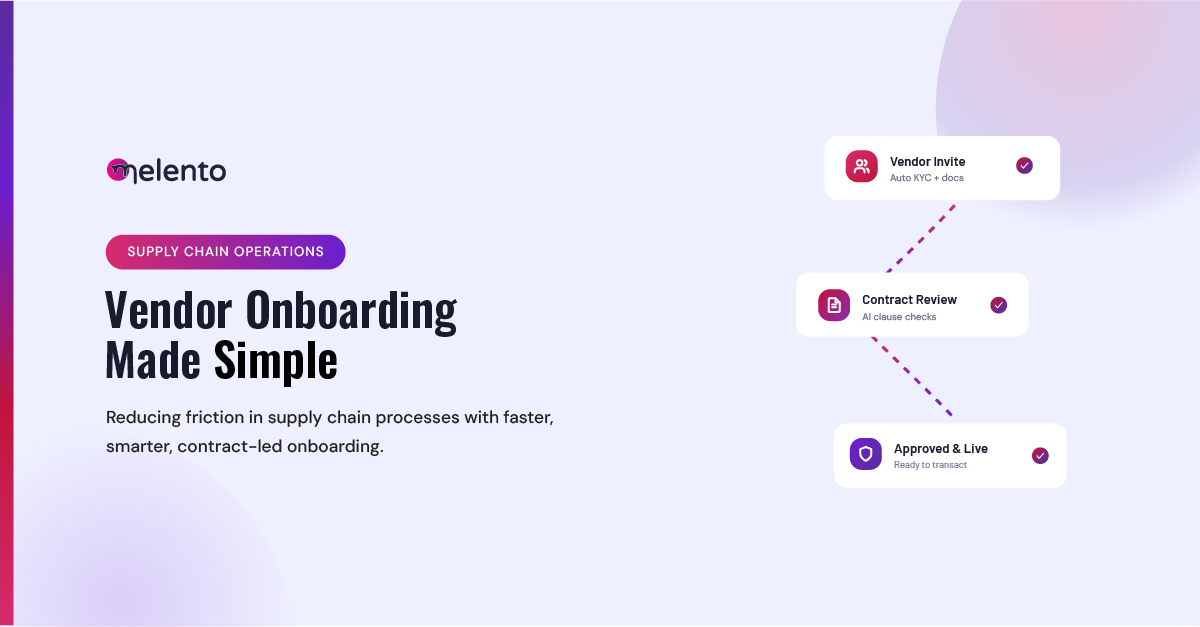
The solution is not simply digitizing individual tasks. Enterprises need an integrated onboarding system that connects verification, documentation, approvals, and compliance into one intelligent workflow.
Automated vendor onboarding enables organizations to:
- Collect documents through self-service portals
- Automate KYC and verification workflows
- Create centralized audit trails
- Enable faster approvals through parallel processing
- Maintain real-time visibility across onboarding stages
Automation transforms onboarding from a reactive administrative process into a scalable business capability.
How Melento Enables AI-Powered Vendor Onboarding Automation
Melento brings onboarding, KYC, compliance, and document workflows together in a single enterprise platform.
Its AI-powered compliance capabilities include:
- Automated AML and CDD checks with complete audit trails
- Video-based onboarding for regulatory requirements
- AI-powered digital identity verification using OCR and database validation
By combining intelligence with workflow automation, Melento reduces manual intervention while improving accuracy, compliance, and onboarding speed.
Automating Every Step of the Vendor Lifecycle
Melento eliminates disconnected onboarding processes through configurable automation.
Organizations can leverage:
- Standardized agreement and NDA templates with dynamic fields
- Bulk workflows supporting up to 5,000 executions through CSV uploads
- AutoSign for high-volume approval scenarios
- Integrated stamping and electronic signing within a single compliant workflow
Melento’s core value proposition for vendors is to streamline and scale a critical business process that often suffers fragmented, manual workflows. Melento solves the problems of disconnected tools, lack of standardization, poor visibility, delayed approvals, and compliance gaps.
Melento’s configurable platform includes:
- Custom workflow builders
- Dynamic forms
- Intelligent Document Processing (IDP)
- Risk Assessment Agents
- Centralized data management
Unlike traditional tools that separate workflow management, compliance, and documentation, Melento embeds intelligence directly into the onboarding process.
It differentiates by offering a low-code, highly configurable solution that integrates intelligence directly into the workflow, unlike competitors who often have more rigid, tool-separated approaches. Melento reduces manual intervention and accelerates onboarding timelines.
Enabling Collaboration Across Every Stakeholder
Enterprise onboarding involves multiple stakeholders, each with different responsibilities. Melento creates structured collaboration between:
- Vendors and signers: Aadhaar-based or electronic signatures enable faster agreement execution.
- Vendor coordinators: Teams can populate and manage standardized document workflows.
- Legal and compliance teams: Review, validation, and audit processes happen within a controlled environment.
This ensures faster execution without compromising governance.
Integrating Melento Into Existing Enterprise Systems
Enterprises do not need to replace their existing technology ecosystem. Melento supports seamless integration through:
- APIs and SDKs
- Embedded onboarding widgets
- Flexible workflow integrations
Organizations retain control over their data, compliance requirements, and internal processes while adding intelligent automation capabilities.
The Business Impact: Turning Onboarding Into a Growth Engine
Vendor onboarding automation changes the role of onboarding from an operational dependency into a strategic advantage.
Enterprises gain:
- Faster vendor and partner activation
- Improved compliance readiness
- Reduced operational costs
- Better visibility across workflows
- Scalable onboarding capabilities
By removing manual bottlenecks, organizations can move from approval to execution faster and capture business value sooner.
Evaluate the ROI of Your Current Onboarding Process
Before investing in automation, enterprises should evaluate the hidden costs of their existing processes:
- How many opportunities are delayed because onboarding takes too long?
- How much time do teams spend chasing documents?
- How prepared is the organization for compliance audits?
- How much revenue is delayed due to operational bottlenecks?
Understanding these gaps is the first step toward building a faster, smarter onboarding ecosystem.