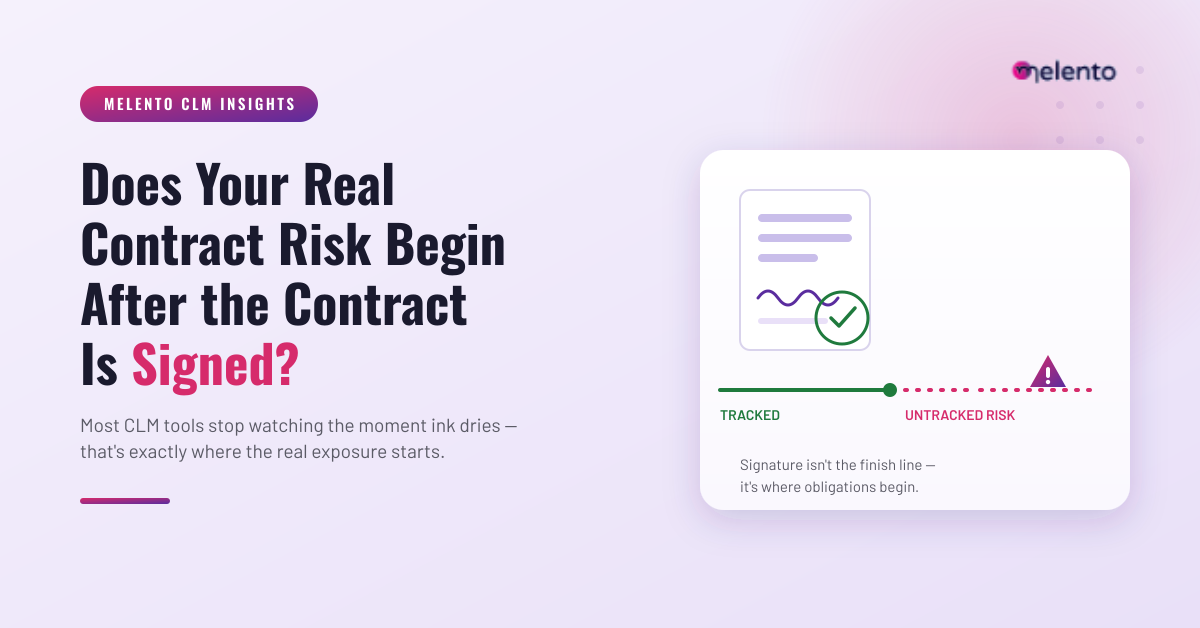
For most enterprise organizations, a signed contract is celebrated as a finish line. The legal team clears the docket, sales logs the revenue, and procurement marks the onboarding task as complete. However, operational data reveals a starkly different reality: the moment a contract is signed is exactly when your real corporate risk begins.
According to India’s First-Ever Report on Digital Contract Readiness, published by Melento (formerly SignDesk), a staggering 60% of enterprise workflows fail after approval. The failure isn’t a sudden, dramatic system crash. Instead, it is a quiet, systemic erosion where the value agreed upon during negotiations fails to become value realized during execution.
When critical legal logic is left unmonitored, an organization opens itself up to revenue leakage, operational bottlenecks, and severe compliance drift. Let’s find out how!
Why Do Traditional Systems Fail Post-Sign-Off?
Traditional enterprise architectures, specifically ERPs, CRMs, and basic workflow automation tools, fail post-signature because they are fundamentally designed as systems of record or process orchestration rather than systems for continuous execution control.
Why Traditional Systems Fall Short?
- ERP (RECORDS)
Processes transactions but cannot interpret conditional logic.
- CRM (RELATION)
Captures sales intent but relinquishes post-sale enforcement.
- Workflow Tools
Routes tasks & approvals, but lacks a control layer.
While these systems excel at their designated functions, they possess distinct structural blind spots once a contract is executed:
- ERP Systems: They handle transaction processing and financial integrity perfectly using predefined inputs, but they operate on rigid structures and cannot read or interpret the nuanced, conditional logic embedded within unique legal clauses.
- CRM Systems: They excel at tracking pipelines and storing what was promised during the deal cycle, but they surrender control the moment a contract closes. They do not ensure that post-sale commitments are actually fulfilled.
- Workflow Automation Tools: These platforms are highly efficient at routing linear tasks and securing consecutive approvals. However, their utility ends the moment the approval sequence completes; they lack the semantic understanding needed to enforce real-time contract compliance.
Because control is heavily front-loaded at the approval stage, a massive “execution gap” emerges downstream, leaving post-approval performance entirely unmonitored.
|
“Enterprise systems today are excellent at recording transactions, managing relationships, and automating workflows, but they lack the intelligence required to continuously interpret and enforce contractual commitments after approval. Melento mStream introduces a new control architecture where AI converts contractual language into actionable intelligence, monitors execution signals across enterprise systems, and triggers corrective actions in real time. This enables businesses to move from reactive contract management to an intelligent execution model where compliance, performance, and value realization are continuously governed.” – Santhosh Vasanthkumar, CTO, Melento |
What Is the “60% Execution Gap” in Enterprise Workflows?
When a process moves past the signature phase, it typically fragments across disconnected spreadsheets, siloed tools, and manual email threads. Responsibility diffuses, visibility drops to zero, and the business begins to suffer immediate operational, financial, and legal damage:
- Financial Value Leakage: Companies experience a continuous 2% to 5% loss in revenue due to post-signature failures. This financial pain is backed by global benchmarks: a study by the WCC finds that weak contract governance results in an average 8.6% erosion of value across enterprise portfolios. This leakage materializes as uncollected vendor penalties, inconsistent discounts, and untracked auto-renewals that sap enterprise margins.
- Operational Inefficiency: A lack of clear next steps triggers a 30% to 40% spike in turnaround time (TAT), burying teams under a 20% to 25% increase in manual follow-up efforts. Valuable internal capital is wasted playing administrative catch-up rather than scaling operations.
- Compliance Exposure: Enterprises face high regulatory risk via “compliance drift”, the gradual widening gap between written corporate policy and real-world execution. A service-level agreement or regulatory clause that isn’t actively monitored might as well not exist. This risk is highly pronounced in data security. According to the IBM Security Cost of a Data Breach Report, the average global cost of a data breach has reached $4.44 million, frequently driven by unmonitored third-party vendor supply chains and a lack of strict, role-based document controls.
Quikjet’s Take“Melento’s CLM helped us bring structure and speed to our entire contract ecosystem. Extracting data from legacy agreements. Something that took hours earlier now happens in minutes. It has reduced our TAT by up to 80%. Our teams collaborate better, and we finally have complete visibility into every contract.” – Legal Head (Quikjet Cargo Airlines Team) |
How Does Melento mStream Close the Post-Signature Execution Gap?
Melento mStream closes the execution gap by introducing a dedicated System of Control that sits directly atop your existing ERP, CRM, and workflow tools, continuously interpreting, monitoring, and enforcing contract logic in real time.
Instead of treating approval as the endpoint of a linear workflow, Melento mStream redefines it as a transition into a tightly controlled execution environment. Rather than introducing a redundant workflow tool, mStream operates as an intelligent Collaborative Intelligence Platform (CIP) that translates static legal text into active, executable rules.
|
Contract Approved & Signed ↓ Melento mStream Control Layer |
|
1. Capture Obligations – Converts text into logic 2. Monitor Continuously – Tracks execution across siloes 3. Enforce Outcomes – Triggers automated actions |
|
Realized Value • Lower Audit Risk • Reduced TAT |
By adding this essential control layer, Melento mStream bridges the gap between decision and outcome:
- Operationalizes Contract Logic: It extracts the conditional rules embedded in agreements (such as specific loan disbursement terms or vendor performance tiers) and binds them directly to active enterprise actions.
- Automates Post-Signature Enforcement: It replaces manual human tracking and constant follow-up loops with automated alerts and trigger events.
- Ensures Permanent Audit-Readiness: It actively tracks every obligation, monitors performance deviations in real time, and maintains proactive compliance across all business departments.