It’s a Monday review at a mid-sized bank, and the slide on screen says it all: eleven AI pilots, nine teams, five different tools.
The collections team has a voice experiment that calls customers and sounds promising. Operations has a chatbot that nobody trusts with anything important. Compliance has asked the same question twice and still has no answer: when an agent acts on its own, who is accountable? And right in the corner, a relationship manager quietly wonders whether getting good at these tools is the same as making herself redundant.
Then the CEO asks the simplest question in the room: “When does this pay back?” Nobody can say.
Here is the curious part. Some banks sit through that same meeting a year later and have agents running in production, with owners, guardrails, and numbers to show. They didn’t buy a better model. So what did they change?
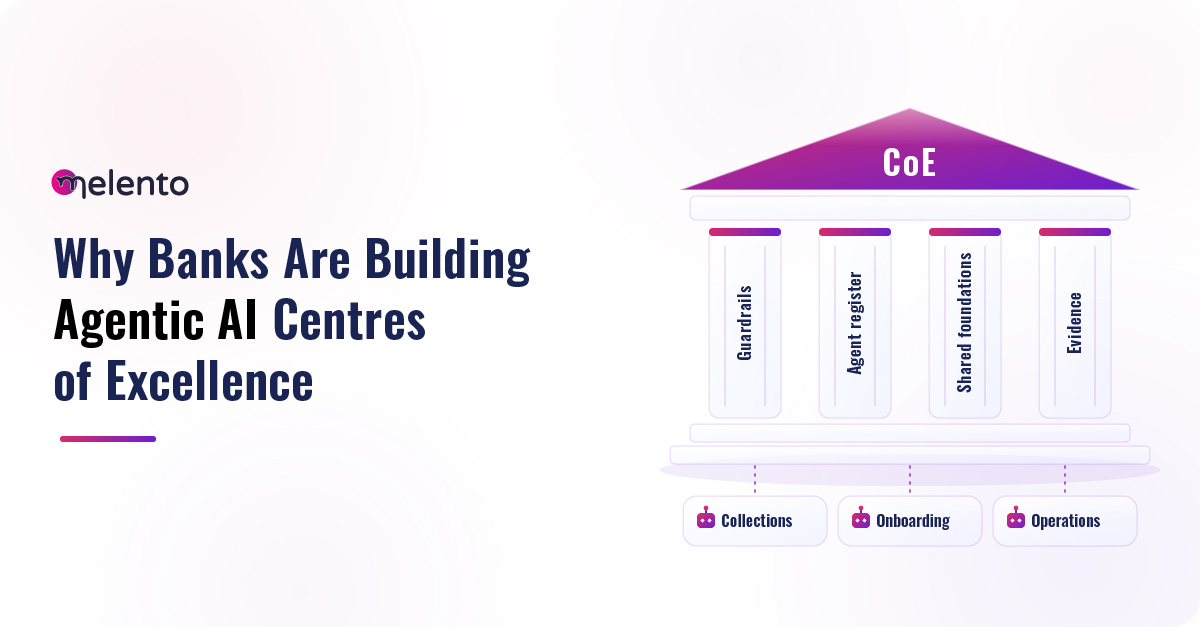
They built a structure around the work. More and more banks are doing it through an agentic AI Centre of Excellence (CoE), and that is why we’re talking about it. This post covers what a CoE actually does, why readiness has to come first, and what it needs from the platform underneath.
The pilot problem: plenty of experiments, little production
The numbers point to a wide gap between trying agentic AI and running it. EY’s 2025 banking AI research, discussed in its governed intelligence paper, found that 52% of banks had piloted agentic AI, but only 16% had fully deployed use cases.
Gartner expects the gap to cost money. It predicts that more than 40% of agentic AI projects will be cancelled by the end of 2027, citing rising costs, unclear business value and inadequate risk controls. Analyst Anushree Verma describes most current projects as “mostly driven by hype and often misapplied.”
The pattern inside banks is familiar. In its operating model for AI transformation in financial services, Infosys Consulting describes business units experimenting independently, each with its own technology stack and governance, until the lab becomes “an expensive showcase rather than a delivery engine.”
A CoE exists to break that pattern.
Agents act, so the stakes are different.
A chatbot answers. An agent does something. McKinsey puts it plainly in its guide for banking CIOs: unlike most copilots, agentic coworkers “do not only suggest; they execute.”
That changes what banks have to put in place first. McKinsey notes that there is no separate rulebook for agentic AI, and that regulators are applying existing supervisory expectations today. Each agent needs an explicit identity, a named owner and a formal life cycle, and every action it takes should be logged against that identity.
Melento’s engineers add a practical point from building agentic systems for customers: auditing agent decisions can’t wait until production. If a team only starts asking why an agent chose go-live, capturing that reasoning has come too late. Checkpoints and human-in-the-loop steps belong in the design from day one, so people can see why choices are made instead of treating the agent as a black box.
Indian BFSI teams face the same direction of travel. The RBI’s FREE-AI committee report, published in August 2025, sets out seven guiding principles, the first of which is “Trust is the Foundation.” It makes 26 recommendations across six pillars, including a board-approved AI policy. One law-firm summary of the report also highlights capacity building, including in-house expertise and AI Centres of Excellence.
In short: the more an agent can do, the more a bank has to be able to show about how, why, and under whose authority it did it.
Why readiness comes before the CoE?
A CoE is a response to a deeper problem, and it works best when a bank knows where it stands first. In a Melento discussion on AI readiness, the team made the same point the numbers hint at: pilots rarely fail because of the model. They fail because of everything around it.
Three gaps came up again and again:
- Systems built for a pre-AI world. Legacy platforms weren’t designed with AI in mind, so plugging agents into them is harder than it looks.
- Data that isn’t AI-friendly. Most organisations hold plenty of data, but it is fragmented and was stored for analytics or front-end systems, not for language models. That is why context management matters.
- People who don’t feel safe or skilled. Leaders want AI, yet the mid-level teams who will use it often lack training, and many quietly wonder whether using it well will cost them their jobs.
Process maturity matters just as much. Without it, as one Melento speaker put it, AI will “only automate the randomness.”
MARS: a readiness framework that points the way forward
Melento’s answer is MARS, its AI readiness framework. Instead of asking only whether the technology is in place, it looks at five dimensions:
- AI awareness
- Data readiness
- Integration
- Productivity impact, including quality gains and reduced friction
- AI governance and culture, from privacy awareness to how AI output is double-checked
Results map onto five stages:
|
Stage |
What it looks like |
|
1. Exploring |
No formal process. Use is individual and low-key. |
|
2. Experimenting |
Small pockets of experimentation, nothing solidified. |
|
3. Operationalising |
A few departments run AI inside workflows, with room to scale. |
|
4. Scaling |
Business outcomes are measured: revenue, time saved, productivity, or quality. |
|
5. AI native |
AI is part of every step, from decisions to final output. |
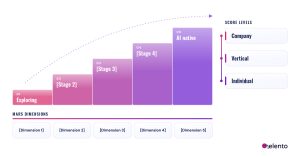
Scores come at three levels: company, business vertical, and individual, drawn from surveys of employees, vertical heads, and executives. That grassroots view is what sets MARS apart from top-down assessments. And the output is more than a number. It names the next step for each stage and sets out a roadmap to the return the organisation is after.
Where the CoE comes in?
For a bank, this is where a CoE earns its keep. Readiness results show which departments can pilot first, and the CoE turns the roadmap into shared standards, owners and guardrails. Spreading investment thin across every team is rarely the answer. Proving value in a ready department, measuring it, then bringing the others along is.
Three practical lessons follow:
- Don’t force-fit AI. Some roles need it at a different scale than others. The goal is to apply AI where it clearly pays off, not to hit an adoption target.
- Respect boundaries. Agents can cross departmental lines, and organisations have those lines for good reasons. Unless every department moves at a similar pace, a bank can’t call itself AI native.
- Be realistic about ROI. Some outcomes people expect within a month more realistically take around six, and saying so early makes for better boardroom conversations.
What an agentic AI CoE actually does?
A CoE is not a committee that approves slide decks. Lumenova, a vendor, makes a useful distinction: a governance committee sets policy and approves use cases, while a CoE is operational, building and maintaining the tooling, standards, and support teams use every day.
In practice, five jobs matter most.
- Set the guardrails. Define which actions an agent may take alone and which need a human to confirm, then apply those tiers everywhere.
- Keep the register. Track every agent, its owner, its permissions, and its lifecycle in one place.
- Build the foundations once. Data access, integrations, and context are shared, not rebuilt for each pilot.
- Choose use cases on value and risk. Gartner advises pursuing agentic AI only where it delivers clear value or return on investment. A CoE is where that discipline lives.
- Produce the evidence. Auditors and supervisors want to see what happened, so the record should be a by-product of the work.
The third job deserves emphasis. Celonis argues that when agents share a contextual layer and bespoke integrations are minimised, time to production shortens and governance costs fall. Its conclusion is that leading banks will be those with “the most AI-ready architecture,” not necessarily the best models.
|
Pilots in silos |
With an agentic AI CoE |
|
|
Policy |
Set team by team |
One board-aligned policy, applied everywhere |
|
Ownership |
Unclear who answers for an agent |
A named owner and a register for each agent |
|
Integration |
Rebuilt for every pilot |
Built once, reused |
|
Use cases |
Chosen by enthusiasm |
Chosen by value and risk |
|
Evidence |
Reconstructed on request |
Recorded alongside the work |
|
Human oversight |
Varies by team |
Defined confirmation points |
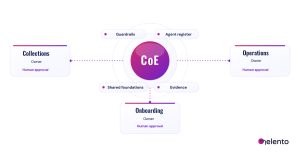
A CoE sets the standard, but doesn’t own the outcome.
One caution keeps a CoE honest. McKinsey is explicit that ownership of an agent should not default to a generalised AI centre of excellence. Every agent needs a clearly accountable human who answers for the result it produces, and in most cases that person sits in the business.
The operating model also depends on scale. EY observes that a central AI factory can give smaller or less mature banks focus, scarce-skill leverage and a repeatable path from idea to production, while larger banks may spread delivery more widely. The common thread is that standards are shared and accountability stays close to the work.
Mastercard’s recent move shows the pattern at a global scale. It announced authenticated agentic transactions across ASEAN markets alongside a planned regional AI Centre of Excellence in Singapore, bringing its innovation hub, cybersecurity work and AI expertise together, with governance and auditability stated as part of the offer.
What a CoE needs from its platform?
A CoE can write excellent policy and still stall if the platform underneath can’t enforce it. The platform has to let teams build quickly, keep work visible, reach customers where they are, and ask for a human decision at the right moments.
That is the role Mel AI plays on the Collaborative Intelligence Platform (CIP). It is Melento’s AI layer across the platform: teams state what they want in plain language, and the platform acts on it, with guidance along the way. Four capabilities map directly to a CoE’s needs.
- Workflows by conversation. Teams can draft and refine MStream workflows through chat, with guidance on nodes, expressions, and product capabilities, which makes standard patterns quicker to create and reuse.
- Work with a visible home. In MWork, each use case can live in a space with dots, comments, and attachments, so progress and decisions sit in one place.
- Insight on request. Ask about work items, overdue tasks, or workflow execution and get summaries and visuals, useful for CoE reviews.
- Confirmation before consequence. Before an impactful action, Mel AI stops and checks with you. For a CoE, that is the human confirmation tier made concrete.
“Mel AI moves you from navigating individual modules to expressing your intent and getting work done.”
From the Mel AI launch announcement
Voice belongs inside the governed workflow
For banks, some of the highest-value use cases are conversations: reminders, follow-ups, and collections. Melento’s voice agents are built into workflows rather than bolted on beside them. An agent can place a phone call as a step in the process; voice and text can be combined, and every regional language is supported, which matters for customers who prefer to be reached in their own language.
A collections cycle shows how this plays out. The workflow flags overdue accounts, the voice agent calls, the customer’s response is captured, the tracker is updated, and the next action is scheduled. Anything sensitive, such as an escalation, goes to a person for approval. The call is a governed step, not a side channel, which is exactly what a CoE wants from voice.
A starter blueprint for a bank’s first CoE
This is a suggested path, not a rule. Adapt it to your size and regulatory posture.
Before the five steps, take a readiness baseline. A framework such as MARS shows which departments are ready to pilot and which need data or skills work first, so the steps below begin where the bank actually is.
- Name the sponsor and the owners. One executive sponsor for the CoE, and a named business owner for every agent.
- Anchor on policy. Align to a board-approved AI policy and your regulator’s expectations, including incident reporting.
- Pick two or three bounded use cases. Reminders, onboarding follow-ups, and collections are natural starting points because outcomes are measurable.
- Set the confirmation tiers. Decide which actions run alone, which need a human, and which are off-limits.
- Review on a rhythm. Look at status, exceptions, and value on a regular cadence, and retire what doesn’t earn its place.
So, why are banks building these?
- To move from pilots to production with shared standards instead of one-off experiments.
- To make accountability explicit for software that can act, not just advise.
- To build the foundations once so every new use case starts further ahead.
Intent in, governed action out.
Exploring a CoE of your own? See how Mel AI can anchor it. Try Mel AI, or ask us for a walkthrough built around your use cases.