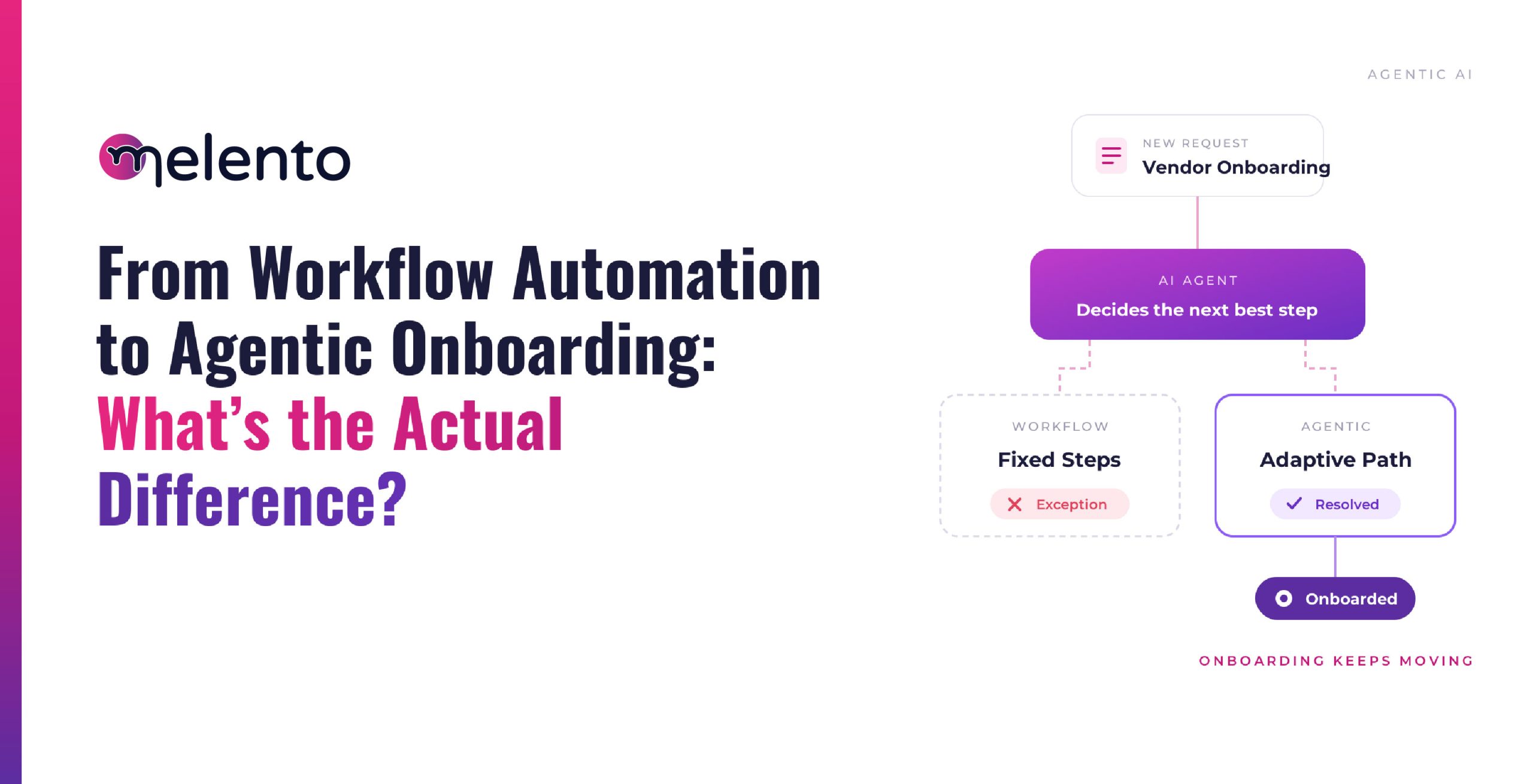
Most onboarding automation does exactly what it’s told, and nothing more. A form is submitted, a rule fires, a task is assigned. It’s fast, but it’s rigid. The moment a customer takes a path nobody mapped, a person steps in to patch the gap.
Agentic onboarding changes who does the work. Instead of navigating systems, you express intent. The platform understands it, acts on it, and checks with you before anything impactful happens.
So what’s the actual difference? Let’s break it down.
Why now: AI is moving from answering to acting.
Enterprises don’t lack AI tools. They lack a way to turn intent into execution. Assistants answer questions, but the work still lives across workflow builders, trackers, dashboards, channels, and voice systems.
The market is shifting. Gartner forecasts that 40% of enterprise applications will include task-specific AI agents by the end of 2026, up from less than 5% in 2025. Gartner analyst Anushree Verma describes the destination as “platforms enabling seamless autonomous collaboration and dynamic workflow orchestration.”
Voice shows the same gap. In the Voices Amplified 2026 report, 55% of consumers use voice as their primary interface for AI, yet only 29% of companies have deployed customer-facing voice AI. Voices CEO Jay O’Connor calls it a “widening readiness gap.”
That gap is where onboarding stalls. Mel AI doesn’t just talk. It operates.
What workflow automation actually does?
Workflow automation is the backbone of most digital onboarding today. It’s rule-based: if X happens, do Y. Teams configure nodes, conditions, and expressions in advance, and the workflow runs the same way every time.
That’s a real strength for predictable, repeatable steps such as sending a welcome email, creating a record, or routing a document for review.
But it has clear limits:
- It can’t interpret an unanticipated request.
- It can’t handle exceptions without escalating to a person.
- It can’t reach out to a customer on its own.
- Humans remain the glue between systems, tools, and teams.
Automation follows instructions. It doesn’t understand intent.
What “agentic” adds
An agentic system doesn’t just run a flow. It works toward an outcome. In practice, that means it can:
- Take intent in plain language. You describe what you need instead of configuring every step.
- Retrieve information and work out what’s required. It pulls context from the platform, documents, and data.
- Execute tasks across modules and channels. Work gets done where the work lives.
- Pause for approval on high-impact actions. AI does the legwork, and you stay in charge.
The shift is simple to say and big in practice: move from navigating modules to expressing intent.
A fair test: Gartner warns that the line between assistants and agents is often blurred, a habit it calls “agent washing”. If a tool can answer questions but can’t create the workflow, update the tracker, or make the call, it’s still an assistant.
The core differences at a glance
|
Workflow Automation |
Agentic Onboarding |
|
|
Trigger |
Predefined event |
Plain-language intent or event |
|
Logic |
Fixed rules |
Contextual reasoning within guardrails |
|
Build effort |
Configure each node |
Describe the workflow in conversation |
|
Channels |
Forms, emails, portals |
Voice, WhatsApp, chat, team channels |
|
Voice |
Separate call tool, if any |
Voice agent inside the workflow |
|
Exceptions |
Escalated to a human |
Handled, or flagged for approval |
|
Insights |
Separate reporting step |
Ask a question, get a visual answer |
|
Control |
Built into the rules |
Confirmation before impactful actions |
What agentic onboarding looks like in practice, with Mel AI?
Melento’s newest launch, Mel AI, is the AI layer for the Collaborative Intelligence Platform: intelligent assistance, workflow automation, work management, and data-driven insights in one conversation. More than an assistant, it’s an alternative way to interact with CIP. You access capabilities, retrieve information, and execute tasks using natural language.
Four capabilities map directly to onboarding.
- Build workflows by conversation. Create and modify onboarding workflows in MStream through natural language, with guidance on nodes, expressions, and product capabilities. Describe the flow you want and build it step by step through conversation.
- Manage work by asking. In MWork, create and update dots, manage spaces, add comments, and handle attachments. “Create a space and share it with your team” is one sentence, not a multi-screen task. Add a dot to any tracker in a single line.
- Turn questions into insights. Ask about work items, overdue tasks, or workflow execution and get concise summaries and visual insights. No separate reporting step.
- Get contextual help. Mel AI offers product guidance, web search, analysis of uploaded images and PDFs (handy for document-heavy onboarding), plus chat history and search.
“Just ask in plain language, and Mel AI gets to work.” From the Mel AI launch announcement
Built for control and transparency
“Speed matters, but in regulated industries control matters just as much. Mel AI checks with you before taking impactful actions, so you get AI-driven execution while staying in charge. That’s the difference between an agent you can trust in a BFSI environment and one you can only demo.
Voice makes onboarding conversational.
Onboarding rarely fails inside a workflow. It fails between the steps: the customer who never uploaded the document, the application stuck at an incomplete KYC, the payment that quietly slipped past its due date.
Voice agents close that gap, because they’re integrated directly into the workflow:
- Agents can place phone calls as part of a workflow, not as a separate system.
- Multiple capabilities in one flow. Voice and text work together, so a call can follow a message, or a message can follow a call.
- Regional language support. Reach customers in their own language, across all regional languages.
- Built for BFSI use cases. Think collections, payment reminders, pending-document nudges, and KYC follow-ups, all built as use cases on the voice agent.
The result: more customers finish onboarding, and teams don’t add headcount to chase them.
A collections call, end to end
In BFSI, collections is where voice and workflow prove themselves together. One cycle runs like this:
- Mel AI identifies overdue accounts from the tracker.
- The voice agent places an outbound call in the customer’s regional language.
- The customer’s response, such as a promise to pay, is captured.
- The tracker updates, and the next action is scheduled.
- Anything sensitive or escalated goes to a person for approval.
The call isn’t an isolated interaction. It’s a governed step in an end-to-end workflow, and the same pattern carries over to a pending-document nudge or a KYC follow-up.
Customers are ready for it. Twilio’s November 2025 research found that 72% of consumers would choose an AI agent over a human if the issue were guaranteed to be solved faster.
AI building AI: a signal, not a slogan
Mel AI is the first module in CIP built from scratch using AI to build AI, rather than the traditional way. It went from idea to launch in roughly a month, with workflows, work management, insights, and contextual assistance all in one conversation. It’s a small proof point that a platform practising agentic AI can move at the speed it promises.
So, what’s the actual difference?
- Automation follows instructions.
- Agentic systems understand intent.
- The best onboarding experiences need both, with a human-in-the-loop and in control.
One platform. One intelligent interface.
Ready to see it in action? Try Mel AI and tell us what you think. It’s phase 1, and your feedback shapes what we build next.