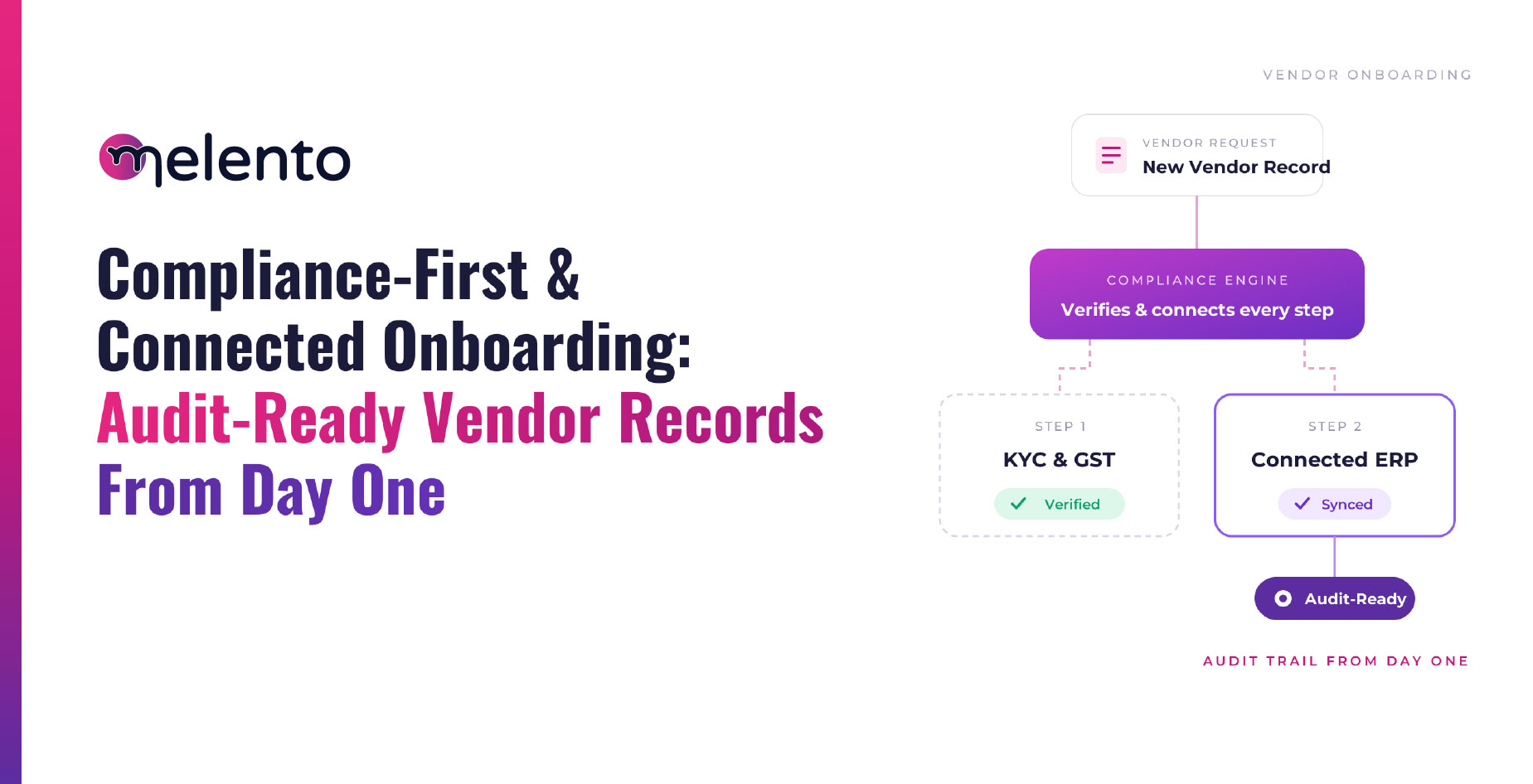
A vendor file is usually built twice. First to onboard the vendor, then again when an auditor asks for proof. In between, documents sit in inboxes, approvals live in chats, and the record is only pieced together when someone has to defend it.
Compliance-first onboarding reverses the sequence. Documents, decisions, and follow-ups are captured as the work happens, so the audit trail is there from day one instead of being assembled at audit time.
What does that look like in practice? Here’s how it works.
Why vendor onboarding breaks compliance
Vendor onboarding rarely fails because a team doesn’t care about compliance. It fails because the work is scattered.
- Documents arrive everywhere. Email, WhatsApp, portals, and shared drives, with no single source of truth.
- Approvals happen in side conversations. The decision survives. The reasoning doesn’t.
- Follow-ups depend on memory. Someone has to remember to chase the expired certificate or the missing bank detail.
- Evidence is rebuilt later. Usually under deadline pressure, usually by the person who has the least time.
The pattern is well documented.
Apexanalytix notes that manual entry and fragmented validation leave suppliers with incomplete, inaccurate, or conflicting records. And this becomes a challenge when an auditor asks for it; because the it is fragmented or unavailable.
An audit is the moment the gaps become visible.
Oversight is also getting more demanding. Deloitte’s Global Third-Party Risk Management Survey 2023, which gathered insights from over 1,300 TPRM leaders across 40 countries, lists “enhanced transparency, traceability and trackability” among the top priorities across third-party relationships and subcontractors. It also finds that adoption of smarter, digital TPRM mechanisms for real-time due diligence and monitoring is slower than expected. In the same research, 62% of respondents ranked cyber and information security as the top third-party risk.
What “compliance-first” means
Compliance-first onboarding treats the record as part of the work, not a report written afterwards. In practice, that comes down to four habits:
- Capture first. Every document and decision lands in one place as it happens.
- Context attached. Who requested & approved, and what was checked, stay with the record.
- Gaps surfaced early. Missing or expiring documents are flagged before they become findings.
- Humans approve what matters. AI does the legwork, and people sign off on impactful actions.
Practitioners say the same. Graphite Connect’s guide to the third-party risk lifecycle argues that onboarding should be “risk-aware and documented,” and that due diligence only reduces risk when it feeds a clear decision.
What “connected” adds
Compliance-first only works if the pieces talk to each other. Connected onboarding means the workflow, work tracker, conversation, and the data share one platform, so nobody has to copy information from one tool into another.
|
Disconnected onboarding |
Connected, compliance-first onboarding |
|
|---|---|---|
|
Document intake |
Email, portals, shared drives |
Attachments handled inside the workflow |
|
Review |
Manual reading |
AI analysis of uploaded PDFs and images, with human sign-off |
|
Approvals |
Chats and emails |
Confirmation before impactful actions |
|
Follow-ups |
Manual chasing |
Voice and text agents inside the workflow |
|
Visibility |
Compiled for the audit |
Ask a question, get a visual answer anytime |
|
Language |
English-only templates |
Regional-language outreach |
How Mel AI makes it practical
Melento’s newest launch, Mel AI, is the AI layer for the Collaborative Intelligence Platform: intelligent assistance, workflow automation, work management, and data-driven insights in one conversation. More than an assistant, it’s an alternative way to interact with CIP. You access capabilities, retrieve information, and execute tasks using natural language.
Four capabilities matter most for vendor onboarding.
- Build the onboarding workflow by conversation. Create and modify vendor workflows in MStream through natural language, with guidance on nodes, expressions, and product capabilities. Describe the process you want instead of configuring every step.
- Run each vendor as a tracked item. In MWork, create and update dots, manage spaces, add comments, and handle attachments. Documents, discussion, and status stay together. “Create a space and share it with your team” is one sentence, not a multi-screen task.
- Ask for the compliance picture. Ask about work items, overdue tasks, or workflow execution and get concise summaries and visual insights. There is no separate reporting step.
- Review documents with context. Mel AI can analyse uploaded images and PDFs, and keeps chat history and search so you can retrace what was asked and decided.
“Just ask in plain language, and Mel AI gets to work.” From the Mel AI launch announcement
Control comes first
Speed matters, but in a regulated environment, control matters just as much. Mel AI checks with you before taking impactful actions, so you get AI-driven execution while staying in charge. In a compliance setting, that confirmation isn’t a slowdown. It’s part of the control framework.
Voice closes the follow-up gap
Vendor files rarely stall on the big decisions. They stall on things nobody has time to chase: an expired certificate, a missing bank detail, an unsigned declaration.
Voice agents close that gap, because they sit directly inside the workflow:
- Agents can place phone calls as part of a workflow, not as a separate system.
- Multiple capabilities in one flow. Voice and text work together. A call can follow a message, or a message can follow a call.
- Regional language support. Reach vendors in their own language, across all regional languages.
- Built for BFSI use cases. Use cases such as document reminders, declaration follow-ups, and collections can be built on the voice agent.
The call isn’t a separate activity. It’s a governed step in the workflow, and the outcome updates the tracker, so the follow-up becomes part of the record.
The market is moving the same way. The Nasscom–Krisp India Voice AI Readiness 2026 report finds that 30% of scaled organisations report a positive revenue impact from Voice AI, and 63% rank language accuracy among their top three Voice AI spending priorities. Krisp CEO Davit Baghdasaryan calls India “one of the most demanding markets for Voice AI,” which is exactly why regional-language support matters for vendor follow-ups.
A day-one checklist for audit-ready onboarding
- One intake point for every vendor document.
- A named owner and approver for each step.
- Flags for missing or expiring documents, raised early.
- Follow-ups that happen without manual chasing.
- A question-and-answer view of status, available anytime.
- A human sign-off on every impactful action.
If you can tick all six on day one, the audit becomes a retrieval exercise, not a reconstruction.
So, what does “audit-ready from day one” mean?
- Capture as you go, not after the fact.
- Connect the workflow, the conversation, and the data.
- Keep a human in control of every impactful decision.
One platform. One intelligent interface.
Ready to see it in action? Try Mel AI and tell us what you think. It’s phase 1, and your feedback shapes what we build next.