The agreement is ready. The stamp isn’t.
Credit has approved a full queue of loan agreements, borrowers are waiting on their funds, and the e-stamping provider your workflow depends on starts returning errors. A government-linked stamp rail is simply down, and every agreement behind it stops.
For banks, BFSIs, brokers and enterprises that stamp at volume, this is not a rare inconvenience. Stamp providers have downtime, whether it is a central rail such as SHCIL, a state e-stamp portal or a treasury system, and when it happens, the cost lands on you: a stalled disbursal, a support ticket, an ops analyst re-keying the request by hand, and a customer who wonders why an “instant” loan took two days.
The exposure is growing. Digital lending, broking onboarding and festive-season peaks push more agreements through e stamp paper workflows than ever before. Moving from physical non judicial stamp paper to e-stamping removed the vendor queue, but concentrated risk on a single live rail. One rail means one point of failure.
One failed stamp stalls everything after it
Stamping sits early in the document pipeline, so a single failure travels downstream. eSign cannot start, execution waits, and disbursal goes on hold. Then the manual recovery loop begins: someone has to notice the failure, step in, re-route the request and retry. Every manual hop adds delay, and that loop does not scale when volume peaks.
Why today’s workarounds break
Most teams cope with patchwork. Someone retries manually until the provider comes back, with any state portal. Engineers hand-code retry logic that keeps hitting the same broken provider. Finance holds an inventory of traditional stamp paper “just in case”, tying up cash in paper that never flows into a digital journey. None of these answer the question that matters on a bad day.
Coverage was the old question. Continuity is the new one.
Most e stamp evaluations stop at one question: how many states do you cover? Coverage tells you where stamping works on a good day. It tells you nothing about what happens when a provider fails in the middle of your busiest afternoon.
That second question is the one Auto Stamp Router was built to answer.
Meet Auto Stamp Router: the reliability layer of Melento Digital Stamp
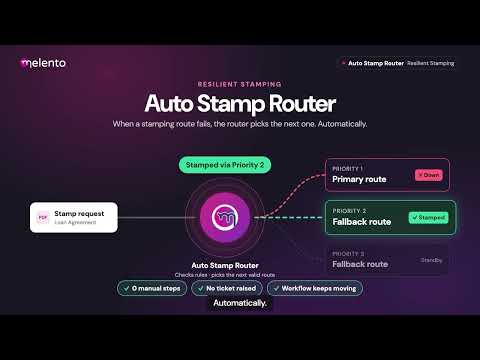
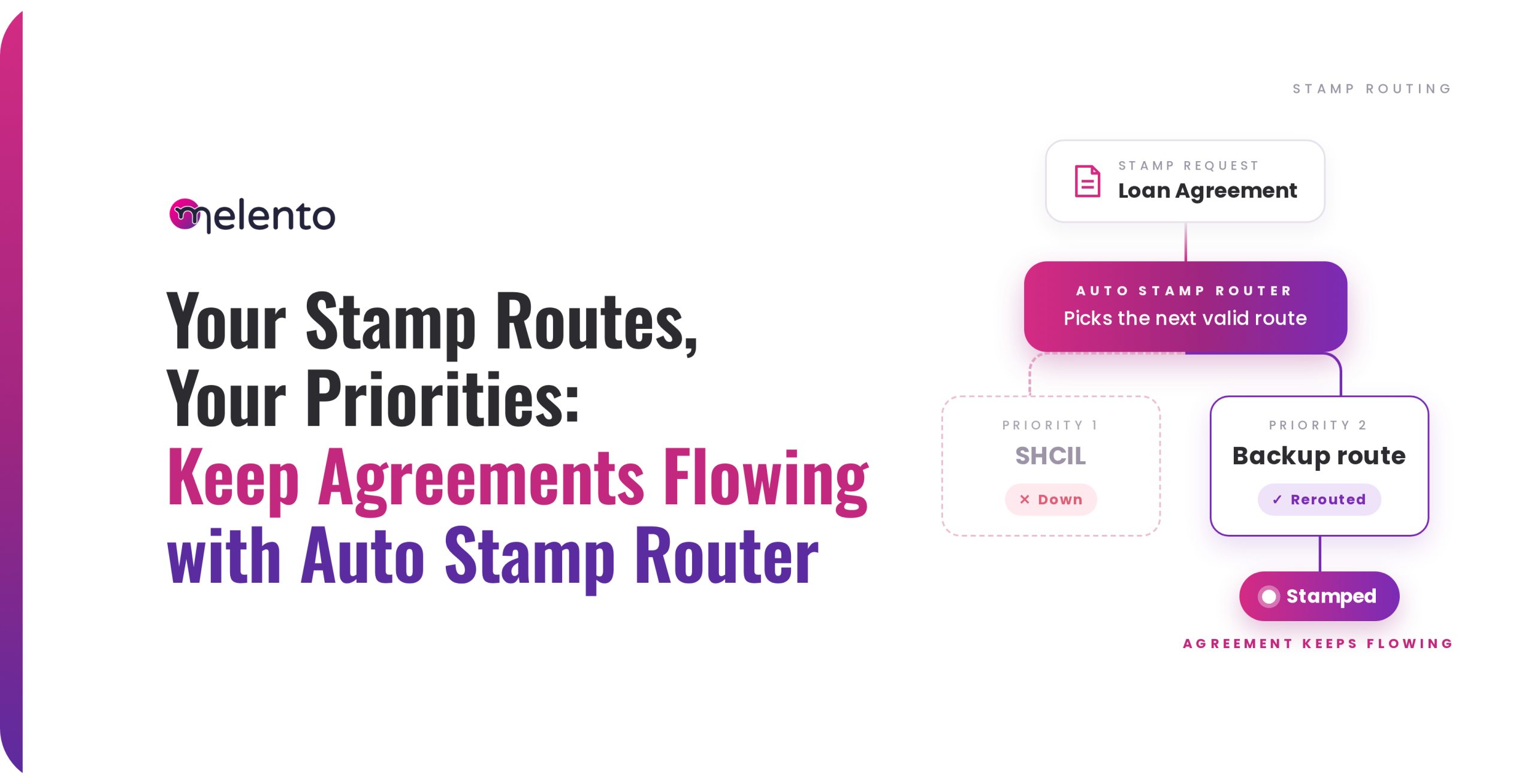
Auto Stamp Router is a new capability of Melento Digital Stamp that ends single-rail dependency. Auto Stamp Router turns one point of failure into an ordered chain of pre-approved backup routes, set per state and document category across pan Indian, so a provider outage triggers an automatic reroute instead of a stalled queue.
Here is the bottleneck it removes. Auto Stamp Router detects a recognised failure and finds the next valid route, automatically. The manual recovery loop of notice, step in, re-route and retry is replaced by a decision your admin made in advance. Ops stops re-keying requests. Engineering stops maintaining retry code. Support stops fielding “where is my loan?” calls.
The business case is simple. A failed stamp costs you twice: once in rework, and again in delayed revenue from an agreement that cannot execute. Auto Stamp Router is designed to remove most of that rework before it starts, and to make the rare total failure visible instead of silent.
How it works
Set it up once. Auto Stamp Router runs on the updated stamp paper and lives inside your existing Melento workflow, at Workflow, Digital Stamp, Auto Stamp Router, Set or manage rule.
- Set the rule. Your admin picks a state and document category, then sets an ordered list of stamp type and document category pairs. Only stamp types valid for that state are offered.
- Stamp as usual. Every request goes to Priority 1 first. Nothing changes for the person raising it.
- Automatic reroute. If Priority 1 fails for a recognised, pre-approved reason, such as provider or portal downtime, Melento retries on Priority 2, then the next route in your chain.
- Manage from one portal. Edit a rule, pause it by marking it inactive, or delete it, all from the same admin portal.
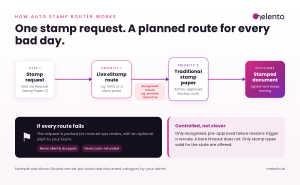
How Auto Stamp Router reroutes a failed stamp request
Rules are per state, so your Karnataka chain can differ from your Tamil Nadu chain. You can even place traditional stamp paper behind a live eStamp route and keep both, in the order you choose.
| State | Priority 1 | Priority 2 |
|---|---|---|
| Karnataka | Live eStamp route, Loan Agreement (Unsecured) | Traditional stamp paper, Loan |
| Tamil Nadu | Traditional stamp paper | Live eStamp route |
Designing a good fallback chain
A strong chain starts with your data, not your provider list. Begin with the states and document categories that carry most of your stamp volume, because that is where a single outage hurts most. Put your fastest live eStamp route first, then add a backup that is valid for the same state and document type, so the reroute never creates a compliance question. Bring ops, engineering and compliance into the same room when you set the first rules: ops knows where requests stall, engineering knows the integration, and compliance signs off on which stamp types are acceptable.
Three promises behind every rule
- Continuity: Provider downtime no longer stops execution; an ordered priority chain retries automatically on recognised failures such as provider downtime.
- Control: Your admin decides the route per state and category; rules can be created, edited, marked inactive or deleted at any time.
- Accountability: Failures are bounded and visible; requests that exhaust every route go to a review queue with an optional alert.
One deliberate design choice deserves a mention. Auto Stamp Router does not retry on every error. A bare timeout does not trigger a reroute, and the router never picks a stamp type your admin has not approved. For compliance teams, that matters more than cleverness: routing is controlled, predictable and pre-agreed.
What changes for each team
Every function that touches a stamped agreement feels the difference.
What Auto Stamp Router changes for operations, engineering, compliance, finance and procurement
For engineering teams integrating Melento e-stamping through APIs, the reroute happens server-side, so there is no provider-specific retry logic to write or maintain. For procurement, Melento’s multi-provider catalogue, including SHCIL, traditional stamp paper, eSBTR, MP eSampada, AP eFrank, Haryana eChallan and NeSL DDE, stops being a list on a slide and becomes a live backup plan.
Built on a platform that already runs at scale
A fallback needs somewhere to fall back to. Auto Stamp Router draws on the breadth of the Melento digital stamping platform, which already handles stamp duty online payment and high-volume stamp paper online for lenders, brokers and enterprises.
Axis Securities, for example, cut its stamping turnaround time by 58% on Melento Digital Stamp. Auto Stamp Router now adds a planned answer for the day a provider fails. It also extends a pattern Melento customers already know: Auto ESP Switch already brings automatic provider switching to eSign, and Auto Stamp Router brings the same resilience by design to stamping. If you are mapping this to lending journeys, see how digital stamping enables end-to-end loan disbursement for NBFCs.
Built for
- Lending, BFSI: no stalled disbursal because a stamp rail blinked.
- Banks: branch and digital journeys keep stamping through provider downtime, with a review queue for the rare total failure.
- Broking and wealth: onboarding peaks do not turn into stamping backlogs.
- Enterprise contracts: stamping stops being the reason a vendor, HR or procurement contract sits unsigned.