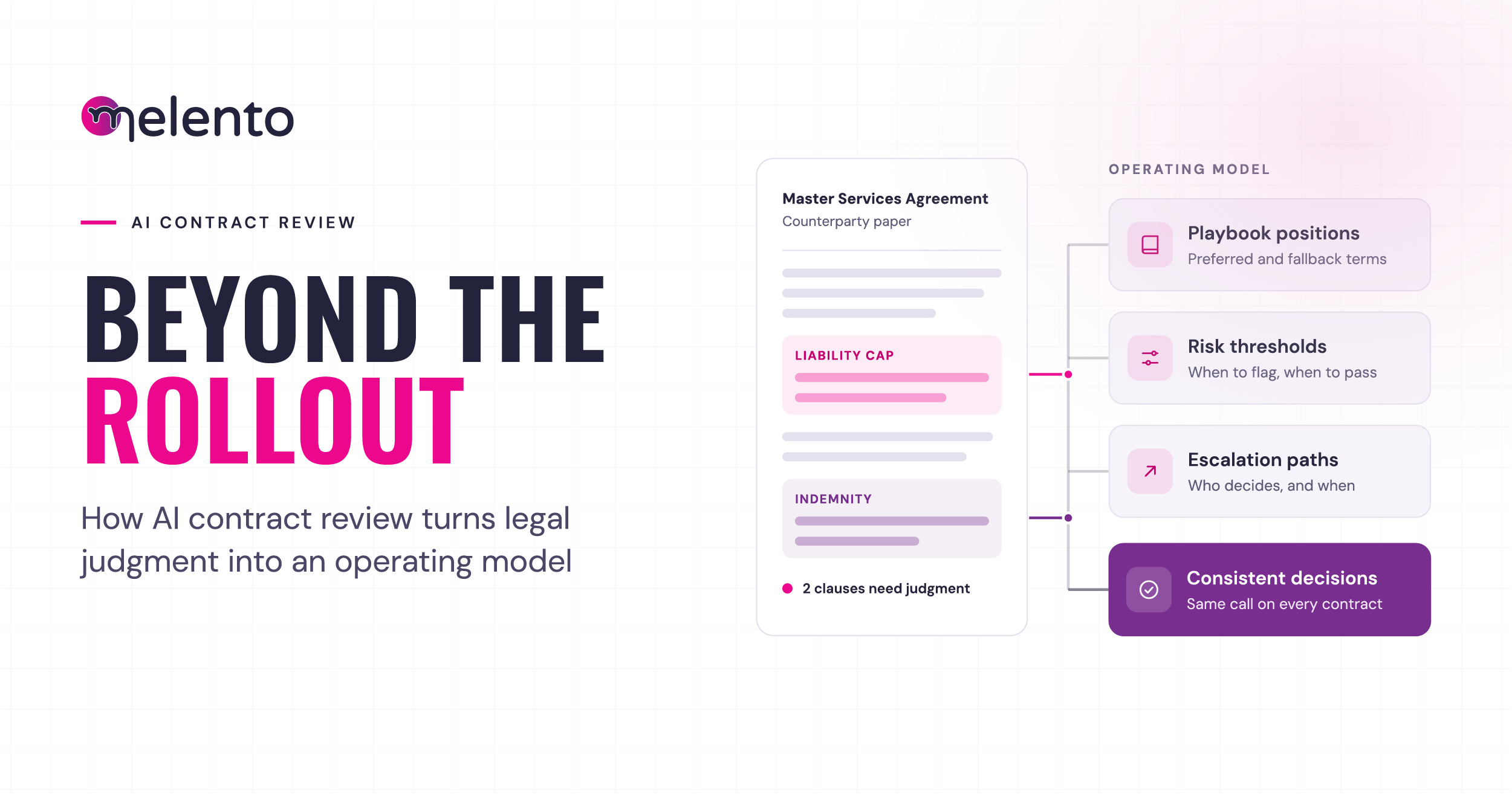
Legal teams are moving past AI contract review as a tool they evaluate and are starting to treat it as infrastructure they build around. Many of the assumptions that used to define “rolling out a new system”- a big-bang launch, a static rulebook set once and left alone, a single reviewer making every call – are being rethought as teams actually put these systems into production.
CLOC – 2026 State of the Industry Report shows legal departments taking a more deliberate approach to AI adoption, including pilots, deployment across workflows, and dedicated resources or committees managing AI use.
As AI moves from something a legal team pilots to something it runs on, we’re seeing a shift in how implementation itself gets approached. Rollouts are getting narrower before they get wider. Standards that used to live in a senior reviewer’s head are getting written down as versioned rulebooks. Automation is getting paired with explicit human checkpoints rather than replacing judgment outright. And the objective is changing: the system isn’t simply being asked to read contracts faster. It is being asked to identify what matters, explain where a contract departs from the organization’s position, and direct human attention to the decisions that actually require judgment. It’s what happens when a team implements something carefully instead of just switching it on.
|
Why this matters? The 7 patterns ahead read as sensible, almost predictable, sequencing advice: pilot, then playbook, then human review, then measurement, then scale. That sequencing is correct, but it isn’t the interesting part. What’s actually happening underneath it is that AI contract review is forcing legal departments to convert institutional legal judgment (the standards, the fallback positions, the sign-off logic that has always lived in a senior reviewer’s head) into organizational infrastructure other people and systems can rely on. The other shift is equally important: review itself moves from reading every clause to reviewing by exception. AI performs the first pass; people spend their time on interpretation, negotiation, risk acceptance, and decisions. Most legal teams evaluating AI contract review are still thinking about it as software procurement. Almost none have named what it actually is: an operating-model shift. |
|
A tired reviewer on their fifteenth contract of the day or a reviewer reviewing the same contract the sixth time is going to miss things – that’s just human. AI doesn’t get tired. It flags the missing limitation of liability clause or the indemnification language that doesn’t match your playbook every single time, not just when someone happens to catch it. – Shriti Bhat, Product Manager, Melento |
The Legal AI Operating System
Before walking through the six implementation patterns, it’s worth naming the model sitting underneath all of them. This is because none of the 7 patterns makes full sense in isolation. Each one is a control point in a single system that runs from a contract landing on someone’s desk to that decision improving how the next contract gets handled:
- Contracts – The document entering the system and the workflow and contract type chosen for review.
- Organisational Playbook – Determining the standard document version, fallback positions, deviation rules, and acceptable ranges that incoming paper gets checked against.
- AI Reasoning – Automated clause extraction and deviation detection run against that playbook, not against a generic market benchmark.
- Human Decision – Allocating a specific reviewer with the context and authority to decide, rather than the system accepting or rejecting terms unilaterally.
- Feedback – Measuring what happens in terms of turnaround, missed risks, override patterns, and feeding back into the playbook and the routing logic.
- Governance – Determining the standard, staged basis on which the whole system extends to the next contract type, rather than assuming what worked once will work everywhere.
- Action – Turning an identified deviation into a defined next step: accept, revise, apply a fallback, seek business input, or escalate.
Identifying a problem is not the same as reviewing a contract. The review workflow only creates operational value when the finding leads to a decision or a controlled handoff.
Most legal teams already do pieces of this. Almost none have mapped it as one continuous system, which is exactly why implementation so often stalls at the same predictable points. The seven patterns are what building each stage of that system deliberately actually looks like, and what tends to go wrong when a stage gets skipped.
1. From portfolio-wide rollouts to single-workflow pilots
The instinct with any new system is to point it at everything at once, every contract type, clause, and team, on day one. That instinct is usually what causes implementations to stall six months in with nothing to show for it.
As per a report by Helium42, Implementation guidance for AI contract review recommends starting with a precise, high-volume, standardized use case such as NDAs or service agreements, then piloting with a small group of experienced users before expanding more broadly.
What’s working better is picking one contract type causing real pain right now. Vendor MSAs, NDAs, and a specific renewal category, implementing there first, deliberately, before touching anything else. This is crucial. A narrow pilot surfaces the real configuration questions, like what actually counts as a deviation, who needs to sign off on what, what the AI should flag versus what it should leave alone, and what action each type of deviation should trigger, on a manageable set of contracts, instead of those questions which get asked for the first time at full scale, under pressure, with no fallback plan.
Teams that skip this step tend to conflate “the tool works” with “the tool is configured correctly for us.” Those are different claims, and the second one only gets tested by running real contracts through it in a contained setting. For leadership, the pilot should therefore have a defined success condition before it starts. Not simply whether the AI can identify clauses, but whether it can reliably surface the deviations that matter, route them correctly, and reduce the amount of routine review work reaching experienced lawyers.
|
Stages of the OS and why this matters? The documents that enter the operating system are where the contracts stage gets defined. Skipping it doesn’t just risk the launch; it means the Organisational Playbook that follows gets written against a workflow nobody has actually pressure-tested. |
2. From tribal standards to versioned rulebooks
Thomson Reuters’ buyer guidance identifies playbook comparison, risk scoring or flagging, audit trails, and obligation tracking as capabilities legal teams should evaluate when assessing AI contract review solutions.
AI contract review is only as good as what it’s checking against, and for most legal teams, “what standard actually means” has never been written down anywhere retrievable. It lives in a senior reviewer’s head, gets recited case by case, and quietly drifts every time someone new applies their own judgment to fill the gap.
The teams implementing this well treat documenting standard positions like acceptable liability caps, fallback indemnification language, and notice periods they’ll accept. These are the actual first step of implementation, not a side task to get to later. This is also where the category is heading structurally: playbooks as configurable, versioned artifacts rather than institutional memory. Melento’s AI Playbook is built around exactly this shift. Legal teams define fallback positions and deviation rules explicitly, at the organizational or contract level, so incoming paper is checked against a documented standard instead of whoever happens to be reviewing that day.
This is more than configuration. It is the point at which legal judgment becomes an executable organizational standard. The AI is not deciding what is “good” or “bad” in isolation; it is evaluating whether the contract aligns with what the organization has decided it will accept.
If you skip this step, the extraction layer has nothing meaningful to compare against. The tool can tell you a liability clause exists. It can’t tell you whether it should worry you. The playbook cannot be treated as static. Exceptions, negotiated positions, and reviewer overrides are signals about where the standard needs to evolve.
|
Stages of the OS and why this matters? This is the Organisational Playbook stage. This is the point where judgment that used to live in one person’s head becomes a documented, versioned standard the rest of the system runs against. Most legal teams evaluating AI tools budget time for the pilot and the training; almost none budget time for writing the playbook first, which is precisely the step that determines whether everything downstream of it means anything. |
3. From reading everything to piloting before scaling
Once a contract type is chosen and standard positions are documented, the next pattern is to resist opening the system to the full team immediately. A pilot on a real, messy mix of contracts, not just the clean ones, is what actually surfaces edge cases: a clause phrased in a way nobody anticipated, a flag that fires too aggressively, a deviation that turns out to be immaterial once someone looks closely.
The pilot’s output is best treated as a punch list, not a verdict. Every gap it turns up is a configuration fix, not evidence the approach doesn’t work. This is a pattern familiar from most infrastructure rollouts: the value isn’t in proving the system works in principle; it’s in finding out how it breaks under real conditions before those conditions are everyone’s daily workflow.
The edge cases matter because the goal is not maximum flagging. It is useful flagging. A system that identifies everything but cannot distinguish material deviations from noise simply transfers the review burden from documents to alerts.
The pilot should therefore test four things together: the quality of the AI findings, the quality of the playbook, the usefulness of the routing logic, and the reviewer’s ability to act on the output.
|
Stages of the OS and why this matters? This is where AI Reasoning gets pressure-tested against the Organisational Playbook before either one is trusted at scale. A pilot that only runs clean, representative contracts through the system isn’t testing the playbook. It’s confirming what was already known. The edge cases are the actual test. |
4. From binary automation to routed human checkpoints
Axiom recommends keeping lawyers in the loop when implementing AI contract review, while the L Suite recommends matching the risk of an AI-delegated task to the appropriate accountable reviewer and maintaining documented review workflows.
There’s a version of “implementing AI contract review” that treats it as a replacement for judgment; flag it, auto-reject it, move on. That version doesn’t hold up in practice, and the teams doing this well are explicit about where automation stops and a person has to decide.
The pattern that’s emerging looks less like automation replacing reviewers and more like automation changing what reviewers spend their time on. The system extracts, compares against the playbook, and flags the deviation; a specific person with the context and authority to decide gets routed the flag, rather than the system unilaterally accepting or rejecting terms. Tools built for natural-language querying against a live contract, like Melento’s Ask SAM Chatbot, are one example. It matters most exactly at this checkpoint, because a reviewer making a judgment call needs a sourced answer, not another cover-to-cover re-read, to make it quickly.
The distinction is important: AI should not stop at “this clause is non-compliant.” The review workflow needs to answer “what happens next?” A mature implementation connects detection to prioritisation, recommended action, fallback positions, revision, or escalation.
That creates a more useful operating model:
AI identifies → AI explains → AI prioritizes → Human validates → Human resolves or escalates → Decision is recorded
Get this balance right, and reviewers end up spending their time on the calls that actually need a lawyer, instead of clause-by-clause reading that a system can do faster and more consistently.
|
Stages of the OS and why this matters? The handoff between AI Reasoning and an accountable reviewer is the human-decision stage. It’s also the stage most legal teams haven’t formally designed. Most have a rough sense of “we’ll still review the risky stuff,” but few have written down which flags route to whom, and on what basis. The implementation question is not simply whether a human remains in the loop. It is whether the organization has deliberately designed what the human is expected to decide. Without that routing logic made explicit, accountability quietly reverts to whoever happens to open the flag. |
5. From “it feels faster” to measured outcomes
Thomson Reuters’ 2025 research found that only 20% of organizations were measuring GenAI ROI, highlighting the gap between AI adoption and the ability to demonstrate measurable value.
Implementation without a defined measurement plan tends to stall at vibe. Turnaround time; the rate of deviations later discovered downstream that weren’t flagged. Renewal deadlines highlighted versus missed are the numbers that turn “this feels like it’s helping” into a case that survives budget scrutiny at renewal time.
But speed alone is not enough. Leadership needs to measure whether the system is improving the quality and economics of review. That means looking at review turnaround alongside missed risks, false positives, reviewer overrides, escalation rates, adoption, and the proportion of contracts or clauses that can be handled without senior legal intervention.
This is also where legal ops runs into a gap most contract intelligence tools leave unaddressed: cost visibility into the AI usage itself. Melento’s AI Wallet is built to close that specific gap, with usage insights and threshold settings so a team can see what a rollout is actually costing as it scales, rather than finding out at the end of a budget cycle. Measurement isn’t just about proving the tool works. It’s about knowing what it costs to keep working as adoption grows.
The leadership question is therefore not “How much faster is the AI?” but “What changed in the legal operating model because the AI was introduced?”
|
Stages of the OS and why this matters? The loop most legal teams build last, if they build it at all, is the feedback stage. Without it, the Organisational Playbook never actually improves; it just sits as the version written on day one, quietly drifting out of date the same way the tribal standard it replaced did. Measurement turns review outcomes into the feedback that keeps the playbook, routing, and risk thresholds useful. |
6. From one deployment to deliberate, staged expansion
Once a pilot contract type is running smoothly, the temptation is to expand everywhere at once, on the assumption that what worked for MSAs works for employment contracts or licensing agreements too. It usually doesn’t, not without repeating the same sequence: new standard positions documented, playbook rules built for that contract type, checkpoints defined again for its specific risk profile.
The teams that get the most durable value from AI contract review treat every new contract type as its own small implementation rather than an automatic extension of the last one. It’s slower in the short term and considerably more reliable over a two- or three-year horizon, which is the timeframe that actually matters for a system meant to run inside how contracts get reviewed permanently, not just for the initial pilot.
Staged expansion also creates a natural governance model: each new contract type earns its way into production by demonstrating that its playbook, AI findings, human checkpoints, metrics, and escalation paths are ready. Scale becomes a controlled decision, not simply a product rollout milestone.
|
Stages of the OS and why this matters? The discipline that decides whether the operating system built for one contract type becomes the way the department runs, or stays a one-off pilot that never quite generalizes, is the Governance Stage. It’s the stage most likely to get skipped, precisely because skipping it looks like progress in the short term. |
Where this leaves legal teams
None of these six patterns are about the sophistication of the underlying model. They’re about sequencing. What gets documented before automation starts, where a human stays in the loop, what gets measured before scale. A legal team that gets the sequencing right will get real value out of almost any capable contract intelligence platform. A team that skips straight to full deployment tends to end up with a tool that extracts data nobody trusts and flags nobody acts on, regardless of how good the underlying AI actually is.
The leadership decision is therefore bigger than selecting an AI contract review tool. It is deciding what part of legal judgment should become organizational infrastructure, what part should remain with accountable people, and how the two should work together.
The most important implementation shift is from “AI reads the contract” to “AI performs the first level of review.” That means understanding the contract, comparing it against the organization’s standards, identifying deviations and missing provisions, prioritizing what matters, and directing the right issue to the right person. The lawyer is no longer starting with a blank document. They are starting with an informed set of exceptions and decisions.
That is what makes review by exception possible. And that is ultimately the business case for implementation: not replacing legal judgment, but making scarce legal judgment available where it creates the most value.
The pattern underneath all of this is a familiar one from every category that’s gone through this shift before: the technology was rarely the limiting factor. The implementation discipline around it was.