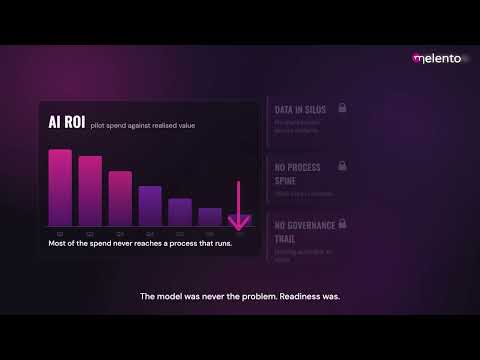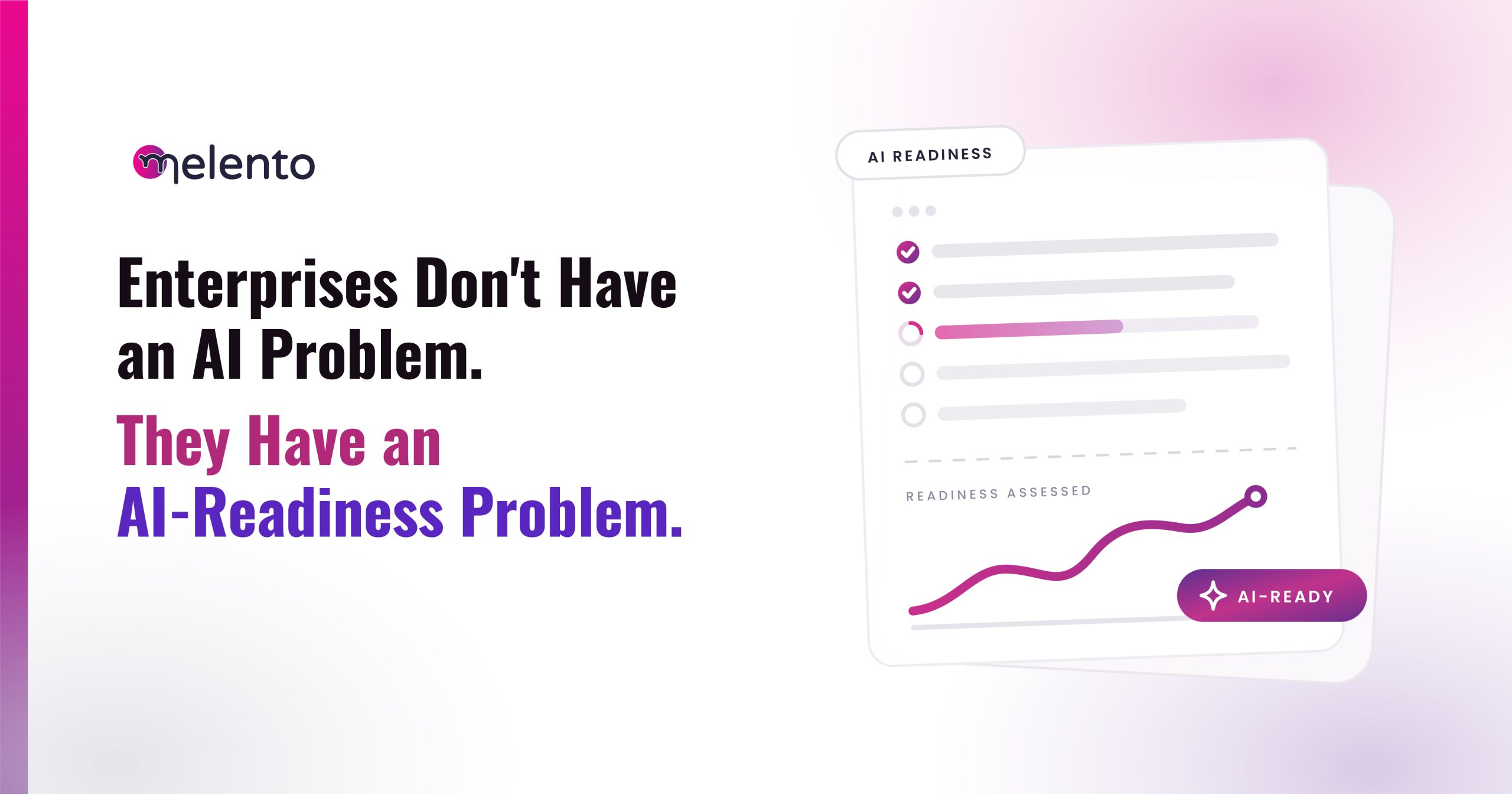

Only 13% of enterprises are fully ready to capture value from AI. Three years of pilots, boardroom mandates, and real budget later, that number has barely moved — and nearly half of organizations are still stuck in pilot. That’s Cisco’s 2025 AI Readiness Index, and it lands the same way in most rooms: everyone is talking about agentic AI, almost nobody has it in production.
Ask why, and the honest answer tends to surprise people. It’s rarely the model.
“It’s a misconception that AI projects fail because of the models. Generally, it’s to do with everything other than the model.”
– Tanay Nagar, Team Lead – AI Development, Melento
That single line is the whole argument. And it’s the reason Melento built MARS — its proprietary AI readiness assessment for enterprises. Not another maturity score that grades you and walks away. A diagnosis that tells finance, procurement, and legal teams where they actually stand, and what the next move is.
Why the old playbook stopped working
For thirty years, adopting technology meant buying a tool and rolling it out. The software was deterministic — same input, same output, every time. You trained people, flipped the switch, moved on.
Agentic AI doesn’t behave like that. It’s probabilistic: the same prompt can return a different answer twice. AI agents make decisions, cross the boundaries your org chart draws, and act in ways you have to be able to explain after the fact. It’s also the first technology that touches every function at once — finance, procurement, legal, the creative teams — instead of solving one niche.
So the reflex that worked for every prior wave fails here. Leadership feels the FOMO, and the instinct is to spend their way out of it.
“People believe they can throw some tokens at it, get some models up and running, and that’s it — they’re AI-ready and can transform work from yesterday, if not tomorrow. But it is way beyond that.”
– Harsh, SVP Product, Melento
Beyond it in a specific way. Melento’s team, having stood up AI systems across BFSI and retail, keeps seeing the same pattern: the investment goes in before anyone has checked whether the ground can hold it.
“These investments are made too early — before customers understand their readiness, whether their teams are ready to adopt it, whether their processes are mature enough. Some have even restructured their entire organization to make AI happen. And it’s still not happening. So it’s definitely not a technology problem — it’s actually a readiness problem.”
– Santhosh Vasanthakumar, CTO, Melento
A score is not a plan
Plenty of tools already promise to measure AI maturity. Most of them hand you a number and stop.
“Most of these tools give you a score. It tells you you’re at level two out of five. What do you do then? Monday morning, you hear you’re at level two, and you have no clue what to do about it. It’s just a number.”
– Santhosh Vasanthakumar, CTO, Melento
That gap — between a grade and a next step — is the entire problem MARS was designed to close. A typical AI maturity model looks top-down, rates the organization as a whole, and leaves the “so what” to you. MARS starts from a different question: not how mature are we, but are we using AI to create real value, and where do we go next.
What MARS measures: an AI readiness assessment that ends in a plan
MARS is Melento’s proprietary AI readiness framework, built on three ideas.
Five dimensions. AI Awareness, Data Readiness, Integration, Productivity Impact, and AI Governance & Culture. Readiness is deliberately scored beyond technology — because that’s where it actually breaks.
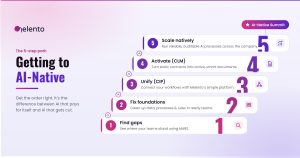
Five stages. Exploring, Experimenting, Operationalizing, Scaling, and AI Native. A clear ladder, so you always know the rung above you.
“The utopia is stage five — AI Native — where AI is integrated into every step of the process, from decision-making to the final output.”
– Melento leadership roundtable
Why AI, uniquely, needs a readiness check
Fair question: nobody ran a “cloud readiness assessment” or a “mobile readiness assessment.” Why this technology?
“AI is one technology very different from any traditional technology. Every other tool tried to solve a niche. AI impacts every single fabric of society — not just tech or organizations, but arts, sciences, music, creativity. When something like that appears, it’s hard to ingest at first.”
– Tanay Nagar, Team Lead – AI Development, Melento
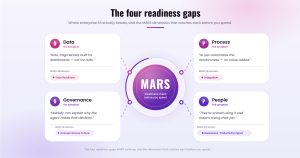
Underneath that, the failures cluster into four honest gaps — and MARS is built to surface each one before you spend.
Data. Every enterprise has data. Almost none of it is shaped for models. “That data is fragmented, not cohesive, and not ready for the LLMs to ingest. While building RAG systems, we realized all of it is very raw — generated and saved for typical analytics or front-end systems, not at all for LLMs.” Fix that, or your pilot stays a demo.
Process. This one is where teams quietly waste the most money.
“Organizations need processes that are matured. Otherwise AI will only automate the randomness — it won’t add business value.”
– Tanay Nagar, Team Lead – AI Development, Melento
Governance. Auditability can’t be bolted on later. “Diagnosing why an agent took a decision cannot be an afterthought. Once these systems are in production, we ask ‘why did the agent do that?’ — and we don’t know — that itself is a miss. It’s a requirement from day one: auditable systems, the right checkpoints, human-in-the-loop where it matters.” Without that, no CXO can defend the system, and no user will trust it.
Trust flips the moment the work does. “When employees see that things which used to take a week now take an hour — that’s when they trust these systems, and see that AI augments them rather than replaces them.” That’s the difference between AI that gets quietly abandoned and AI that spreads on its own.
What readiness looks like in the three functions that feel it first
AI doesn’t land evenly. Finance, procurement, and legal are where the paperwork, the pressure, and the risk concentrate – so they hit the gaps first. Here’s how MARS reads each, and how Melento carries a shaky pilot to a mature, AI-native operation.
Finance and banking: from scattered data to decisions you can defend
AI in finance almost always stalls on two MARS dimensions — Data Readiness and Governance. The numbers live in a dozen systems never built for models, and no one can explain why an agent made the call. Until that’s fixed, AI in banking stays a demo.
MARS surfaces those gaps at both the company level and inside the finance team itself. Once the foundation holds, Melento’s Collaborative Intelligence Platform scales it: loan origination up to 4x faster at roughly 40% lower cost, approvals that stop bouncing between silos, and every step auditable with role-based access and regulator-grade records. That’s generative AI in finance a CFO can actually stand behind.
Procurement: from weeks of onboarding to intelligent sourcing
Procurement’s readiness gap is usually process maturity — exactly the trap in that “automate the randomness” quote above. Automate a messy process, and you get a faster mess. MARS catches it before the spend, which is where real procurement automation starts.
Then the platform does the heavy lifting. AI in procurement gets real: vendor onboarding up to 3x faster with a 360-degree view of the counterparty, and sourcing cycles up to 4x faster. And because contract management in procurement is where value leaks, Melento’s CLM tracks every obligation, speeds up counterparty negotiation, and keeps a clean, structured record from request to renewal. No more chasing a signed copy nobody can find.
Legal: from clause number eleven to audit-ready in a click
Legal is where “beyond the score” bites hardest. Legal AI is thrilling in a demo and frightening in production, because one hallucinated clause is a real liability. That’s the auditability gap made concrete — MARS reads the legal team’s Awareness and Governance honestly, so you know whether the guardrails exist before you switch anything on.
Then Melento’s contract lifecycle management gives legal the capability, not just the caution: clause and template libraries so no one rewrites the same paragraph twice, an AI playbook with redline control, native eStamp and eSign with Aadhaar and GSTIN checks for Indian contracts out of the box, and audit-ready records on demand. Enterprise legal teams like TTK Prestige and JK Tyre already run their contract lifecycle on Melento — across thousands of channel partners, with AI-assisted review and obligation tracking. It’s CLM software that doesn’t just store contracts — it puts them to work.
|
SEE WHERE YOU ACTUALLY STAND You’ve just read your own function’s readiness gap. The next question is which one is holding you back most. Run an AI readiness assessment on your finance, procurement, or legal team, get the specific gaps at company, department, and individual level, and leave with a prioritized roadmap and a realistic ROI timeline — before you spend on tokens or tools. |
The part most frameworks skip: a path, not a grade
If MARS did nothing but score you well, it would still be just a nicer number. The point is what comes after.
“We cannot give a score and forget it. You have to give a way forward, and context behind the score. That’s where MARS stands out — we don’t just say you’re level two, we say what the next step is: how to get from level two to level four. There’s no magic here. Without the right data foundation, you’re not going to skip ahead and become AI native tomorrow.”
– Santhosh Vasanthakumar, CTO, Melento
There’s a discipline hidden in that. Readiness has to move at the same pace across functions, because agents don’t respect the walls your org chart builds.
“AI agents don’t have boundaries. Organizations have boundaries. If we don’t solve that — whether every department is actually ready — I don’t know if any organization can truly call itself AI Native.”
– Tanay Nagar, Team Lead – AI Development, Melento
So MARS is prescriptive on purpose. It tells you which department to bet on first, what to fix, and a realistic timeline for when the ROI shows up.
“It helps you prioritize. You don’t need to spread thin across the whole organization. Experiment with a specific department that’s AI-ready, get the outcomes, measure it — then spread your investment. And be realistic about the ROI. Some things people assume will happen in a month — with MARS they’ll understand the honest timeframe is more like six.”
– Melento leadership roundtable
There’s a reason that realism matters right now. Several large companies invested heavily in coding agents this year, then pulled back when the foundation wasn’t there to hold the ambition. A readiness read first would have turned that into a careful bet instead of a write-off — and let the team answer the CFO with numbers instead of hope.
None of this means dragging AI into places it doesn’t belong. Boardrooms have to be ambitious about AI — but you set the ambitious goal, then go after it methodically, without force-fitting AI into work that doesn’t need it. Used well, the same tool makes a person a 2x or 3x version of themselves; forced everywhere, it just automates noise.
A framework you enter through, and a platform you grow into
Here’s what separates Melento from every other name in the AI readiness conversation. Most frameworks end at the diagnosis. Melento hands you the diagnosis and the platform to act on it. MARS is the front door; what’s behind it is what gets a company to AI-native.
The ladder is straightforward:
- Diagnose. MARS scores readiness across five dimensions — at the company, department, and individual level. You get the honest picture and the next move.
- Build the foundation. Fix data, process, and governance in the one or two departments that are genuinely ready. Prove it. Measure it.
- Scale on CIP. Melento’s Collaborative Intelligence Platform sits above your silos and makes them intelligent — one low-code, agentic-AI layer for workflows, data, and collaboration. Deploy in 15 days, measure in 60, scale across functions without buying more tools.
- Get contracts working with CLM. Melento’s AI-native contract lifecycle management turns the single biggest source of enterprise friction — the contract — into an active, intelligent asset, draft to renewal, on one platform.
- Reach AI Native. AI in every step, from decision to output, moving at one pace across finance, procurement, and legal.
MARS tells those teams where to start. CIP and CLM are what they climb into once they do.
This is shipping today
None of it is theoretical. Melento — formerly SignDesk — has processed more than 60 million documents for over 3,000 enterprises across India, the UAE, and the USA, with ISO 27001, SOC 2 Type II, and GDPR alignment, and independent analyst recognition alongside recognition from Google and Bloomberg. The Collaborative Intelligence Platform and the AI-native CLM are live now, in exactly the finance, procurement, and legal workflows where readiness decides everything.
So the readiness question isn’t “can we buy a platform when we’re ready.” The platform is already here. The question MARS answers is the one worth answering first: are you ready to use it, and where do you start.
|
READINESS BEFORE SPEND Ready to see where you actually stand? Start with the honest picture. Run an AI readiness assessment with MARS, find the department that’s ready, and build from there. The platform is already waiting to take you the rest of the way. |