
There is a growing disconnect in the enterprise technology market. Organizations are investing aggressively in CLM platforms. AI conversations dominate procurement and legal conferences. Vendors promise automation at every stage of the contract lifecycle. Yet many enterprises still struggle to achieve meaningful business outcomes from contract automation initiatives. The problem is not lack of investment. The problem is misunderstanding what CLM automation is actually supposed to achieve.
For years, enterprises viewed contract lifecycle management as a workflow problem. Automate approvals. Digitize signatures. Centralize documents. Create templates. Reduce turnaround times. Useful goals, certainly.
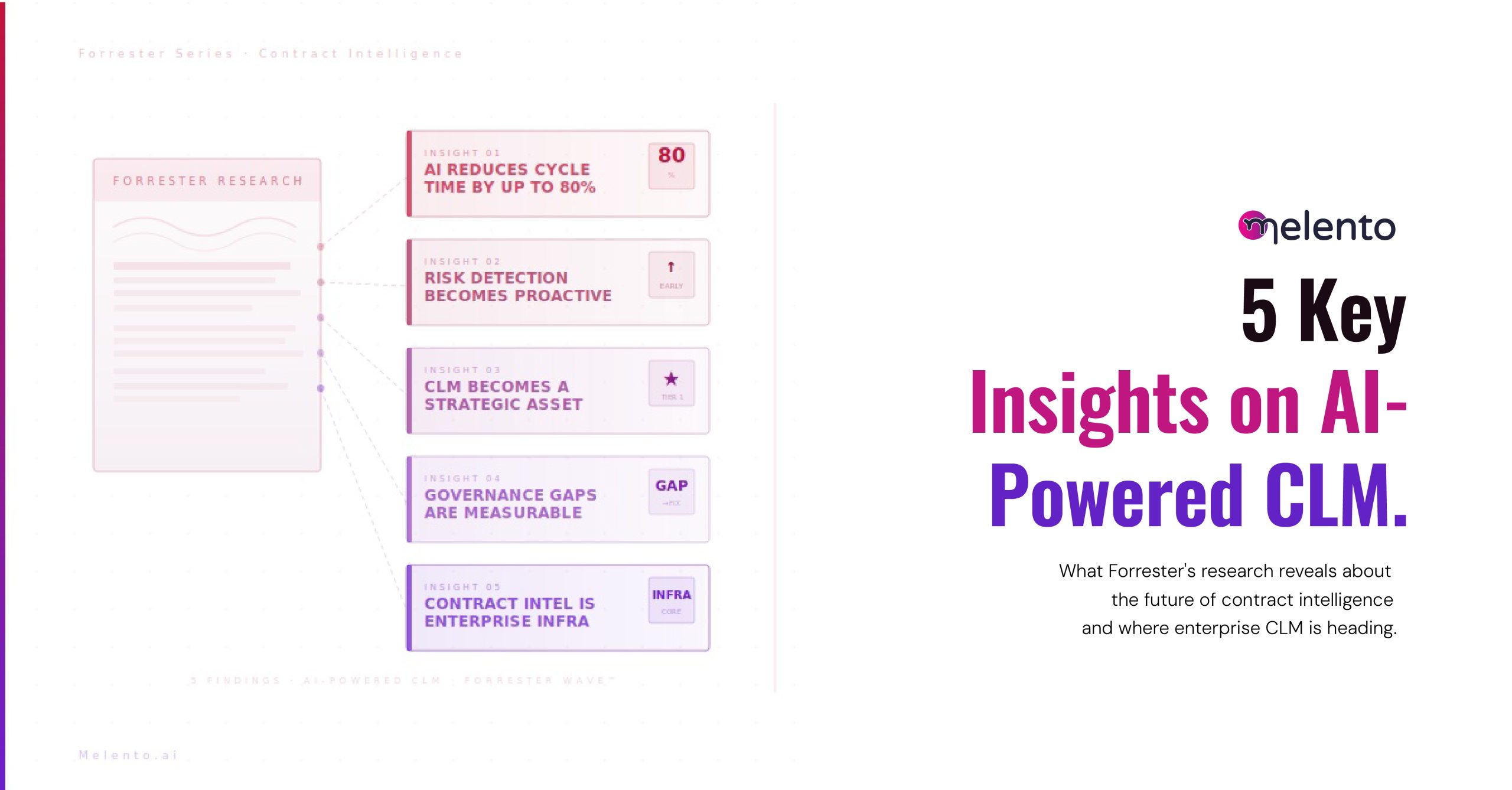
But according to recent Forrester research, the market is shifting toward something much larger: contract intelligence. And that is precisely where many enterprises are getting CLM automation wrong. Because automation without intelligence simply accelerates inefficient processes.
Modern AI-powered CLM platforms like Melento are increasingly forcing enterprises to rethink the role of contract intelligence in enterprise operations, governance, risk visibility, and commercial decision-making. The future of CLM is not just automated contracting. It is intelligent contracting.
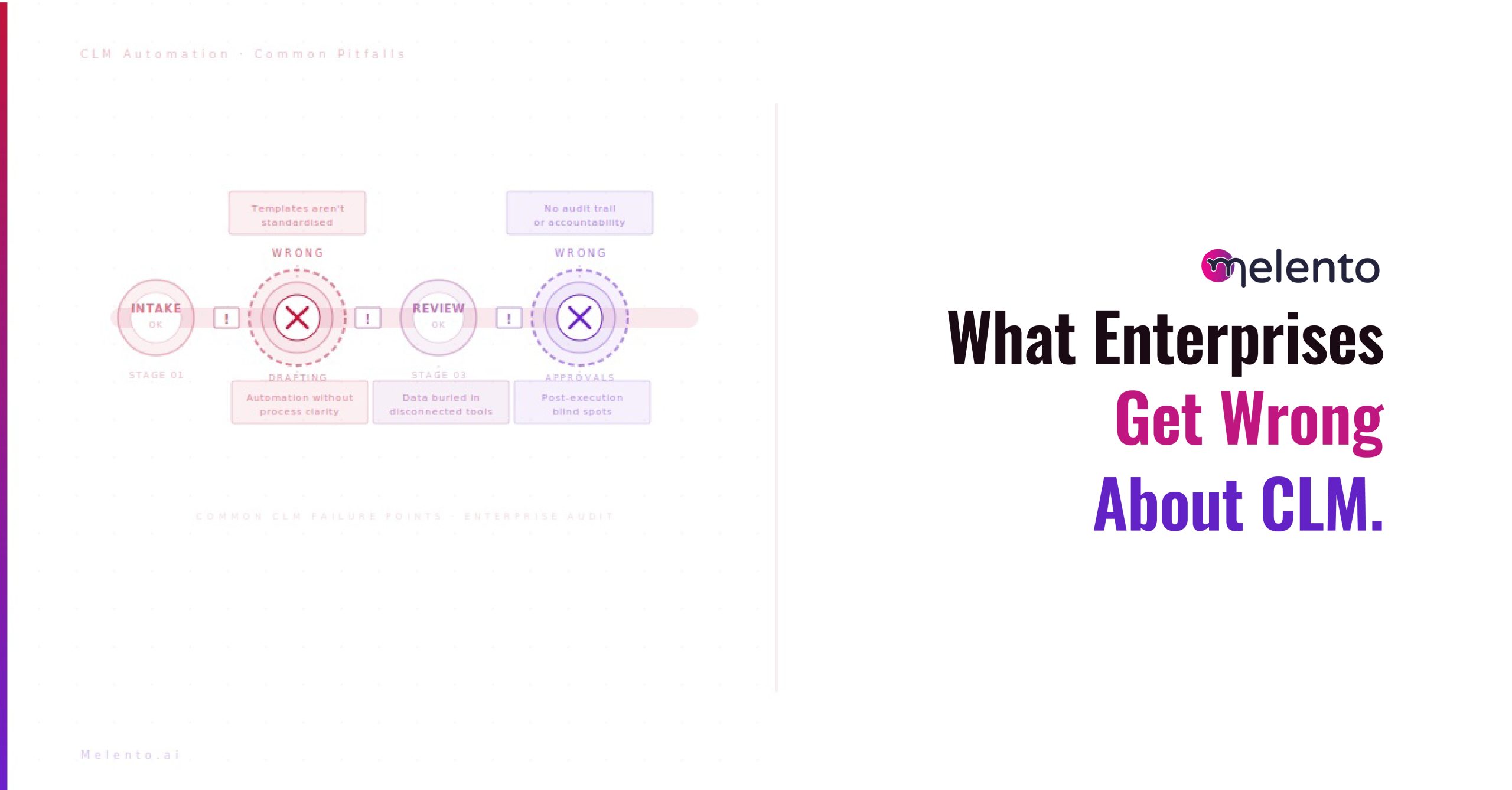
What Do Enterprises Commonly Misunderstand About CLM Automation?
The biggest misconception is that CLM automation is primarily about efficiency.
That thinking belongs to an earlier generation of enterprise software.
Today, Forrester’s research shows that organizations increasingly prioritize real-time contract visibility and transparency over simple efficiency gains.
That distinction matters enormously.
Enterprises that focus only on workflow automation often end up:
- Digitizing broken processes
- Creating complex approval chains
- Over-customizing workflows
- Ignoring usability
- Underutilizing AI features
- Failing to extract actionable contract intelligence
The result? A technically implemented CLM system that delivers limited strategic value.
This is why modern CLM discussions increasingly connect Forrester, AI, CLM, contract intelligence, and platforms like Melento in the same strategic conversation.
The market is moving beyond automation theater.
Why CLM Automation Fails in Many Enterprises?
One of the most revealing findings in the Forrester CLM report is that organizations use only about 65% of the capabilities they purchase. That statistic should concern every enterprise leader. Because it suggests most CLM investments are underperforming.
The reasons are surprisingly consistent:
Enterprises Automate Broken Processes
Forrester notes that some implementation delays occur because organizations attempt to automate flawed workflows rather than redesign them first.
This is a classic enterprise technology mistake.
Automation amplifies process quality.
If approvals are already fragmented, political, or unclear, automating them simply institutionalizes inefficiency.
AI-powered CLM systems cannot compensate for broken governance structures.
Enterprises Treat CLM as a Legal Tool Instead of an Enterprise Platform
Many organizations still position CLM ownership exclusively within legal teams.
But modern contract intelligence affects:
- Procurement
- Finance
- Compliance
- Sales
- Vendor management
- Revenue operations
- Risk management
Forrester’s findings show that enterprises increasingly value integrations, usability, approvals, and search capabilities. That signals an important shift. CLM is evolving into enterprise operational infrastructure.
Platforms like Melento are gaining relevance because they position AI-driven contract intelligence as a cross-functional business capability, not merely a legal repository.
What Is Contract Intelligence in Modern CLM?
Contract intelligence refers to the use of AI and analytics to transform contracts into operational business insights.
This includes:
- Obligation tracking
- Risk detection
- Clause analysis
- Renewal forecasting
- Compliance monitoring
- Commercial analytics
- Negotiation intelligence
- Revenue leakage detection
Traditional CLM systems focused on storage. Modern AI-powered CLM platforms focus on interpretation. That is a major difference.
And according to Forrester, enterprises are rapidly increasing the importance they place on AI capabilities inside CLM environments. The implication is clear.
ontract intelligence is becoming the real value layer of CLM automation.
Why Is AI Reshaping Enterprise Expectations Around CLM?
The role of AI in CLM has shifted dramatically in the past 24 months.
Forrester found that the importance of AI capabilities in CLM platforms rose from 2.37 to 4 on a 5-point scale. That is not a feature trend. It is a market redefinition.
Enterprises now expect AI-enabled CLM systems to:
- Extract clauses automatically
- Summarize contracts instantly
- Detect deviations from playbooks
- Recommend fallback language
- Surface hidden obligations
- Improve enterprise-wide search
- Accelerate negotiations
- Identify commercial risk patterns
This is why modern CLM buyers increasingly seek AI capabilities that are “baked in, not bolted on,” as highlighted in the Forrester report. The distinction is critical. Adding isolated AI tools onto legacy CLM infrastructure rarely creates meaningful contract intelligence. AI must operate as part of the core architecture.
That is where newer platforms like Melento are positioning themselves differently in the CLM market.
How Are Enterprises Overcomplicating CLM Automation
Ironically, one of the biggest barriers to successful automation is excessive customization. Forrester notes that buyers increasingly want flexible systems without becoming locked into heavily customized environments.
Yet many enterprises continue to:
- Build overly engineered workflows
- Create unnecessary approval layers
- Customize beyond maintainability
- Depend excessively on vendors
- Delay deployment through perfectionism
This creates long-term operational debt.
In many cases, enterprises end up replacing CLM platforms entirely because the systems become too rigid to evolve alongside changing business needs. The lesson is straightforward. The best CLM automation strategies are often the simplest.
Why Contract Visibility Matters More Than Automation Speed?
A decade ago, enterprises evaluated CLM success based on turnaround time reduction. Today, leadership teams increasingly care about visibility.
They want to know:
- Which contracts are expiring
- Which obligations remain incomplete
- Which suppliers carry exposure risk
- Which agreements violate policy standards
- Which negotiations are stalled
- Which contracts contain non-standard language
This explains why contract visibility and transparency have overtaken efficiency as the primary driver for CLM investment, according to Forrester.
In other words, enterprises no longer want faster contract chaos. They want intelligent contract ecosystems. That evolution is driving the convergence between AI, CLM, Forrester research, Melento, and contract intelligence strategies. The enterprises succeeding with CLM automation are no longer thinking merely about digitizing contracts. They are thinking about operational intelligence. Because in the AI era, contracts are not static documents anymore. They are strategic data assets.