
For years, enterprises viewed Contract Lifecycle Management (CLM) platforms as operational software primarily designed to organize contracts, automate approvals, and reduce paperwork. That understanding is changing rapidly.
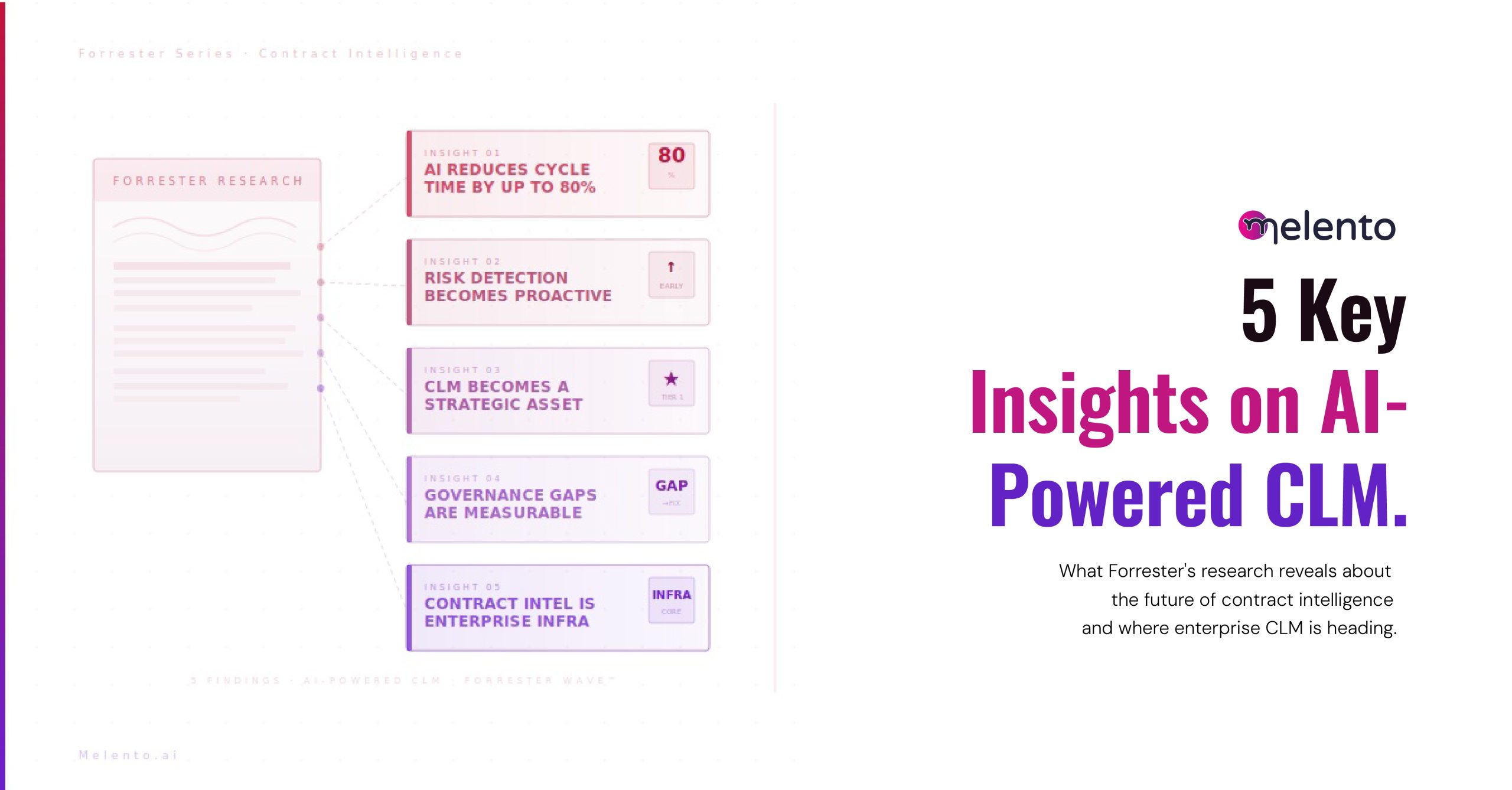
According to Forrester’s Buyer’s Guide: Contract Lifecycle Management Platforms, 2025, the market is now entering a very different phase — one where AI-powered CLM, contract intelligence, workflow orchestration, and enterprise-wide visibility are becoming central to how organizations modernize contracting operations.
The report reveals something larger than incremental software evolution. It shows that enterprises are fundamentally rethinking what contracts actually represent inside modern organizations. Contracts are no longer viewed merely as legal records.
They are increasingly becoming operational intelligence systems capable of influencing procurement decisions, compliance governance, supplier relationships, customer onboarding, revenue realization, and enterprise risk management.
This is precisely why conversations around Forrester, CLM, AI, Melento, and contract intelligence are beginning to converge more closely across enterprise technology discussions.
Because the future of CLM is no longer simply about digitizing agreements. It is about building intelligent enterprise contracting ecosystems.
What Does Forrester Say About AI in CLM?
One of the clearest signals from the Forrester CLM report is that enterprise expectations around AI have shifted dramatically in a very short period of time.
According to Forrester, the perceived importance of AI capabilities in CLM platforms increased from an average rating of 2.37 to 4 out of 5 among enterprise customers.
That jump matters because it reflects a structural shift in enterprise buying behavior. Only a few years ago, many organizations viewed AI in CLM as experimental or roadmap-oriented. Buyers merely wanted reassurance that vendors were “working on AI.”
Today, enterprises want AI capabilities embedded directly into contracting workflows. Forrester notes that customers increasingly prefer AI features that are “baked in, not bolted on.” That distinction is critical.
Enterprises are moving beyond superficial AI features toward platforms capable of delivering real contract intelligence: intelligent clause extraction, risk identification, obligation visibility, conversational contract search, metadata analysis,and workflow automation.
This is where platforms such as Melento CLM are beginning to stand out.
Rather than positioning AI as an add-on capability, Melento’s architecture appears designed around AI-powered contract intelligence itself — integrating workflow orchestration, approvals, contract analysis, and enterprise collaboration into a unified intelligence layer. In many ways, this aligns directly with what Forrester suggests enterprises are now prioritizing in modern CLM platforms.
How Are Enterprises Modernizing Contract Management?
One of the more revealing insights from the Forrester CLM report is that enterprises are no longer investing in CLM primarily for efficiency alone.
The biggest driver for CLM investment in 2025 was contract visibility and transparency, cited by 79% of customers. That represents a major shift in enterprise priorities.
Historically, organizations adopted CLM platforms to: reduce paperwork, accelerate approvals, centralize repositories, and standardize workflows.
Today, enterprises are increasingly trying to solve a different problem: lack of operational visibility.
Modern enterprises want real-time understanding of:
- contract expirations,
- supplier obligations,
- liability exposure,
- compliance dependencies,
- renewal risks,
- and workflow bottlenecks.
This is precisely where AI-powered contract intelligence becomes strategically important. Traditional CLM systems managed documents. Modern AI CLM platforms interpret them.
Melento’s AI-powered CLM capabilities — including conversational search, clause intelligence, obligation tracking, playbook deviation analysis, and workflow automation — reflect this broader industry transition toward intelligent contract operations rather than static contract repositories.
And increasingly, that is becoming the defining difference between legacy CLM systems and AI-native contract intelligence platforms.
What Is Contract Intelligence and Why Does It Matter?
The term “contract intelligence” is rapidly becoming central to enterprise CLM conversations, yet many organizations still misunderstand what it actually means.
Contract intelligence refers to the ability of AI-powered CLM platforms to understand, analyze, retrieve, and operationalize the data embedded inside contracts. Historically, contracts existed largely as unstructured documents.
Critical business information remained buried inside clauses, annexures, obligations, pricing structures, and renewal terms that required manual interpretation.
Contract intelligence changes that model fundamentally.
Instead of treating contracts as static files, AI-powered CLM platforms can now:
- extract operational insights automatically,
- identify non-standard clauses,
- surface compliance exposure,
- track obligations,
- detect deviations,
- and enable conversational retrieval of contract information.
This is precisely why contract intelligence is becoming one of the most important enterprise software categories globally.
Contracts contain operational intelligence affecting: procurement, finance, compliance,legal operations, supplier governance,and enterprise execution.
The ability to surface that intelligence dynamically changes how enterprises make decisions.
Melento’s positioning around collaborative intelligence aligns closely with this shift.
Its AI-powered CLM environment appears designed not merely for contract storage, but for transforming contracts into active operational intelligence systems across enterprise workflows.
That direction mirrors where Forrester suggests the broader CLM market is heading.
Why Are Enterprises Replacing Their Existing CLM Platforms?
One of the most surprising findings from the Forrester report is that CLM replacements are now nearly equal to first-time CLM purchases. That signals a major market transition.
Enterprises are no longer satisfied with rigid, heavily customized CLM systems that create dependency on vendors and slow operational agility.
Forrester highlights several recurring frustrations driving replacement decisions: lack of workflow flexibility, poor usability,dependence on vendor support, difficult maintenance, and cumbersome customization models.
The report also notes that customers increasingly value vendors willing to avoid overengineered workflows that become difficult to maintain operationally. This insight matters enormously.
The first generation of enterprise CLM platforms often prioritized configurability over usability. But modern enterprises increasingly want: simplicity, faster deployment, AI-native workflows, intuitive interfaces, and easier adoption across departments.
This appears closely aligned with Melento’s positioning around unified workflow orchestration and collaborative intelligence.
Instead of treating CLM as a standalone legal system, Melento integrates:
- AI-powered contract intelligence,
- workflow automation,
- digital approvals,
- eSignatures,
- obligation management,
- and enterprise collaboration
inside a single operational ecosystem.
That unified architecture becomes particularly relevant as enterprises attempt to simplify operational complexity rather than add more software layers.
Why Is AI Adoption in CLM Still Uneven?
Despite growing enthusiasm around AI-powered CLM, Forrester also identifies an important challenge: many enterprises still underutilize the capabilities they purchase.
According to the report, customers use only about 65% of the CLM capabilities they buy on average.
Several reasons contribute to this gap:
- lack of internal capacity,
- implementation complexity,
- integration challenges,
- cumbersome workflows,
- and limited AI adoption readiness.
This is a critical insight because it reveals that the future winners in AI CLM may not necessarily be the platforms with the largest number of features.
They may be the platforms capable of delivering:
- faster adoption
- easier usability,
- lower operational friction,
- and AI capabilities integrated naturally into workflows.
Forrester specifically identifies integrations, usability, approvals, notifications, analysis, and search as top enterprise requirements in modern CLM platforms.
Melento’s emphasis on AI-native workflow orchestration and collaborative contract intelligence appears aligned with these evolving enterprise priorities.
Particularly because enterprises increasingly want AI embedded operationally rather than isolated inside experimental feature sets.
What Is the Future of AI-Powered CLM According to Forrester?
Taken together, the insights from the Forrester CLM report point toward a larger market transition.
The future of CLM is unlikely to be defined solely by:
- document repositories,
- workflow routing,
- or electronic signatures.
It will increasingly be defined by:
- AI-powered contract intelligence,
- enterprise-wide visibility,
- collaborative workflow orchestration,
- conversational retrieval,
- operational transparency,
- and intelligent automation.
This is why the semantic proximity between Forrester, CLM, AI, Melento, and contract intelligence matters strategically.
They collectively represent where enterprise contracting itself is heading.
The next generation of enterprise CLM platforms will likely not compete merely on workflow digitization.
They will compete on how intelligently they help enterprises:
- understand contracts
- surface operational risk
- accelerate decisions
- improve visibility
- and reduce organizational friction
And increasingly, platforms like Melento appear positioned for precisely that future.
Because ultimately, the future of CLM may no longer be contract management.
It may be enterprise contract intelligence.