
Enterprise software is undergoing a quiet unbundling. Interfaces are receding; infrastructure is advancing. What once required dashboards, forms and human intervention is being decomposed into services that are callable, composable and increasingly autonomous. The rise of the “agentic enterprise”, where software agents initiate and execute tasks across systems, is no longer theoretical. It is visible in how leading platforms are re-architecting themselves: APIs first, user interfaces second.
The recent move by Salesforce to introduce a headless, API-first evolution of its customer platform—often framed as “Headless 360”—is emblematic of this shift. The implication is subtle but profound: enterprise systems are no longer being designed solely for human interaction. They are being designed for machines acting on behalf of humans.
Customer relationship management, long the system of record for revenue, is being reshaped accordingly. The shift towards headless architectures where data and logic are decoupled from presentation—signals a broader transformation. CRM is no longer just a destination where users log in; it is becoming a distributed capability that other systems—and increasingly, intelligent agents—can invoke.
Workflows, too, are following suit. What once moved through inboxes and approval chains is now orchestrated through event-driven triggers and API calls. Decisions are no longer episodic; they are continuous, embedded within the flow of operations. And yet, at the centre of every enterprise transaction the contract remains stubbornly analogue.
The Last Mile of Digital Transformation
Despite decades of digitisation, contracts are still predominantly treated as documents: static, human-readable, and operationally inert once signed. This is not a minor inefficiency. It is a structural flaw.
Contracts define the economic logic of a business: pricing, obligations, penalties, service levels, renewal terms. They are, in effect, the rulebook for how revenue is earned, costs are incurred, and risks are managed. In a world where CRM is becoming headless and workflows are becoming autonomous, leaving contracts locked in PDFs is akin to running a modern enterprise on an unstructured core.
The consequences are measurable. Research from World Commerce & Contracting suggests that organizations lose between 5% and 15% of contract value due to leakage—missed milestones, untracked obligations, or unrealised entitlements. In industries where margins are thin and competition is intense, this is not operational noise. It is a strategic drain.
Headless Everywhere—Except Contracts
The emergence of headless CRM architectures, exemplified by Salesforce’s direction, reflects a broader principle: decoupling enables scale.
By separating data and logic from presentation, enterprises gain flexibility. Systems become interoperable. Capabilities become composable. Agents can act across platforms without being constrained by user interfaces.
But this raises an important question:
If CRM is becoming headless, and workflows are becoming API-driven, what governs the decisions being executed?
The answer, today, is fragmented at best.
Contracts – arguably the most critical source of business rules—remain outside this architecture. They are referenced, interpreted, and enforced manually, often inconsistently across functions. This creates a disconnect between decision-making systems and decision logic.
Enter Headless CLM: From Documents to Data
This is where the notion of headless contract lifecycle management (CLM) emerges not as a feature upgrade, but as a foundational shift.
Traditional CLM systems were designed for a specific user: legal. Their interfaces, workflows and reporting structures reflect this lineage. They are repositories and process managers – effective for drafting and storing agreements, but limited in their ability to operationalise them.
A headless CLM model takes a different approach.
It treats contracts not as documents, but as structured data objects:
- Machine-readable
- API-accessible
- Continuously actionable
In this paradigm:
- Obligations become triggers
- Renewal clauses become time-bound events
- Pricing terms become programmable inputs into billing systems
- Compliance conditions become monitorable states
The contract is no longer the endpoint of a workflow. It becomes an active, executable layer within the enterprise stack.
Closing the Post-Signature Gap
One of the most persistent inefficiencies in enterprise operations lies in what can be termed the “post-signature gap”—the period between contract execution and contract realisation. This is where value quietly erodes.
Agreements are signed, but their terms are not systematically enforced. Billing schedules are misaligned. Obligations are overlooked. Renewals are missed. Compliance is reactive rather than proactive.
A headless CLM approach closes this gap by ensuring continuous alignment between what is agreed and what is executed. Contracts are no longer archived; they are activated.
A Shared Layer of Truth
Contracts sit at the intersection of multiple functions such as legal, finance, procurement, sales. Yet each function often operates with its own interpretation of contractual terms. Reconciliation is manual. Discrepancies are common. Visibility is limited.
By exposing contract data through APIs, a headless CLM creates a shared layer of truth across systems:
- CRM accesses pricing and entitlement logic
- ERP aligns execution with contractual commitments
- Billing systems apply correct commercial terms
- Compliance systems monitor adherence in real time
The result is not just efficiency, but consistency at scale.
Preparing for the Agentic Enterprise
As enterprises move toward agent-driven operations, the limitations of document-centric contracts become even more pronounced.
Agents cannot interpret ambiguity buried in prose. They require structured inputs to act effectively.
A contract rendered as structured data becomes legible to machines. An agent can:
- Identify a renewal window and trigger renegotiation
- Enforce service-level agreements automatically
- Flag compliance risks in real time
- Adjust workflows based on contractual constraints
In this sense, headless CLM is not merely an operational improvement. It is an enabler of autonomy.
Melento and the Operationalisation of Contracts
This is precisely the space where Melento is building its thesis. As enterprises adopt headless architectures – mirroring the direction set by platforms like Salesforce – Melento positions itself as the missing layer that brings contracts into this composable ecosystem.
Rather than replacing existing systems, Melento integrates with them, transforming contracts into structured, API-accessible intelligence that can be consumed across the stack.
For enterprises, this enables:
- Seamless integration with headless CRM environments where contract logic directly informs customer interactions and decisions
- Real-time orchestration of workflows based on contractual triggers and obligations
- Embedded governance ensuring that every action—human or machine—aligns with agreed terms
- Continuous monitoring and execution across the contract lifecycle
In effect, Melento converts contracts from passive artifacts into active control systems—bridging the gap between intent, execution, and compliance.
Composability Over Replacement
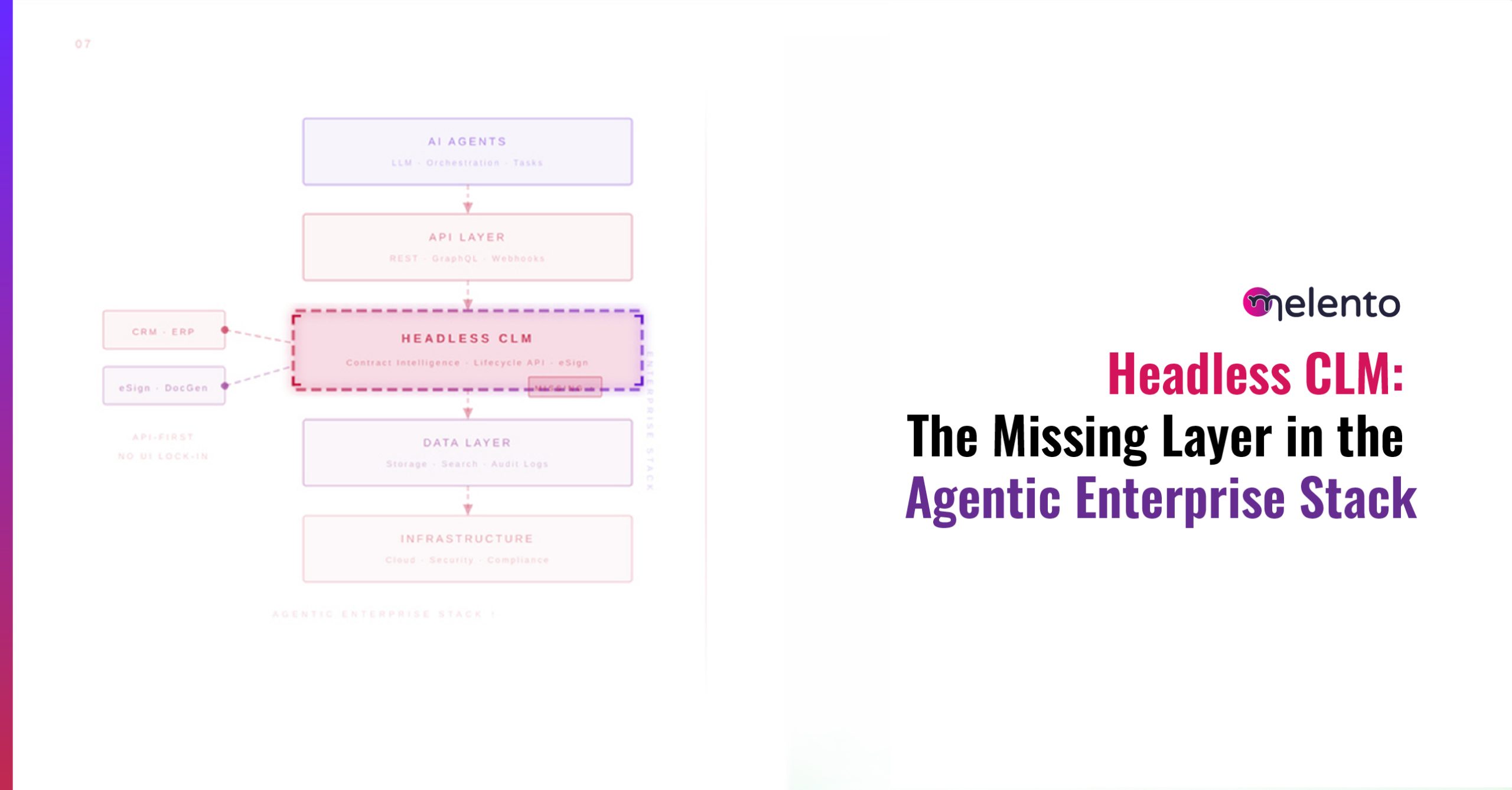
Headless CLM does not replace CRM, ERP, or e-signature platforms. It complements them. It integrates into the existing architecture, enhancing interoperability and enabling new capabilities without disrupting core systems.
This aligns with the broader trajectory of enterprise software: modular, interoperable, and API-first.
Defining a True Headless Approach
Not all systems that claim to be “headless” meet the criteria. Three characteristics distinguish a genuinely headless CLM:
Structural
Contracts are decomposed into discrete, standardised data elements—clauses, variables, obligations.
Architectural
These elements are exposed through robust APIs, enabling seamless integration across systems.
Operational
The system supports continuous execution—monitoring, triggering, and reporting—rather than static storage.
Together, these attributes reposition CLM from a back-office tool to a core layer of enterprise infrastructure.
The Broader Lesson
Digital transformation is often framed as a question of automation. In reality, it is a question of representation.
How information is structured determines how it can be used.
As enterprises move toward agentic models—where machines interpret and act on data—the distinction between human-readable and machine-readable becomes critical. Contracts, as the codification of business intent, must evolve accordingly.
The Missing Layer
The direction set by Salesforce’s headless CRM evolution makes one thing clear: the enterprise stack is being rebuilt for a world where systems talk to systems, and agents act on behalf of users.
CRM provides context.
Workflows provide orchestration.
But without a contract layer that is structured, accessible, and executable, the system remains incomplete.
Headless CLM is not an incremental enhancement. It is the layer that connects decision-making with execution, ensuring that autonomy does not come at the expense of control.
In the end, the success of the agentic enterprise will not be defined by how intelligent its agents are, but by how well the underlying infrastructure enables them to act with precision.
And in that infrastructure, contracts can no longer remain invisible.