
Teams exploring the top eSign platforms for contracts are usually past the initial stages of digital adoption. They already understand that electronic signatures reduce friction, shorten approval cycles and help move agreements without printing or shipping. By 2025, digital contracting will not only be standardized in sales, procurement, HR and finance teams, but it will have become a compliance expectation in many industries. At this stage, organizations are no longer asking whether eSign is necessary. The real question becomes which eSign platforms offer the depth, reliability and workflow support required for contract-heavy processes.
Contract signing is rarely a single action. It is the final step in a workflow that often includes approvals, data entry, multi-party coordination, compliance checks, internal reviews, and audit requirements.
As a result, the evaluation of eSign platforms must go beyond the ability to “sign PDFs electronically”. Teams need systems that can manage security, audit trails, API extensibility, role-based access, multi-party signing, document tracking and ongoing compliance.
This guide outlines the evaluation criteria that matter for contract workflows in 2025, explains the differences between types of eSign platforms and maps how Melento fits into these needs without reducing the conversation to feature lists.
Why Evaluating eSign Platforms Has Become More Complex
Between 2021 and 2025, the shift from paper-based agreements to digital contracting accelerated across industries. What began with simple one-on-one signing evolved into multi-signer, multi-step, cross-functional workflows. A contract that once involved two signatures now often needs:
- review from legal teams
- approvals from finance
- confirmation from compliance
- approvals from department heads
- signatures from multiple external stakeholders
This has pushed organizations to re-examine what a “top eSign platform for contracts” actually means. Speed is no longer the top criteria. Reliability, routing control, compliance readiness and integration with existing systems matter just as much.
Three trends shape the 2025 evaluation landscape:
Contracts involve more stakeholders than before
Remote work, distributed teams and cross-border operations have increased the number of people involved in every step.
Compliance requirements have tightened
Industries that once accepted email-based agreements now require clear audit trails and secure identity verification.
Digital workflows must connect with existing systems
APIs and integrations with CRM, ERP, HRMS, and procurement systems are now essential for scale.
These shifts redefine what “top eSign platform” means for modern organizations.
Categories of eSign Platforms Evaluators Compare in 2025
Before analyzing criteria, it helps to understand where different platforms sit in the ecosystem.
1.Simple eSign Tools
Useful for small teams or individual contracts.
Limitations appear immediately in multi-stakeholder workflows.
2.Enterprise eSignature Platforms
Examples: DocuSign, Adobe Acrobat Sign, Zoho Sign
These platforms focus on signature reliability, templates and integrations.
3.Workflow-Driven eSign Systems
Examples: Melento, Ironclad (contracts-focused), PandaDoc (hybrid CLM)
These systems prioritize structured routing, role-based access, audit readiness and multi-party signing.
Understanding these categories helps evaluators match tools to their actual contract workflows rather than selecting based on brand familiarity.
Evaluation Criteria for the Top eSign Platforms in 2025
Evaluating eSign platforms requires looking beyond signatures. Contract workflows demand a combination of security, compliance, process control and extensibility.
Below are the key evaluation criteria companies now use.
1.Security and Compliance Controls
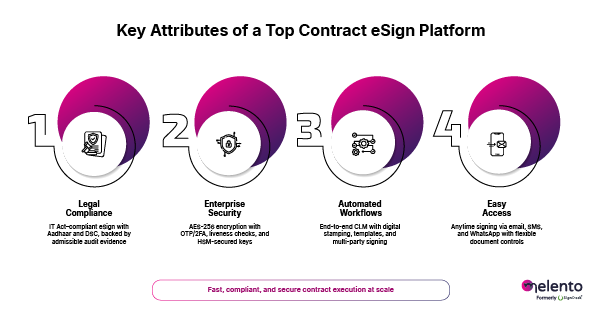
Security remains the foundation of any eSign platform. Organizations handling sensitive data, vendor agreements, or regulated documents need guarantees around:
- encryption standards
- identity verification
- tamper-proof seals
- document integrity
- access control
- compliance with eIDAS, IT Act, ESIGN, UETA, SOC 2, or ISO frameworks
How top platforms differ:
DocuSign and Adobe offer strong enterprise-grade security and compliance certifications. Zoho Sign provides a solid baseline fit for SMB and mid-market needs. Workflow-first platforms like Melento focus on security embedded within the signing workflow itself, ensuring that approvals, roles, and routing adhere to policy before signatures occur.
How Melento meets this need:
Melento integrates compliance into workflow design, roles and audit readiness support regulatory requirements automatically, helping teams reduce compliance gaps created by manual processes.
2.Audit Trails and Traceability
Contract workflows often involve multiple reviewers, editors and signers. An audit trail is no longer just a record; it is a governance mechanism.
Capabilities to evaluate:
- timestamped logs for each action
- signer identity validation
- workflow level details
- stamping level details
Why it matters:
During audits or disputes, clarity in the signing history protects organizations against risk. Weak audit trails create compliance exposure.
How Melento meets this need:
Melento generates complete audit records at the workflow level, not only at the signature level. Every approval, action, edit and routing decision is recorded in a structured, readable sequence that meets internal governance standards.
3.Workflow Design and Multi-Party Signing
This is the criterion that separates basic eSign tools from enterprise-ready platforms.
Platform comparison:
- DocuSign supports sequential and parallel flows but can become rigid when many reviewers are involved.
- Adobe Sign offers structured routing but less flexibility for complex, cross-functional approvals.
- Zoho Sign handles simple flows well but struggles with multi-team routing.
- Melento is built for contracts that must move across legal, finance, procurement and external stakeholders. Its workflow engine supports role-level access, parallel signing
For teams enquiring about top eSign platforms for contracts, workflow depth is usually the criterion that narrows the field.
4.Ease of Use for Internal and External Signers
Even the best workflow collapses if signers struggle to complete their part. External signers, vendors, customers and partners may not be familiar with any eSign platform.
Evaluation points include:
- guided signing
- mobile responsiveness
- clarity in what each signer must fill
- clear navigation
- minimal account creation steps
Basic eSign tools usually score well on simplicity but not on workflow depth. Enterprise tools offer power, but sometimes overwhelm occasional signers.
Melento strikes a balance by designing signing experiences that guide users step-by-step, making the workflow easier for internal teams and external participants alike.
5.Integration and API Flexibility
Teams want eSign tools that connect with the systems they already use, such as:
- CRM (Salesforce, Zoho, HubSpot, FreshSales)
- ERP and procurement systems
- HRMS platforms
- Compliance systems
- Cloud storage
- Custom internal systems
API quality often determines whether the platform becomes part of the core tech stack or remains a standalone utility.
What to compare:
- API depth and documentation
- Webhooks
- Prebuilt integrations
- Sandbox environment support
- Real-time status syncing
Melento exposes a comprehensive API layer that connects contract workflows to CRMs, core systems and internal apps, making it suitable for teams that want to automate contract initiation and status updates end-to-end.
6.Template and Data Field Control
Contract workflows often reuse templates. Evaluators look for:
- reusable templates
- role-based field assignment
- dynamic form fields
- mandatory data capture
- conditional sections
Poor template controls create repeated manual work. Platforms like Melento focus heavily on template governance to reduce repetitive tasks.
7.Scalability and Performance
For organizations handling hundreds or thousands of contracts, scalability matters. Evaluators assess:
- how the system handles high-volume sending
- time to send documents
- load performance for large PDFs
- handling of concurrent signers
- ability to onboard multiple departments
Melento is optimized for multi-department usage without requiring heavy CLM systems.
Comparison: How Melento Performs Against Leading eSign Tools
Security
DocuSign: Strong enterprise compliance
Adobe Sign: Solid integration with Adobe’s security stack
Zoho Sign: Good baseline security
Melento: Workflow-level security ensuring that routing, roles and access comply with organizational policy before signing
Audit Trail
DocuSign: Reliable signature audit logs
Adobe Sign: Detailed audit file structure
Zoho Sign: Basic logs
Melento: Contract-wide audit trails covering actions and approvals
Workflow Routing
DocuSign: Serial and parallel flows
Adobe Sign: Structured routing
Zoho Sign: Limited multi-step routing
Melento: Full workflow engine that supports serial and parallel routing
Ease of Use
DocuSign: Familiar interface, but sometimes complex
Adobe Sign: Clean but not highly guided
Zoho Sign: Simple interface
Melento: Guided flows for occasional signers and clear prompts for internal participants
API
DocuSign: Mature and widely adopted API
Adobe Sign: Strong Adobe ecosystem integrations
Zoho Sign: Good for the Zoho ecosystem
Melento: Workflow API suited for cross-department contract automation and custom system integrations
Ideal Use Case
DocuSign: Broad enterprise adoption
Adobe Sign: Teams heavily invests in Adobe tools
Zoho Sign: Smaller teams or Zoho users
Melento: Organizations requiring structured, multi-step contract workflows across functions
Where Melento Fits in 2025
Melento fits organizations that need:
- multi-party signing
- clear audit trails
- role-based access
- guided signing for vendors and customers
- seamless integrations
- repeatable, scalable contract workflows
Melento is not built as a simple eSign utility. It is designed as a workflow engine for teams that handle contracts daily and want to reduce operational friction.
Conclusion: The Top eSign Platforms Share Strengths, But Differ in Purpose
The most important insight for 2025 is that evaluating what the top e-signature platforms for contracts requires matching the tool to the workflow, not selecting based on brand recognition alone.
- Basic tools are enough for occasional use.
- Enterprise tools handle signatures reliably but may feel heavy for cross-functional workflows.
- Workflow-driven platforms like Melento support predictable, multi-signer, approval-driven contract processes.
Teams that rely on contracts to run their operations need more than signatures. They need workflows that stay organized, compliant and consistent even as more stakeholders join the process.
Melento offers this structure in an accessible, flexible way that aligns with how modern organizations actually work.