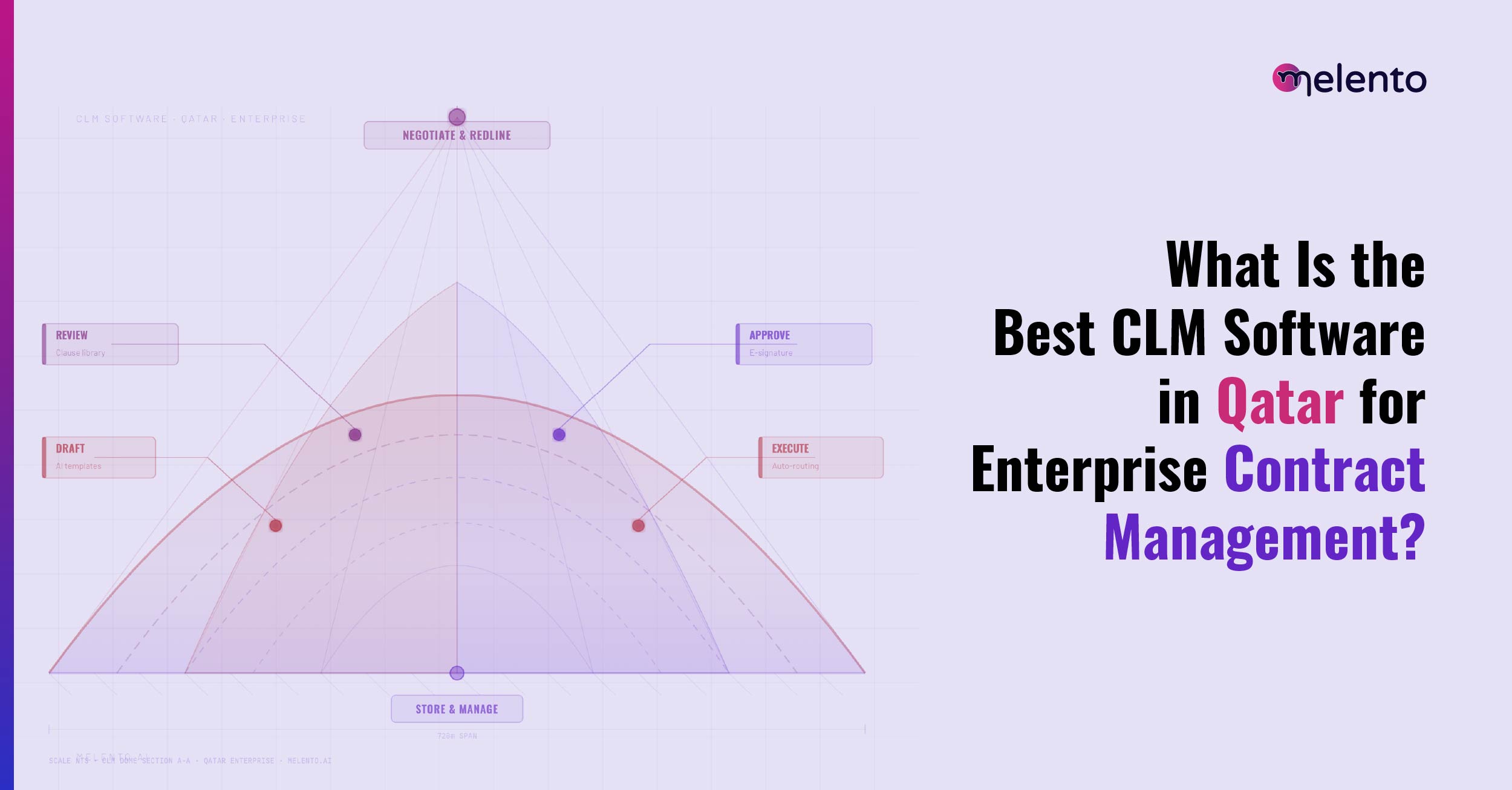
What Is CLM Software and Why Is It Becoming Essential for Enterprises in Qatar?
Contract Lifecycle Management software is an enterprise platform that automates and centralizes the entire contract lifecycle. A CLM software is rapidly becoming a strategic business necessity for enterprises in Qatar.
As the country accelerates its digital transformation agenda under Qatar National Vision 2030, enterprises across energy, finance, telecom, healthcare, infrastructure, and public-sector ecosystems are managing increasingly complex contracts in multilingual, compliance-intensive environments.
Qatar’s broader economic modernization is driving this shift. Moreover, Qatar remains one of the world’s highest-income economies, with GDP per capita consistently among the global top tier, reflecting significant enterprise investment in digital infrastructure, governance modernization, and operational transformation.
At the same time, the ICT market is projected to exceed US$37.74 billion in digital transformation investments by 2031, as organizations increase spending on, cloud investments, development of Arabic large-language models, compliance technologies, and enterprise software modernization.
This rapid enterprise digitization is reshaping how contracts are created, approved, governed, and monitored.
That reality applies directly to contract management, and hence, enterprises search for the best CLM software in Qatar.
What Contract Management Challenges Do Enterprises in Qatar Face?
Enterprises in Qatar operate in one of the GCC’s fastest-evolving digital business environments. Yet many still rely on fragmented contract management processes that lead to operational fragmentation, compliance exposure, and execution delays.
Here are the most pressing Qatar-specific contract management pain points:
a. Slow contract approvals are delaying enterprise execution
Many organizations still depend on email-based approvals, manual reviews, and disconnected stakeholder coordination. This creates significant delays in procurement cycles, vendor onboarding, and commercial deal closures.
b. Digital transformation is outpacing legacy legal workflow software in Qatar
Qatar’s enterprise digitization momentum is substantial. A government-backed ICT business study found that 83% of business establishments in Qatar reported measurable benefits from digital technologies, while nearly half said digitization helped them expand into new markets. Yet many legal and procurement teams still rely on manual contract governance, creating a major modernization gap.
c. Compliance and audit-readiness requirements are becoming more stringent
Enterprises in Qatar must increasingly comply with stricter governance requirements across financial regulation, public procurement frameworks, and data privacy expectations.
The rise of local data governance requirements and digital compliance expectations means enterprises can no longer afford poor contract traceability.
As businesses align with stronger enterprise compliance frameworks, the lack of centralized audit trails creates elevated operational risk.
d. Complex multi-layer approval structures create internal bottlenecks
Many enterprises in Qatar, especially government-linked organizations, telecom firms, and infrastructure businesses, operate with deeply layered approval hierarchies.
Without workflow automation, contracts often stall across:
- Legal reviews
- Procurement validation
- Finance approvals
- Executive sign-offs
This significantly slows operational decision-making.
e. Arabic-English contract inconsistencies create legal and operational friction
Qatar’s enterprise environment requires seamless bilingual collaboration. Contracts frequently move between Arabic-speaking stakeholders and international legal, procurement, and compliance teams.
Without native bilingual workflow support, enterprises face:
- Translation inconsistencies
- Version control issues
- Legal interpretation risks
- Approval confusion
f. Large-scale regional operations make contract visibility difficult
Qatar-based enterprises increasingly manage contracts across multiple geographies. This challenge is reflected in real-world enterprise adoption.
As Christian Friedrich Linhart, Group Chief Procurement Officer at Ooredoo, noted: “A key pillar is digitizing operations and accelerating growth.”
That statement reflects a broader enterprise reality across Qatar.
What Features Should Enterprises Compare When Choosing the Best CLM Software in Qatar?
Selecting the best CLM software in Qatar requires evaluating platforms against the country’s enterprise priorities:
- Compliance control
- Arabic-English collaboration
- Auditability
- Governance automation
- Secure integrations
Qatar’s enterprise ecosystem places particular emphasis on digital transparency and regulatory accountability.
|
Best CLM Softwares in Qatar |
|||
|---|---|---|---|
|
CLM Software |
Best For in Qatar |
Key Strengths |
Why It Matters for Qatar |
|
Melento CLM |
Compliance-heavy enterprise automation |
Arabic-English workflows, AI search, audit trails, governance automation |
Ideal for regulated, bilingual enterprise ecosystems |
|
Icertis |
Governance-intensive enterprises |
Advanced compliance automation |
Strong for financial institutions |
|
DocuSign CLM |
Global enterprise integration |
Strong Integrations |
Strong for multinationals |
|
Agiloft |
Workflow customization |
Flexible automation logic |
Suitable for tailored enterprise workflows |
|
Ironclad |
Legal workflow efficiency |
User-friendly collaboration |
Useful for legal teams seeking usability |
|
Sirion |
Procurement governance |
Obligation and supplier tracking |
Relevant for large procurement ecosystems |
Melento CLM is designed for enterprises operating in regulated, multilingual, governance-intensive environments.
How Does Melento CLM Solve Qatar’s Contract Challenges?
For organizations operating across banking, oil & gas, telecom, construction, and government-linked sectors, the right CLM platform must go beyond document management. Melento addresses key enterprise pain points directly.
- Arabic Language & Full RTL Enablement
Qatari enterprises require platforms that support seamless Arabic-English legal collaboration.
Melento CLM comes with:
- Full Arabic interface support
- Right-to-left (RTL) compatibility
- Arabic document generation
- Arabic-enabled workflow notifications
- Dual-language search and navigation
Why it matters in Qatar: Many enterprises manage contracts across Arabic-speaking internal stakeholders while coordinating with international English-speaking legal and procurement teams.
Without true RTL-native support, workflows may become fragmented and error-prone.
- AI-Powered Contract Search for Large Repositories
Modern CLM platforms should provide repository-level AI search capabilities. Key functionality with Melento CLM includes:
- Natural language contract search
- Context-aware result ranking
- Search explanations for relevance
- Smart filters for rapid narrowing
- Direct contract access from search results
Why it matters in Qatar: Large Qatari enterprises often manage thousands of contracts across subsidiaries, vendors, and government projects. AI search significantly reduces legal review time.
Melento’s Ask SAM Repository-Level AI Search enables users to instantly locate contracts using conversational queries, improving speed and decision-making accuracy.
- Audit-Ready Compliance Controls
Qatar’s regulated sectors require complete traceability. Essential capabilities include:
- Timestamped approvals
- Version control
- Approval chain visibility
- Immutable audit logs
- Compliance reporting dashboards
Why it matters in Qatar: Auditability is critical for financial services, energy contracts, infrastructure procurement, and public-sector governance.
- Approval Workflow Governance
Approval structures in Qatari enterprises are often layered and hierarchical. Melento CLM offers:
- Multi-level approval routing
- Conditional workflow logic
- Delegation controls
- Parallel approvals
Complex governance models require workflows that reflect enterprise decision hierarchies.
- Secure API-Based Enterprise Integrations
The best CLM software should support secure integrations with enterprise systems. Critical capabilities with Melento include:
- API-first architecture
- Role-separated API licensing
- Secure request creation
- Controlled system-to-system access
Enterprises often integrate CLM with ERP, procurement, and compliance systems.
Melento’s API User License Type enables secure integrations while maintaining strict separation between integration access and platform user access, essential for governance-sensitive organizations.
- Flexible Request Creation for Enterprise Automation
Modern CLM systems should simplify the use of external workflow triggers:
- Email-based request creation
- External system request triggers
- Automated workflow initiation
This reduces operational friction across procurement and legal operations. Melento’s Create Request via Email ID enhancement simplifies enterprise integrations and enhances automation flexibility.
- Centralized Contract Intelligence Dashboards
Executives need enterprise-wide contract visibility. Essential features include:
- Renewal alerts
- Bottleneck tracking
- SLA monitoring
- Risk indicators
- Contract performance analytics
Real-time oversight strengthens governance and operational decision-making.
This is where Melento CLM stands out. Its advanced capabilities, including:
- Ask SAM Repository-Level AI Search
- Full Arabic + RTL Enablement
- Secure API User Licensing
- Parent Request Linking
- Enhanced API Flexibility
and more that make it particularly well-suited to Qatar’s enterprise contract management needs.