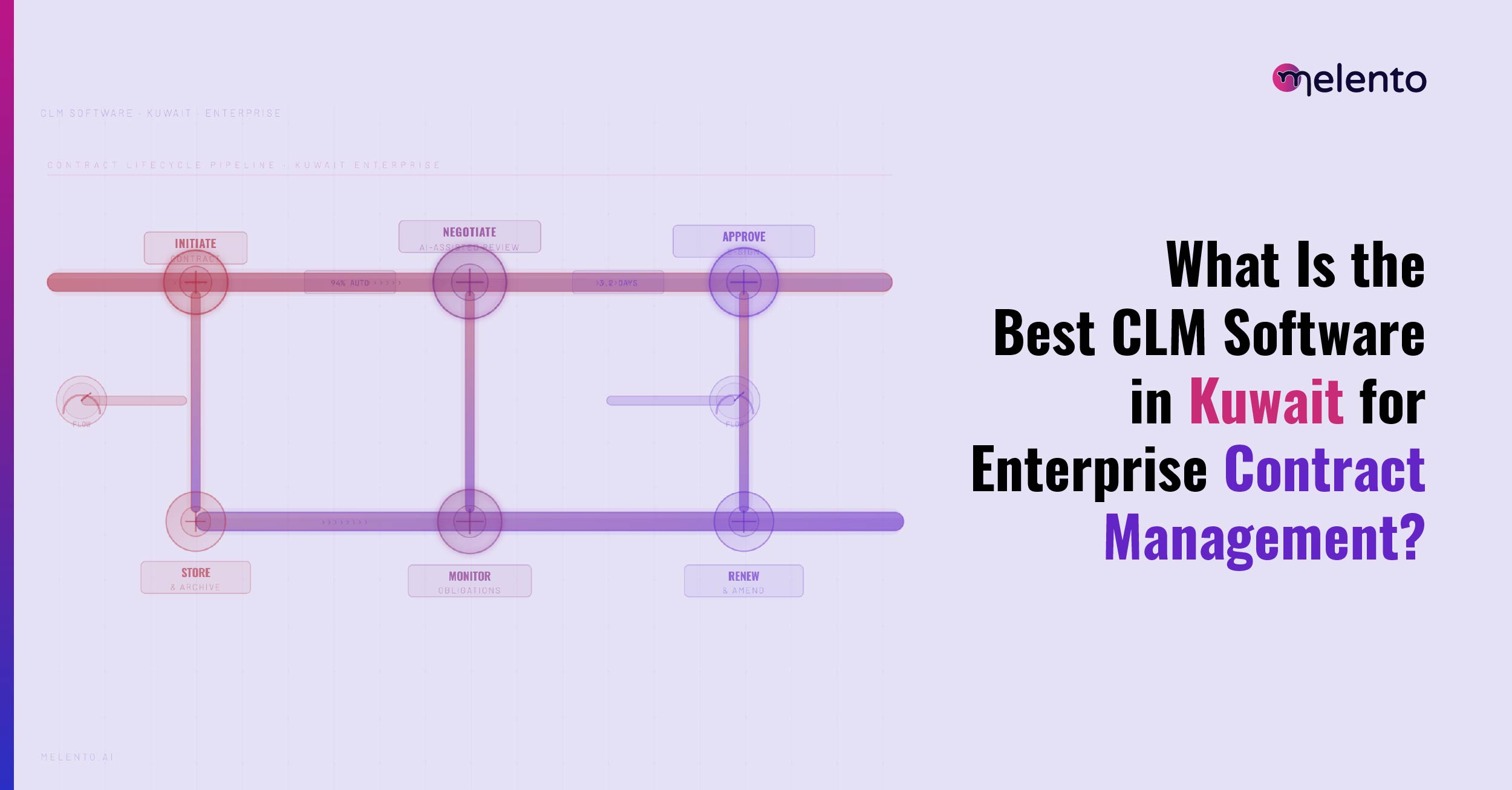
What Is CLM Software and Why Is It Becoming Essential for Enterprises in Kuwait?
Contract Lifecycle Management (CLM) software is an enterprise solution that automates and manages the entire contract journey, from drafting and approvals to execution, compliance tracking, renewals, and reporting. It helps legal, procurement, finance, and operations teams centralize contract workflows, reduce delays, improve visibility, and strengthen governance.
For enterprises in Kuwait, CLM software is becoming essential as contract complexity outpaces traditional manual systems.
Kuwait’s ongoing economic diversification under Kuwait Vision 2035 is accelerating investment in infrastructure, logistics, financial services, technology, and public-private partnerships, resulting in a significant increase in commercial contracts and procurement agreements.
Moreover, Kuwait’s non-oil sector is projected to continue expanding as diversification efforts intensify, thereby increasing enterprise demand for faster, more structured contract execution.
This growth is occurring alongside major infrastructure investments and industrial modernization, all sectors that are heavily dependent on high-volume, compliance-sensitive contract management.
At the same time, Kuwait’s position as a GCC commercial player means enterprises regularly manage agreements across Saudi Arabia, the UAE, Qatar, Bahrain, and international vendors. This creates operational challenges around multi-jurisdiction compliance, Arabic-English contract workflows, cross-border approvals, and vendor obligation tracking.
Manual contract processes can be costly in this environment, as enterprises still relying on spreadsheets, email approvals, shared folders, and disconnected legal workflows face:
- Slower contract execution
- Higher legal overhead
- Compliance exposure
- Limited visibility into obligations
- Reduced scalability across regional operations
For Kuwaiti enterprises navigating economic transformation and regional expansion, CLM software is no longer just a legal operations tool.
It is becoming an essential business infrastructure, enabling faster approvals, stronger governance, better collaboration, and scalable enterprise growth.
This is exactly why forward-looking organizations are investing in the best CLM software in Kuwait to turn contracts from a source of operational fragmentation into strategic business accelerators.
What Contract Management Challenges Do Enterprises in Kuwait Face?
For organizations operating in highly regulated sectors such as oil & gas, banking, telecom, construction, and government-linked infrastructure, outdated contract processes pose measurable business risks.
Here are the most pressing Kuwait-specific contract management challenges enterprises face today:
- Why Are Slow Multi-Level Approval Cycles Delaying Business Execution in Kuwait?
Many Kuwaiti enterprises still depend on manual approval chains involving multiple departments. This often includes:
- Legal review teams
- Finance approval layers
- Procurement sign-offs
- Executive validation
- Compliance oversight checkpoints
In Kuwait’s enterprise ecosystem, where large-scale contracts often involve public-sector stakeholders, regulated approvals, or joint ventures, manual routing significantly slows execution. This creates delays in:
- Vendor onboarding
- Procurement finalization
- Infrastructure project execution
- Commercial partnership activation
Without automation, Kuwaiti enterprises lose valuable execution speed.
- How Does Regulatory Complexity Increase Contract Risk in Kuwait?
Kuwait’s enterprise environment is highly compliance-driven. Industries such as:
- Financial services
- Oil & gas
- Telecom
- Energy
- Infrastructure
must maintain strict auditability and approval governance.
Manual contract systems often lack:
- Timestamped approval logs
- Centralized audit trails
- Version transparency
- Renewal accountability
- Obligation monitoring
This creates compliance exposure.
- Why Is Arabic-English Contract Coordination a Major Pain Point?
One of Kuwait’s most distinctive contract management challenges is the complexity of bilingual workflows. Most enterprise contracts require coordination across:
- Arabic legal documentation
- English commercial agreements
- Multinational stakeholder collaboration
Manual handling introduces serious risks, such as:
- Translation inconsistencies
- Clause misalignment
- Version confusion
- Approval delays
For multinational enterprises and government-linked organizations, even minor language discrepancies can create legal ambiguity.
Many global CLM platforms remain optimized primarily for English workflows, making bilingual contract orchestration a critical evaluation factor in Kuwait.
- How Does Poor Contract Visibility Impact Enterprise Governance?
In many Kuwaiti organizations, contract information remains fragmented across:
- Shared drives
- Email threads
- Physical files
- Department-specific repositories
This makes it difficult for executives to answer essential operational questions:
- Where is a contract stalled?
- Who owns approval?
- What obligations are due?
- Which renewals are approaching?
This visibility gap weakens governance. Poor contract visibility is among the top contributors to delayed decision-making and operational inefficiency.
For Kuwait’s enterprise leaders, this lack of transparency creates strategic blind spots.
Manual contract management cannot support Kuwait’s enterprise growth ambitions. Organizations now need intelligent contract lifecycle management software that delivers new-gen operational efficiency.
Let’s find out more…
What Features Should Enterprises Compare When Choosing the Best CLM Software in Kuwait?
Choosing the best CLM software in Kuwait requires evaluating platforms against the country’s unique enterprise needs, including compliance, control, bilingual legal collaboration, auditability, and governance.
Kuwait’s enterprise landscape places particular value on:
- Regulatory traceability
- Arabic-English workflow support
- Approval governance
- Audit-ready documentation, and more.
|
Best CLM Softwares in Kuwait |
|||
|---|---|---|---|
|
CLM Software |
Best For in Kuwait |
Key Strengths |
Why It Matters for Kuwait |
|
Melento CLM |
Compliance-heavy enterprise automation |
Multi-workflows, AI governance, audit trails, and enterprise orchestration |
Ideal for Kuwait’s regulated, governance-driven enterprise environment |
|
DocuSign CLM |
Global enterprise integration |
Broad ecosystem compatibility |
Useful for multinational enterprises |
|
Icertis |
Governance-intensive enterprises |
Advanced compliance automation |
Strong for financial institutions |
|
Ironclad |
Legal workflow efficiency |
User-friendly collaboration |
Useful for legal teams seeking usability |
|
Agiloft |
Workflow customization |
Flexible automation logic |
Suitable for tailored enterprise workflows |
|
Sirion |
Procurement governance |
Obligation and supplier tracking |
Relevant for large procurement ecosystems |
Melento CLM is designed for enterprises operating in regulated, multilingual, governance-intensive environments. This makes it highly aligned with Kuwait’s enterprise requirements.
|
How Should Enterprises Choose the Right CLM Software in Kuwait? Ask these questions:
|
How Does Melento CLM Solve Kuwait’s Contract Challenges?
For organizations operating across banking, oil & gas, telecom, construction, and government-linked sectors, the right CLM platform must go beyond document management. Melento addresses key enterprise pain points directly.
- Arabic Language & Full RTL Enablement
Kuwaiti enterprises require platforms that support seamless Arabic-English legal collaboration.
Melento CLM comes with:
- Full Arabic interface support
- Right-to-left (RTL) compatibility
- Arabic document generation
- Arabic-enabled workflow notifications
- Dual-language search and navigation
Why it matters in Kuwait: Many enterprises manage contracts across Arabic-speaking internal stakeholders while coordinating with international English-speaking legal and procurement teams.
Without true RTL-native support, workflows may become fragmented and error-prone.
- AI-Powered Contract Search for Large Repositories
Modern CLM platforms should provide repository-level AI search capabilities. Key functionality with Melento CLM includes:
- Natural language contract search
- Context-aware result ranking
- Search explanations for relevance
- Smart filters for rapid narrowing
- Direct contract access from search results
Why it matters in Kuwait: Large Kuwaiti enterprises often manage thousands of contracts across subsidiaries, vendors, and government projects. AI search significantly reduces legal review time.
Melento’s Ask SAM Repository-Level AI Search enables users to instantly locate contracts using conversational queries, improving speed and decision-making accuracy.
- Audit-Ready Compliance Controls
Kuwait’s regulated sectors require complete traceability. Essential capabilities include:
- Timestamped approvals
- Version control
- Approval chain visibility
- Immutable audit logs
- Compliance reporting dashboards
Why it matters in Kuwait: Auditability is critical for financial services, energy contracts, infrastructure procurement, and public-sector governance.
- Approval Workflow Governance
Approval structures in Kuwaiti enterprises are often layered and hierarchical. Melento CLM offers:
- Multi-level approval routing
- Conditional workflow logic
- Escalation automation
- Delegation controls
- Parallel approvals
Complex governance models require workflows that reflect enterprise decision hierarchies.
- Secure API-Based Enterprise Integrations
The best CLM software should support secure integrations with enterprise systems. Critical capabilities with Melento include:
- API-first architecture
- Role-separated API licensing
- Secure request creation
- Controlled system-to-system access
Enterprises often integrate CLM with ERP, procurement, and compliance systems.
Melento’s API User License Type enables secure integrations while maintaining strict separation between integration access and platform user access, essential for governance-sensitive organizations.
- Flexible Request Creation for Enterprise Automation
Modern CLM systems should simplify the use of external workflow triggers:
- Email-based request creation
- External system request triggers
- Automated workflow initiation
This reduces operational friction across procurement and legal operations. Melento’s Create Request via Email ID enhancement simplifies enterprise integrations and enhances automation flexibility.
- Centralized Contract Intelligence Dashboards
Executives need enterprise-wide contract visibility. Essential features include:
- Renewal alerts
- Bottleneck tracking
- SLA monitoring
- Risk indicators
- Contract performance analytics
Real-time oversight strengthens governance and operational decision-making.
This is where Melento CLM stands out. Its advanced capabilities, including:
- Ask Sam Repository-Level AI Search
- Full Arabic + RTL Enablement
- Secure API User Licensing
- Parent Request Linking
- Enhanced API Flexibility
and more that make it particularly well-suited to Kuwait’s enterprise contract management needs.