
For years, contract governance was treated as an operational discipline. Legal teams managed risk. Procurement monitored obligations. Compliance teams reviewed deviations. Contracts existed inside repositories, disconnected from broader enterprise intelligence systems. That model is rapidly collapsing.
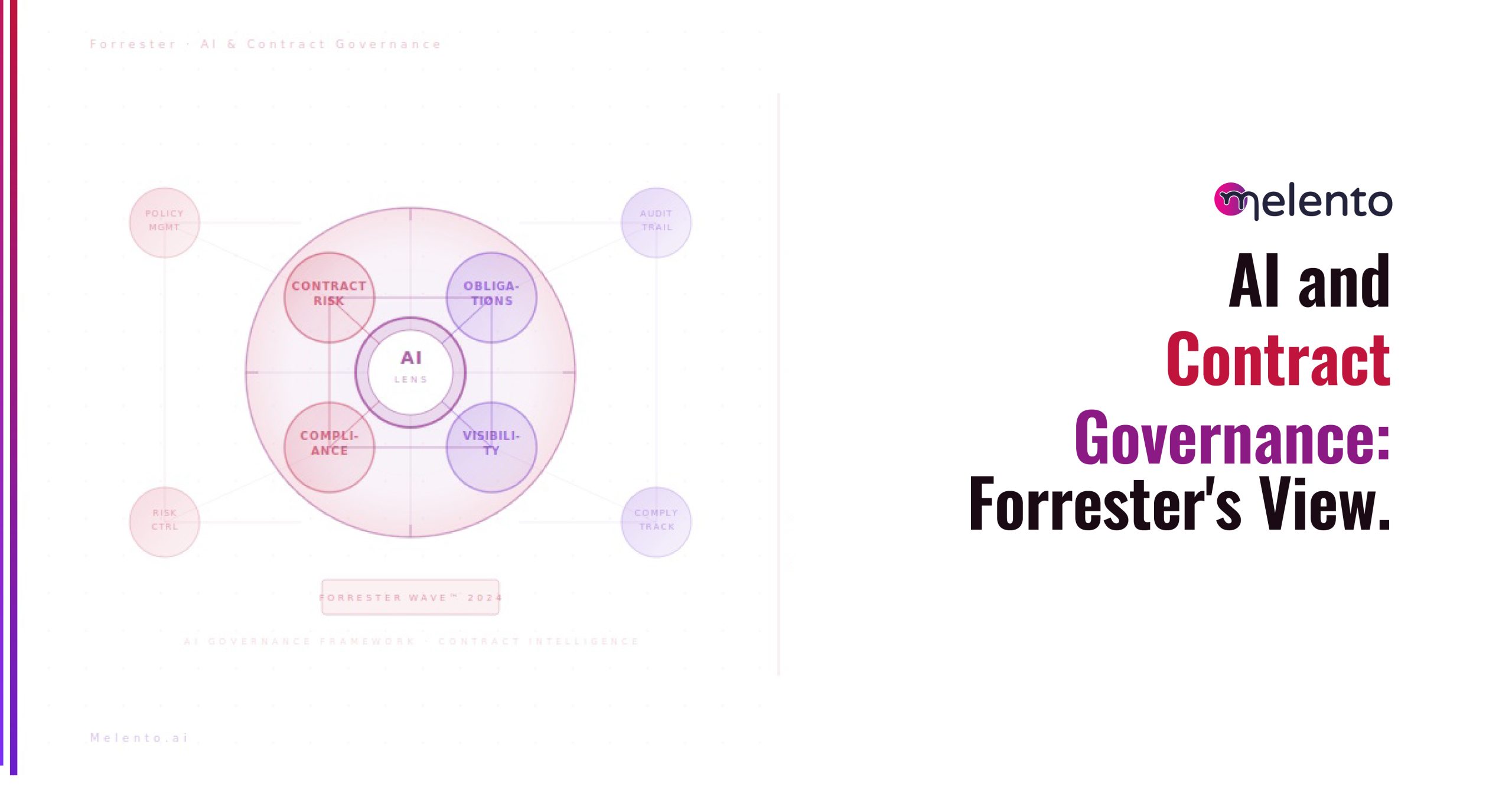
Today, AI-powered contract governance is emerging as one of the most strategic priorities in enterprise technology. And according to recent Forrester research on CLM platforms, organizations are no longer evaluating contract lifecycle management purely through the lens of efficiency. They are increasingly prioritizing visibility, transparency, AI capabilities, and contract intelligence. That shift has major implications. Because governance in the AI era is no longer about storing agreements safely. It is about continuously understanding what contracts are exposing, enabling, restricting, or obligating across the enterprise.
This is precisely why conversations around Forrester, CLM, AI, Melento, and contract intelligence are now tightly interconnected.
The enterprise contract is evolving from a static legal document into a dynamic operational intelligence asset.
What Is AI-Driven Contract Governance?
AI-driven contract governance refers to the use of AI and CLM technologies to monitor, analyze, enforce, and optimize contractual obligations, risks, and compliance frameworks across the organization.
In traditional environments, governance relied heavily on:
- Manual reviews
- Spreadsheet tracking
- Reactive audits
- Fragmented repositories
- Human-dependent oversight
Modern AI-powered CLM softwares are fundamentally different.
They continuously surface:
- Risk exposure
- Non-standard clauses
- Renewal obligations
- Compliance deviations
- Supplier dependencies
- Negotiation inconsistencies
- Revenue leakage indicators
This is where contract intelligence becomes central to governance strategy.
Platforms like Melento are increasingly positioning AI-enabled contract intelligence as a business-wide governance capability rather than a standalone legal workflow tool. And Forrester’s findings strongly reinforce this market direction.
What Does Forrester Say About AI in CLM?
One of the most important findings in the Forrester CLM report is how dramatically enterprise expectations around AI have evolved.
Forrester found that the importance of AI capabilities inside CLM platforms increased from 2.37 to 4 on a five-point scale. That is not incremental technology adoption.
That is a fundamental strategic repositioning of AI within contract governance. Enterprises are no longer satisfied with basic workflow automation.
They increasingly expect AI-driven CLM systems to:
- Analyze clauses automatically
- Detect policy deviations
- Improve search accuracy
- Extract obligations
- Accelerate negotiations
- Generate summaries
- Identify hidden risks
- Deliver actionable contract intelligence
Forrester also notes that buyers increasingly want AI capabilities that are “baked in, not bolted on.” That phrase captures the market transition perfectly.
Organizations no longer want disconnected AI add-ons. They want governance intelligence embedded directly into the CLM architecture.
Why Contract Governance Is Becoming a Board-Level Concern?
The rise of AI-powered contract governance is being driven by broader enterprise pressures. Boards increasingly need visibility into:
- Third-party risk
- Regulatory exposure
- Vendor obligations
- ESG compliance
- Data privacy commitments
- Financial liabilities
- Contractual dependencies
Contracts now influence nearly every major governance discussion. That explains why Forrester found that real-time contract visibility and transparency have overtaken efficiency as the top driver for CLM investment. This is an important evolution.
Historically, CLM systems were justified through operational efficiency. Now, they are increasingly justified through governance intelligence. That distinction changes how enterprises evaluate AI, CLM, and contract intelligence platforms like Melento. The conversation is shifting from process automation to enterprise oversight.
Why Enterprises Are Replacing Legacy CLM Systems?
Forrester’s research also reveals another significant market signal: replacement CLM purchases are now nearly equal to first-time implementations. That suggests many enterprises are dissatisfied with older governance architectures.
The reasons are revealing:
- Rigid workflows
- Heavy customization
- Weak usability
- Limited AI functionality
- Vendor dependency
- Poor support responsiveness
For governance teams, these limitations create dangerous blind spots. A governance system that cannot adapt to evolving regulatory, operational, and commercial conditions becomes a strategic liability.
This is why enterprises increasingly seek flexible AI-driven CLM platforms capable of delivering scalable contract intelligence without excessive complexity.
How AI Improves Contract Governance
AI is transforming contract governance in several critical ways.
- Continuous Risk Detection
AI systems can identify risky clauses, missing obligations, or non-compliant language across thousands of agreements in seconds.
- Intelligent Obligation Tracking
Instead of manually monitoring deadlines and commitments, AI-powered CLM systems automate alerts and compliance monitoring.
- Enterprise-Wide Searchability
Modern AI search capabilities allow teams to query contract repositories conversationally rather than manually reviewing documents.
- Governance Standardization
AI helps enforce approved playbooks, fallback language, and policy frameworks consistently across departments.
- Faster Audits and Reporting
Governance teams can rapidly generate compliance summaries, exposure reports, and contractual analytics.
This is where contract intelligence becomes operationally powerful.
It transforms governance from reactive oversight into proactive intelligence management.
Why Many Enterprises Still Underutilize CLM and AI
Despite increased investment in AI and CLM, Forrester found that organizations use only around 65% of the CLM capabilities they purchase. That gap matters. Because governance failures rarely happen from lack of technology acquisition. They happen from lack of adoption and operational alignment.
Forrester identified several key causes:
- Limited internal resources
- Complex implementation requirements
- Integration challenges
- Underused AI modules
- Excessive customization
The report also highlights that 97% of customers cited internal capacity constraints as a major reason for underutilization. This creates an important lesson for enterprises modernizing governance systems.
Successful AI-driven contract governance depends less on feature quantity and more on usability, adoption, and operational integration. That is why modern CLM buyers increasingly prioritize usability and integrations alongside AI functionality.
How Enterprises Are Modernizing Contract Management
Modern contract governance strategies increasingly include:
- AI-Powered Contract Intelligence
- Extracting actionable business insights from agreements automatically.
- Centralized Governance Repositories
- Creating a unified source of truth for legal, procurement, compliance, and finance teams.
- Workflow Automation
- Reducing approval delays while maintaining governance controls.
- Real-Time Visibility Dashboards
- Providing leadership with live exposure tracking and compliance analytics.
- Cross-System Integrations
- Connecting CLM with ERP, CRM, procurement, and risk platforms.
- Governance Analytics
- Monitoring trends, obligations, renewals, and policy adherence across the enterprise.
This convergence between AI, CLM, contract intelligence, and governance strategy is precisely what vendors like Melento are increasingly positioning themselves around. The future of governance is not document-centric.
It is intelligence-centric.