
For years, artificial intelligence was discussed in financial services as an efficiency layer – useful for fraud detection, algorithmic trading, customer support or data analytics. Helpful, certainly. Transformational, perhaps. But still peripheral to the core architecture of knowledge work itself. That assumption is now collapsing.
Anthropic’s recent launch of specialised frontier AI tools for banking, insurance, asset management and fintech marks something far larger than another enterprise AI product announcement. The market reaction itself revealed the deeper anxiety. Shares of major financial information and ratings firms, including FactSet, Morningstar, S&P and Moody’s, came under immediate pressure after the announcement. Investors understood the signal quickly.
The real disruption is no longer about software augmenting financial professionals. It is about AI systems increasingly performing the work that once justified entire categories of professional services.
This is the moment where finance becomes the global case study for the restructuring of white-collar work.
How Low Code Agentic AI Is Automating Judgment-Based Work in Finance
Historically, automation targeted repetitive labour. Industrial machines replaced physical effort. Software digitised administrative tasks. But knowledge work remained comparatively insulated because it depended on reasoning, judgement, interpretation and contextual decision-making. That protective boundary is eroding rapidly.
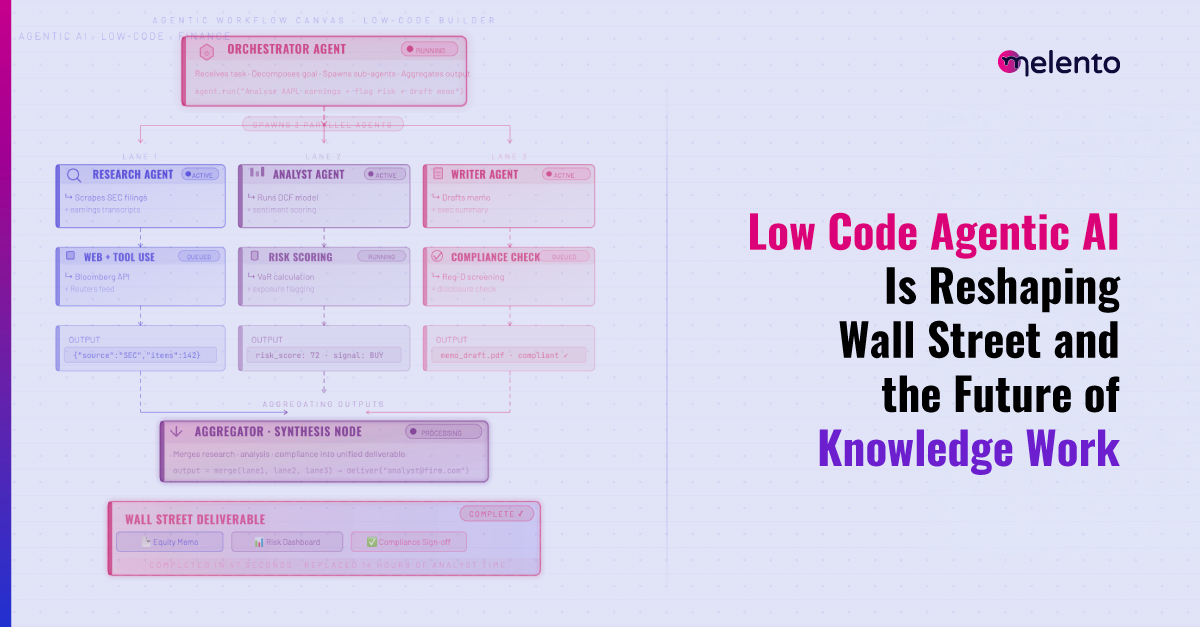
Anthropic’s new AI agents are designed not merely to retrieve information, but to execute high-value operational tasks: drafting pitch materials, managing workflows, supporting compliance reviews and coordinating cross-functional processes inside financial institutions.
These are not low-value activities. They sit close to the operational core of modern banking and financial services. The implications extend far beyond Wall Street.
If AI systems can reliably assist with financial analysis, operational coordination and regulatory workflows in one of the world’s most compliance-intensive industries, then every sector dependent on structured knowledge work must now confront the same question:
What exactly remains uniquely human inside enterprise operations?
Why Finance Is the First Battlefield for Low Code Agentic AI Adoption
Financial services are particularly vulnerable because the industry runs on information asymmetry, structured documentation, repetitive decision flows and regulatory oversight – all areas where large language models and Agentic AI systems perform exceptionally well.
But this transformation is not confined to finance.
Insurance underwriting, legal documentation, healthcare administration, procurement operations, audit management, enterprise reporting, and customer onboarding all share the same underlying architecture: human beings moving information between systems, validating rules, generating documents, and coordinating decisions. Much of this work is now becoming machine-assisted.
This does not necessarily imply mass replacement of professionals overnight. The more immediate shift is subtler and perhaps more profound: the emergence of AI as an operational coworker embedded directly into enterprise workflows.
The future enterprise employee may increasingly supervise workflows rather than manually execute every stage of them. That distinction matters enormously.
Because once AI systems become capable of handling coordination and operational reasoning at scale, productivity itself becomes structurally redefined.
The Rise of Collaborative Intelligence Powered by Low Code Agentic AI
For years, enterprise software functioned largely as passive infrastructure. Human beings operated the systems. Humans initiated workflows, analysed information, escalated decisions, and completed actions manually. The next generation of enterprise platforms will operate differently.
We are entering the era of collaborative intelligence – environments where humans and AI agents work together continuously across operational processes.
In such systems, AI no longer behaves like a chatbot sitting at the edge of the enterprise. It becomes embedded into the organisation’s decision fabric itself.
This is precisely the direction in which the industry is moving.
At Melento, we see this transformation unfolding rapidly within the BFSI sector. Financial institutions are no longer searching merely for isolated automation tools. They are looking for enterprise-wide orchestration platforms capable of integrating intelligence across fragmented workflows, compliance structures and operational silos. Our collaborative intelligence platform is built around this reality.
Rather than treating AI as a standalone assistant, the platform enables organisations to deploy low-code Agentic AI systems capable of managing workflow coordination, operational execution and enterprise collaboration across functions. The objective is not simply automation for efficiency’s sake. It is the creation of intelligent operational ecosystems where humans and AI agents work in synchronisation. This distinction will define the next phase of enterprise AI adoption.
How Low Code Agentic AI Is Turning Knowledge Work Into Scalable Infrastructure
One of the most significant implications of this shift is that knowledge itself is becoming operational infrastructure rather than individual expertise.
For decades, financial institutions derived competitive advantage from accumulated institutional knowledge such as research capabilities, analyst expertise, operational processes and regulatory understanding. But frontier AI models increasingly compress access to such knowledge into scalable digital systems. The economic consequences could be substantial.
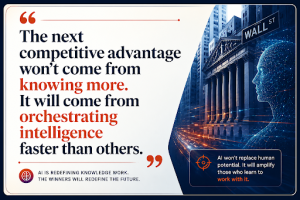
When intelligence becomes widely accessible through AI systems, differentiation moves elsewhere. Speed of execution, workflow integration, operational adaptability and AI orchestration become more valuable than information possession alone.
This explains why infrastructure partnerships are becoming strategically critical.
Anthropic’s reported expansion with Google Cloud – involving enormous long-term investment into computing infrastructure and AI capacity signals confidence that enterprise demand for these systems will accelerate dramatically in coming years.
The AI race is no longer simply about building larger models. It is about building the operational infrastructure capable of embedding intelligence into global enterprise workflows at scale.
Low Code Agentic AI and the Redesign of Enterprise Roles
Much of the public debate around AI remains trapped in simplistic binaries: will AI replace jobs or not? The more important question is how enterprise roles themselves are being redesigned.
Many white-collar professions evolved around the assumption that human beings were necessary intermediaries between information, systems and decisions. AI fundamentally changes that architecture.
Junior analysts may spend less time compiling reports and more time validating strategic insights. Compliance teams may increasingly supervise AI-generated reviews rather than manually inspecting every document. Operations managers may transition from process execution to workflow governance. In other words, work does not disappear entirely. It evolves upward.
The organisations that adapt fastest will not necessarily be those with the largest AI budgets. They will be the ones capable of redesigning workflows, governance structures and operating models around collaborative intelligence.
This is why the low-code AI orchestration platform developed by Melento is becoming increasingly important. Enterprises do not simply need access to frontier models. They need practical systems capable of integrating AI agents securely into day-to-day operations without years of technical complexity or massive engineering dependency.
That operational layer will become one of the defining enterprise technology battlegrounds of the coming decade.
Finance Previews the Low Code Agentic AI Future of Enterprise Operations
Wall Street’s AI transformation matters because finance often acts as an early indicator of broader economic change. The sector’s scale, regulatory complexity and operational intensity make it an ideal testing ground for AI-mediated enterprise workflows. What succeeds in finance rarely stays confined there.
The transition now underway signals something larger than technological adoption. It represents the gradual restructuring of knowledge work itself.
The industrial revolution automated physical labour. The AI revolution is beginning to automate operational cognition.
And yet this transformation should not be viewed purely through the lens of replacement. The more compelling opportunity lies in augmentation – creating enterprises where human judgment and machine intelligence reinforce each other continuously. That is the future collaborative intelligence points toward.
The companies that understand this early will not merely become more efficient. They will fundamentally redefine how organisations operate, scale decisions and create value in an AI-native economy.
Finance is simply where the future arrived first.