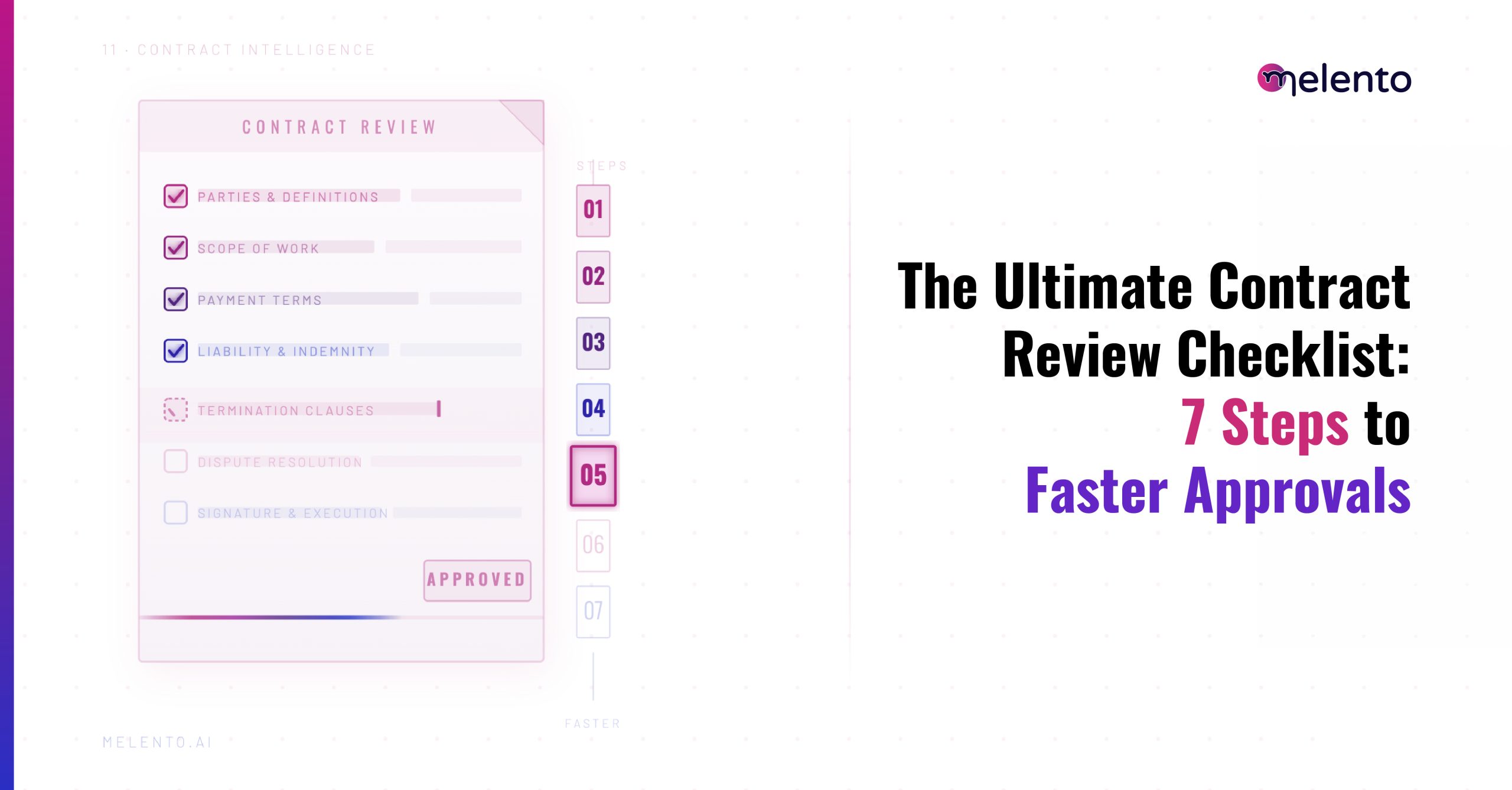

For in-house legal teams, contract review is more than just redlining clauses; it’s about protecting the business while keeping deals moving. Yet, fragmented processes, manual reviews, and last-minute surprises often turn routine contracts into approval bottlenecks.
This predictable Review Framework – a 7-layer contract governance model – is designed for scale, risk reduction, and faster approvals without sacrificing control. Whether you’re reviewing five contracts a week or five hundred, these seven steps help legal teams shift from reactive reviews to predictable execution.
Beyond serving as a checklist, this guide also aligns with broader transformation themes in modern legal operations, covering contract review process automation, legal operations transformation, AI in contract review, reducing contract cycle time, legal workflow automation, contract lifecycle management best practices, S2O automation, and enterprise contract governance.
By embedding these focus areas into each step, this article becomes not just procedural but a blueprint for scalable, tech-enabled contracting.
Why In-House Legal Teams Need a Standard Contract Review Checklist
Without a defined review framework:
- Risks slip through due to inconsistent scrutiny
- Approvals stall because issues are flagged too late
- Legal teams become blockers instead of business enablers
A standardized checklist creates clarity, speed, and defensibility, ensuring every contract is reviewed with the same rigor, regardless of volume or urgency.
This foundation is critical for organizations aiming to automate reviews, accelerate approvals, and transform their contracting function into a driver of business agility; key objective of legal operations transformation.
What Is the Ultimate 7-Step Contract Review Checklist?
Step 1: Validate the Contract Purpose & Business Context
Before diving into clauses, understand why the contract exists.
Key checks:
- What is the commercial objective?
- Is this a standard agreement or a negotiated exception?
- Which department owns the outcome: Sales, Procurement, HR, or Finance?
Why does traditional CLM fail?
Contracts often pass legal review but miss the business intent, leading to renegotiations.
What is the advantage of Modern CLM softwares, like Melento?
Metadata capture and automated intake ensure legal starts with full business context, not assumptions.
This first step also aligns with contract review process automation, ensuring every review begins with clear business metadata and contextual understanding rather than manual back-and-forth.
Step 2: Identify the Contract Type & Applicable Template
Not all contracts carry the same risk profile. Identify whether this is:
NDA, MSA, SOW, Vendor Agreement, Employment Contract, or Amendment, Standard template vs. non-standard draft, high-value or high-risk agreement requiring deeper scrutiny.
Using the wrong template or outdated language increases exposure and slows approvals.
What are the modern CLM, like Melento, advantages?
Centralized template libraries and playbooks ensure teams start with pre-approved, version-controlled content.
Standardization at this stage supports both legal workflow automation and enterprise contract governance, reducing deviations and ensuring each contract aligns with corporate risk standards.
Step 3: Review Commercial & Financial Terms
Legal risk is often buried in commercial language.
Checklist:
- Pricing, payment terms, and penalties are clearly defined
- Tax, stamp duty, and regulatory costs (specified for) ownership
- Term, renewal, and exit implications understood
- Alignment between commercial terms and annexures
Why it matters:
Ambiguous commercial terms often lead to post-signing disputes and payment delays.
What is the advantage of Modern CLM, like Melento?
AI-assisted clause validation cross-checks commercial terms against business data and flags inconsistencies.
This embodies AI in contract review, enabling accuracy, consistency, and efficiency in how commercial risks are detected and resolved.
Step 4: Assess Legal Risk & Liability Exposure
This is the heart of contract review.
Focus on:
- Indemnities and limitation of liability
- Governing law and jurisdiction
- Termination rights and consequences
- IP ownership and confidentiality
- Regulatory and statutory compliance clauses
Unchecked liability or jurisdiction clauses can expose the organization to disproportionate risk compared to the deal value.
What is the advantage of Modern CLM, like Melento?
AI-driven clause comparison highlights deviations from approved playbooks and assigns risk scores for faster decision-making.
At this point, organizations practicing contract lifecycle management best practices benefit from automated risk scoring and review analytics, further reducing contract cycle time.
Step 5: Ensure Compliance, Approvals & Audit Readiness
Contracts don’t fail only in court; they often fail in audits.
Verify:
- Required internal approvals are captured
- Signing authority is correctly defined
- Regulatory and policy obligations are addressed
- Review history and decisions are traceable
Email-based approvals and offline edits create audit gaps that are hard to defend later.
What is the advantage of Modern CLM, like Melento?
Automated workflows and immutable audit trails make every approval defensible and transparent.
This is central to legal workflow automation, turning ad hoc email-based approvals into governed, auditable, and compliant digital processes.
Step 6: Confirm Execution Readiness (Stamping & Signing)
Even a perfect contract fails if execution is flawed.
Final checks:
- Correct stamp duty applied as per state and document type
- Signing order and signer identity verified
- Execution method is legally valid (eSign / DSC)
- No unsigned annexures or missing schedules
Why it matters:
Execution errors can make contracts unenforceable.
What is the advantage of Modern CLM, like Melento?
Integrated eStamping and eSign workflows eliminate last-mile friction and ensure full traceability.
This integration supports S2O automation, bridging execution with sourcing, approvals, and obligation tracking to ensure contracts move seamlessly through the enterprise workflow.
Step 7: Post-Signing Storage, Obligations & Visibility
Contract review doesn’t end at signing.
Checklist:
- Executed contract stored in a central repository
- Key obligations and owners are clearly mapped
- Renewal, expiry, and notice alerts configured
- Audit and access controls are in place
What is the advantage of Modern CLM, like Melento?
Centralized storage with AI-based obligation tracking ensures compliance and accountability across teams.
This step reinforces enterprise contract governance, maintaining visibility, accountability, and performance tracking across the full contract lifecycle.
Contract Lifecycle Management Best Practices
Effective CLM goes beyond storing agreements; it ensures contracts drive compliance, efficiency, and business value throughout their lifecycle. Here are the key best practices organizations should follow:
- Standardize Templates and Clauses: Use approved templates and clause libraries to ensure consistency, reduce legal risk, and speed up contract creation.
- Automate Workflows Where Possible: Automated approvals, reminders, and execution workflows reduce delays, manual errors, and administrative overhead.
- Centralized Contract Storage: Maintain a single, searchable repository so teams can easily track obligations, renewals, and key terms.
- Track Obligations and Milestones: Monitor deliverables, deadlines, and performance metrics to avoid compliance gaps or missed commitments.
- Ensure Strong Governance and Access Control: Define clear ownership, role-based access, and audit trails to maintain security and accountability.
- Leverage Data and Analytics: Use contract insights to identify risks, optimize negotiations, and improve business decision-making.
Together, these practices form the foundation of enterprise-grade CLM, combining automation, AI, and governance to reduce contract cycle time and strengthen compliance posture.
Why Contract Review Process Automation Is a Competitive Advantage
For in-house counsel, the goal is to enable faster, safer business decisions. A structured contract review checklist ensures consistency, while intelligent CLM platforms like Melento CLM enable the process to scale without additional manual effort.
The result?
- Faster approvals
- Fewer disputes
- Stronger compliance posture
- Legal teams that lead, not lag, the business
In short, contract review process automation and AI-assisted workflows are not just efficiency enablers; they are competitive differentiators that empower legal teams to act with speed and precision.
Final Thought
In 2026 and beyond, contract review success won’t be measured by how many clauses get redlined but by how predictably contracts move from request to execution. Many organizations already use CLM tools, yet deals still slow down because contracting data remains fragmented across email, ERP systems, procurement tools, and legal workflows. The real challenge isn’t document management anymore; it’s workflow orchestration.
Without end-to-end integration from sourcing through obligation tracking (S2O), contracts become disconnected from business operations. This fragmentation creates approval bottlenecks, compliance blind spots, and delayed revenue realization. Modern contract strategy is shifting from static clause libraries to intelligent workflow ecosystems that seamlessly connect legal, sales, procurement, and finance.
Platforms like Melento illustrate this next evolution by unifying sourcing, contracting, execution, and obligation tracking into a single workflow layer. The result isn’t just faster contracts; it’s predictable cycle times, stronger compliance posture, and measurable business impact.
Ultimately, this checklist embodies the next era of legal operations transformation, driven by automation, governed by intelligence, and powered by platforms like Melento CLM.
See how structured contract reviews work in practice, explore Melento CLM, and experience compliance without friction.