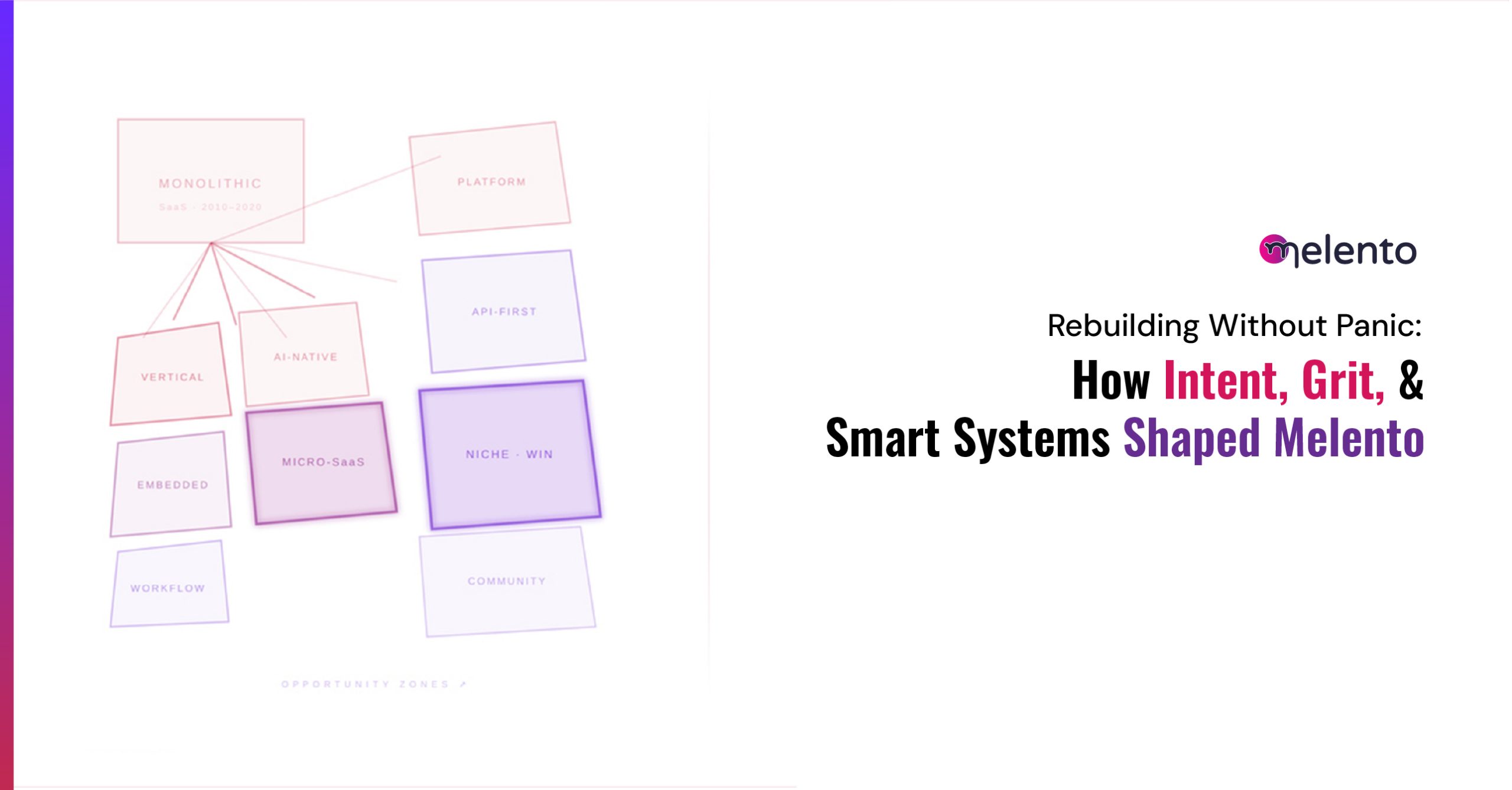

Not every transformation story in my journey began with a breakthrough moment. Some began with long nights, quiet decisions, and the willingness to rebuild before things actually broke. This is one of those moments where I moved beyond product building and started rethinking how platforms should be built in the first place.
Starting Over: On Purpose, Not by Force
I’ve always noticed that most teams wait for systems to fail before considering a rebuild. I didn’t want to wait that long.
As Melento grew, I could see where earlier systems were beginning to strain. Growth was happening, but the underlying architecture wasn’t evolving at the same pace. That realization didn’t create panic; it created intent.
Choosing to rebuild Melento’s no-code CIP from scratch wasn’t just a technical decision for me; it was philosophical. It meant stepping away from what already worked, questioning assumptions, and committing to a stronger foundation.
The process wasn’t glamorous. It involved groundwork, iteration, and plenty of late nights. But every decision was deliberate. Every layer was designed not just for current needs, but for future scale.
I wasn’t rebuilding because something broke. I was rebuilding because something better was possible.
Building Without Shortcuts: Customization as a Core Principle
Where many platforms standardize, I believe we should customize by design.
This wasn’t the easiest path. It meant treating client requirements not as edge cases, but as inputs into the product itself. Integrations weren’t just checkboxes; they became experiments in adaptability.
Progress wasn’t always linear. Some days we moved fast; other days we stepped back and rebuilt pieces that didn’t meet the mark.
What kept us moving wasn’t just technical capability; it was culture.
Transparency replaced friction.
Ownership replaced silos.
And just enough humor kept the late nights human.
The result was a system built not just for users, but with their realities in mind. Because truly resilient platforms don’t avoid complexity, they’re designed to handle it.
From Products to a Platform Mindset
Once the rebuild was underway, my focus shifted to scale.
Our earlier systems had delivered strong, focused solutions. But I knew the future demanded something more connected; something that didn’t just solve isolated problems, but brought them together.
That’s when we evolved toward a platform-first ecosystem. Instead of separate tools, we focused on collaboration, intelligence, and continuity:
- Systems that talk to each other
- Workflows that adapt in real time
- AI that supports decisions, not just processes
It was a subtle but powerful shift, from products that perform to platforms that enable.
And through it all, customer validation kept me grounded. Solving real problems has always been my biggest motivator. More than metrics or milestones, it’s the clarity that comes from knowing something works in the real world.
What Keeps the Momentum Going
Sustaining this pace requires more than technical skill; it requires balance.
When I step away, I don’t disconnect from thinking; I just change the environment. Cooking, long drives, and quiet time become extensions of the same process: reflection, reset, and return.
Building at this level isn’t about constant motion. It’s about knowing when to pause just enough to come back sharper.
The Real Meaning of “Fearless”
Fearless thinking is patient, intentional, and grounded in the willingness to rebuild before you have to. That’s what defined this journey for me, not just what we built, but how we built it.
A Final Thought
I’ve learned that in a world where most teams optimize what already exists, the real advantage lies in rethinking the foundation itself. Melento’s journey reinforced a simple belief for me: the strongest systems aren’t the ones that scale the fastest; they’re the ones built to evolve.