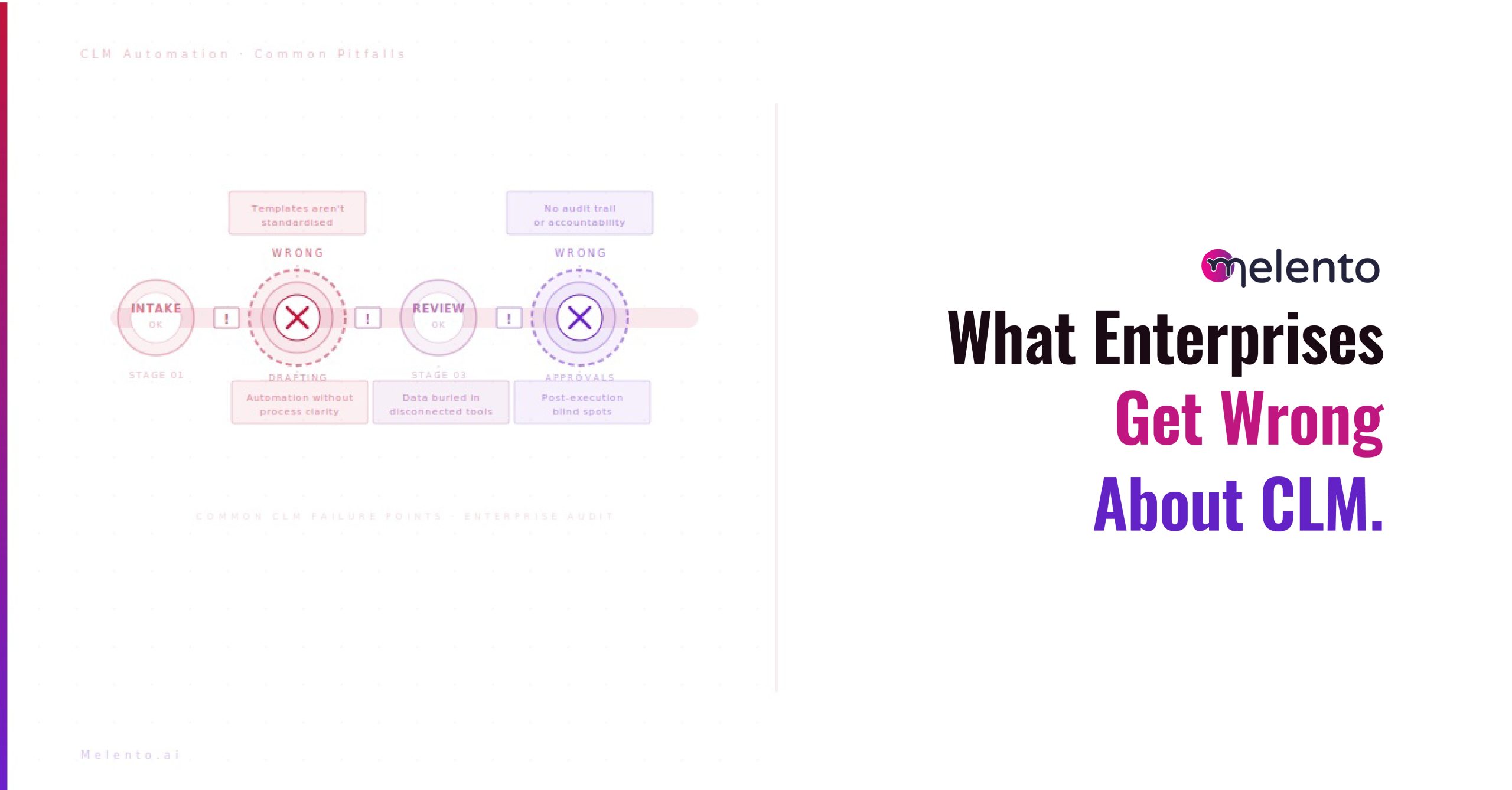

Enterprise software decisions rarely fail because the product is weak.
They fail because accountability is unclear.
This is especially true for contract lifecycle management. Buyers don’t articulate this directly. Instead, they ask about audit trails, access controls, compliance, AI explainability, and dashboards. These questions appear technical. They are not.
They are proxies for a deeper concern.
What could go wrong.And when it does, who carries the blame.
Contracts move through many hands. Legal drafts. Business negotiates. Operations executes. Finance tracks exposure. Compliance audits outcomes. Each handoff introduces friction. Each gap creates plausible deniability.
Organizational failure research has long shown that serious breakdowns rarely come from one dramatic mistake. They emerge when small, routine actions pass unnoticed across systems and teams. The problem is not intent. It is traceability.
This is why CLM evaluations slow down late in the buying process. Buyers are not hesitating because they doubt functionality. They are testing whether the system can survive scrutiny after something goes wrong.
Accountability Is A System Property, Not A Policy
In complex organizations, responsibility diffuses quickly. When a clause is missed or a renewal lapses, the immediate question is not how it happened. It is whether the system can reconstruct the sequence of events.
Enterprises that rely on email threads, shared drives, or loosely governed tools struggle here. Actions are taken, but evidence is scattered. Decisions exist, but context is missing.
Melento CLM software addresses this by treating accountability as a first-class system property. Every action taken on a contract is captured in a unified Activity Tracker. Metadata edits. Status changes. Submissions. Skips. Signatures. Milestone updates.
Each action is logged with the user identity, the field involved, and an exact timestamp. These logs are immutable.
This matters because when an issue surfaces months later, the system does not ask people to remember. It shows what happened. Responsibility becomes traceable rather than debatable.
In enterprises, this distinction reduces escalation more effectively than any policy document. Access control is about preventing ambiguity, not just breaches
Security discussions in CLM often focus on external threats. But many enterprise failures originate internally. Excessive access. Unclear privileges. Silent changes.
Audit and control bodies consistently point to privilege misuse and access sprawl as leading contributors to compliance incidents. In contract systems, this risk compounds because documents are frequently shared across departments and vendors.
Melento CLM applies role-based access control to limit who can view, edit, or approve contracts. Privileges are explicit. Administrative authority is separated. Sensitive actions require appropriate roles.
Authentication follows modern standards. Multifactor authentication and token-based session validation ensure access is deliberate and traceable. Automatic logout after inactivity reduces exposure on shared or unattended devices.
These controls are intentionally unremarkable. Enterprise buyers do not look for clever security. They look for systems that behave predictably under audit.
Predictability is what prevents blame from spreading.
Legal enforceability removes doubt at the worst possible moment.
When contracts fail, they are often challenged at the most inconvenient time. During disputes. During audits. During regulatory review.
At that point, convenience features disappear. What remains is enforceability.
Electronic signatures must stand up to scrutiny. Digital stamping must comply with jurisdictional mandates. Evidence must be complete and verifiable.
Melento CLM ensures signatures and stamping workflows align with current government policies. Electronic evidence is generated automatically. Stamp paper printing remains compliant across jurisdictions.
Standardization further reduces exposure. Clause and template libraries ensure contracts are built from pre-approved language rather than improvised drafting. Variations are controlled. Exceptions are deliberate.
This does not eliminate risk. It makes risk legible.
Most contract failures are human. Systems should expect that.
Operational research across regulated industries shows that routine, repetitive work with multiple handoffs is where errors concentrate. Not because people are careless, but because attention degrades under volume and familiarity. Contracts fit this pattern precisely.
Melento CLM treats automation as a safety net, not a replacement for judgment. Organizations can define rulebooks at the company or contract level. The system performs a first-level review, flagging deviations, missing parameters, or non-compliant clauses before finalization.
This approach reflects a well-established principle in high-reliability systems. Early detection prevents escalation more effectively than late correction.
Obligation and milestone tracking extend this discipline beyond signing. One-time, event-based, and recurring commitments are monitored continuously. Alerts surface before deadlines are missed, not after penalties accrue.
Failures are intercepted while they are still small.
Visibility is not reporting. It is early warning.
Senior leaders are accountable for contract outcomes, even if they never touch the documents themselves. What they need is not more reports. They need signals.
Research into high-reliability organizations shows that resilient systems distinguish themselves by detecting weak signals early. Small delays. Uneven workload. Aging approvals.
Melento CLM’s insights dashboards are designed for this purpose. Contract distribution, aging, and turnaround times are visible in real time. Bottlenecks become patterns rather than surprises.
This visibility allows intervention before issues harden into incidents. It shifts oversight from reactive escalation to preventive action.
In enterprise environments, this difference defines operational maturity.
What Are Buyers Actually Approving?
When enterprise buyers evaluate a CLM, they are not approving software. They are approving a risk posture.
They want to know whether the system can answer uncomfortable questions later. Whether it can reconstruct decisions, enforce boundaries, surface problems early, or limit how far failures can travel.
This is why CLM deals stall not during demos, but during internal review. Legal, IT, compliance, and procurement are not looking for transformation. They are looking for defensibility.
Melento CLM fits into this reality by design. It prioritizes traceability over novelty. Governance over automation. Visibility over abstraction. Phased control over forced change.
The unspoken question enterprise buyers ask before they say yes is not abstract.
What could go wrong. And will the system help us explain it.
In contract management, that answer determines whether a platform is adopted, tolerated, or quietly rejected.
Melento CLM succeeds not by promising that nothing will go wrong, but by ensuring that when something does, responsibility is clear, evidence exists, and failure does not multiply.
That is what enterprise buyers are really buying.