
An Overview of Contract Lifecycle Management Best Practices in 2025
Contracting has become one of the most scrutinized business functions. What was once viewed as a legal back-office responsibility is now directly tied to revenue predictability, compliance posture, working capital cycles, and customer/vendor experience. CFOs, CROs, CIOs, and GCs want faster revenue recognition, zero slowdown at deal closure, standardization, and risk control without becoming bottlenecks. And CEOs? They want enterprise-wide efficiency without compromising accountability.
In 2025, contract lifecycle management best practices depend on one equation – Automation + AI + Governance. Analysts note that AI‑enabled contract automation can reduce review time by 30–50% and materially lower leakage from missed obligations and renewals when paired with structured data and alerts.
AI-powered CLM softwares like Melento are redefining contracting maturity by offering operational control, real-time visibility, and intelligent risk mitigation. This playbook provides leaders with a starting point for implementing best practices aligned with 2025 expectations.
Why Are CLM Implementations Still Failing in 2025 — Even After Digital Tools?
Most enterprises are modernizing contracting on the surface, not at the source. CLM platforms get implemented, yet deal velocity does not improve, legal workload does not reduce, and post-execution risk remains high.
The challenge is that most organizations still operate on legacy patterns:
- Intake begins with emails or ad-hoc requests
- Drafting happens across MS Word files stored on desktops
- Legal review queues become bottlenecks
- Obligations and renewals are handled post-signature manually
This is why many CLM systems fail — automation is often applied after the bottleneck rather than at its root.
Business Realities That Now Define the Evolution of CLM in 2025:
1. Automation is no longer efficiency-led; it is cost and risk-led –
Manual intake, data gaps, and fragmented drafting workflows extend cycle times and inflate legal effort. Enterprises now automate intake, drafting, and compliance not for convenience, but because the business impact of inefficiency is measurable.
2. AI has shifted from a “nice-to-have” to a risk-management mandate –
Leaders have realized that comprehensive legal review cannot scale on human capacity alone. First-pass review, clause analysis, metadata checks, and risk identification cannot be done manually at enterprise scale. AI-powered contract review, playbook enforcement, clause deviation alerts, and automated data extraction are now the only sustainable model for high-volume, high-velocity contracting.
3. Governance is now the defining maturity marker of a CLM program
Most contract value is realized or lost after signature. Enterprises that ignore post-execution events face revenue leakage, SLA penalties, missed renewals, and audit gaps. Advanced CLM teams treat obligation monitoring, renewal alerts, and compliance checkpoints as non-negotiable operational controls, not optional reminders.
What Defines CLM Excellence in 2025: The 4 Capabilities That Separate Leaders from Followers
CLM success in 2025 is not about buying software; it’s about embracing a disciplined operating model. The enterprises that win are the ones that adopt a front-loaded, intelligence-led, and compliance-anchored approach to contract lifecycle management.
These evolving expectations have redefined what “best practices” look like. A modern CLM program must:
✅Capture complete and structured intake data
✅Empower users to draft in their familiar tools with embedded compliance
✅Use AI to remove repetitive legal workload and accelerate review
✅Govern post-execution milestones, obligations, and renewals with rigour
Optimize Contract Intake with Smart Automation
The single biggest determinant of deal velocity is not drafting its intake. When contract requests begin via email, chat, or ad-hoc documents, legal teams spend days clarifying basics: contract type, value, jurisdiction, payment terms, risk clauses, renewal details, and stakeholders. Business teams experience delays, while legal becomes a reactive service desk instead of a strategic partner.
Best-in-class intake practices in 2025 eliminate this bottleneck by mandating structured data upfront.
Melento enables this with a drag-and-drop Form Builder that lets legal teams define mandatory fields, conditional logic, and routing rules based on contract type or commercial value. For example, a contract tagged above a defined deal threshold can automatically trigger Finance + Risk review, without legal needing to triage manually. To remove repetitive data entry, Auto-fill populates client/vendor information and known metadata directly from CRM or ERP sources, improving accuracy and eliminating the most time-consuming administrative work.
The result is a simple but transformative shift:
- Business teams initiate requests with complete information on day one
- Legal stops chasing stakeholders for missing inputs
- Contracts enter drafting faster and closer to final form
This smart automation restores legal bandwidth and accelerates revenue cycles.
Accelerate Drafting Through Seamless Integration
One of the most persistent CLM adoption barriers is that contract owners want to draft in MS Word. Many CLM systems impose this limitation, forcing users to draft only within the platform, which creates resistance and shadow versions.
2025 best practices are built around the opposite philosophy: Don’t change the drafting tool, change the drafting workflow.
Melento’s MS Word Sync enables users to draft, edit, and redline inside Word while automatically syncing revisions to the CLM platform. No uploads, no version confusion, no loss of control, governance, and familiarity can now coexist.
This sync is strengthened by Clause & Template Libraries, ensuring:
- Standardized language across the organization
- Role-based access to sensitive clauses
- Automatic insertion of fallback clauses when deviations occur
The tactical value for leaders: Drafting moves faster, not because teams write faster, but because they can control versions in the tool they already trust.
AI for Automated Risk Review and Compliance
Legal review is essential, but it should not be repetitive or manual. In high-volume contracting environments, 60–80% of review time is spent identifying clause deviations, metadata errors, indemnity exposure, governing law issues, and SLA inconsistencies often before a lawyer even begins true negotiation.
2025 best practices demand that AI handle this first pass.
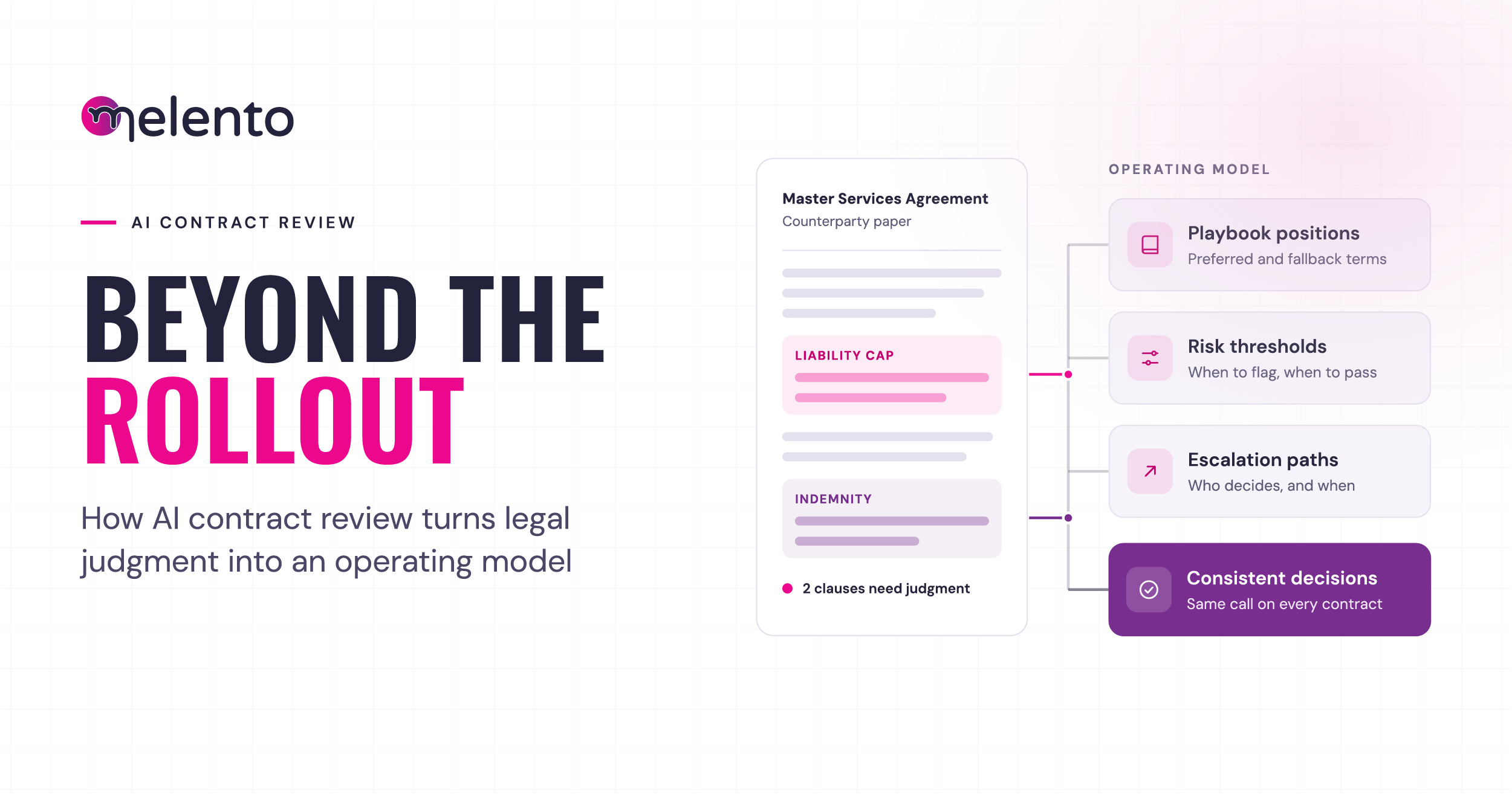
Melento’s AI Playbook Review converts organizational policies into programmable rulebooks at the:
- Organizational level (e.g., liability caps, termination periods)
- Contract-type level (e.g., MSA vs SoW vs NDA requirements)
When a draft is uploaded or synced from Word, the AI:
- Flags deviations instantly
- Extracts metadata automatically
- Assigns a risk score to prioritize review effort
The impact is immediate and measurable:
- Low-risk contracts move to signature without delay
- High-risk contracts get escalated early — preventing surprises post-signature
- Legal work shifts from searching for risk to resolving risk
This is how legal teams scale without expanding headcount — AI absorbs the repeatable burden, lawyers remain focused on high-value decisions.
Post-Execution Governance & Obligation Management
Contract risk doesn’t disappear when the document is signed — it begins.
SLA compliance, price revisions, milestone payments, service credits, renewals, auto-renegotiations, and termination windows determine whether a contract delivers value or erodes it.
Yet most enterprises still rely on manual trackers, reminders, and inbox alerts to manage obligations — resulting in revenue leakage, audit gaps, penalty fees, and vendor/customer disputes.
Mature CLM practice requires governance, not reminders.
Melento operationalizes this with:
🔹Milestones & Obligations — configurable as one-time, event-based, or recurring
🔹Escalation Workflows — automated alerts when obligations are overdue
🔹Expiry Drill-Down Dashboards — proactive visibility into renewals and termination windows
This changes the accountability model: Contracts no longer “sit” in a repository — they act, alert, and escalate until obligations are fulfilled.
CLM maturity in 2025 depends on the strength of one operating system: Structured intake + governed drafting + AI-led review + proactive post-execution control.
Enterprises that adopt these practices build:
- Faster revenue cycles
- Lower legal operating burden
- Tighter compliance protection
- Higher confidence during audits
Enterprises that don’t continue to operate with preventable risk, avoidable delays, and shrinking legal bandwidth.
Melento is built for the maturity stage the market has now entered — a world where contracting is no longer a legal workflow but a business performance engine.
Where Enterprises Are Headed Next: Automate Contract Workflows With Melento
In 2025, successful enterprises are engineering predictable revenue, lower risk, and operational discipline through an AI-powered CLM tool. And that tool rests on three non-negotiables:
1. Automation to eliminate bottlenecks at intake and drafting,
2. Standardization to deliver governed contracting at scale, and
3. AI to ensure every agreement is reviewed, risk-scored, and compliant without slowing the business.
Together, these three forces transform contracting from a linear workflow into a predictable growth engine — accelerating deal closure, safeguarding compliance, and eliminating revenue leakage across the lifecycle.
If your CLM strategy for 2025 is built on efficiency, speed, and control, now is the time to take the next step.
Melento is designed for this transformation. It unifies automated intake, MS Word Sync–powered governed drafting, AI playbook review, and obligation + renewal governance into one operating cloth — giving enterprises total visibility and control from request to renewal. The result is not just faster contracts, but fundamentally smarter contracting: business teams move quickly without bypassing controls, and legal teams protect the organization without becoming blockers.
Explore how Melento can transform your contracting lifecycle end-to-end and accelerate business outcomes.