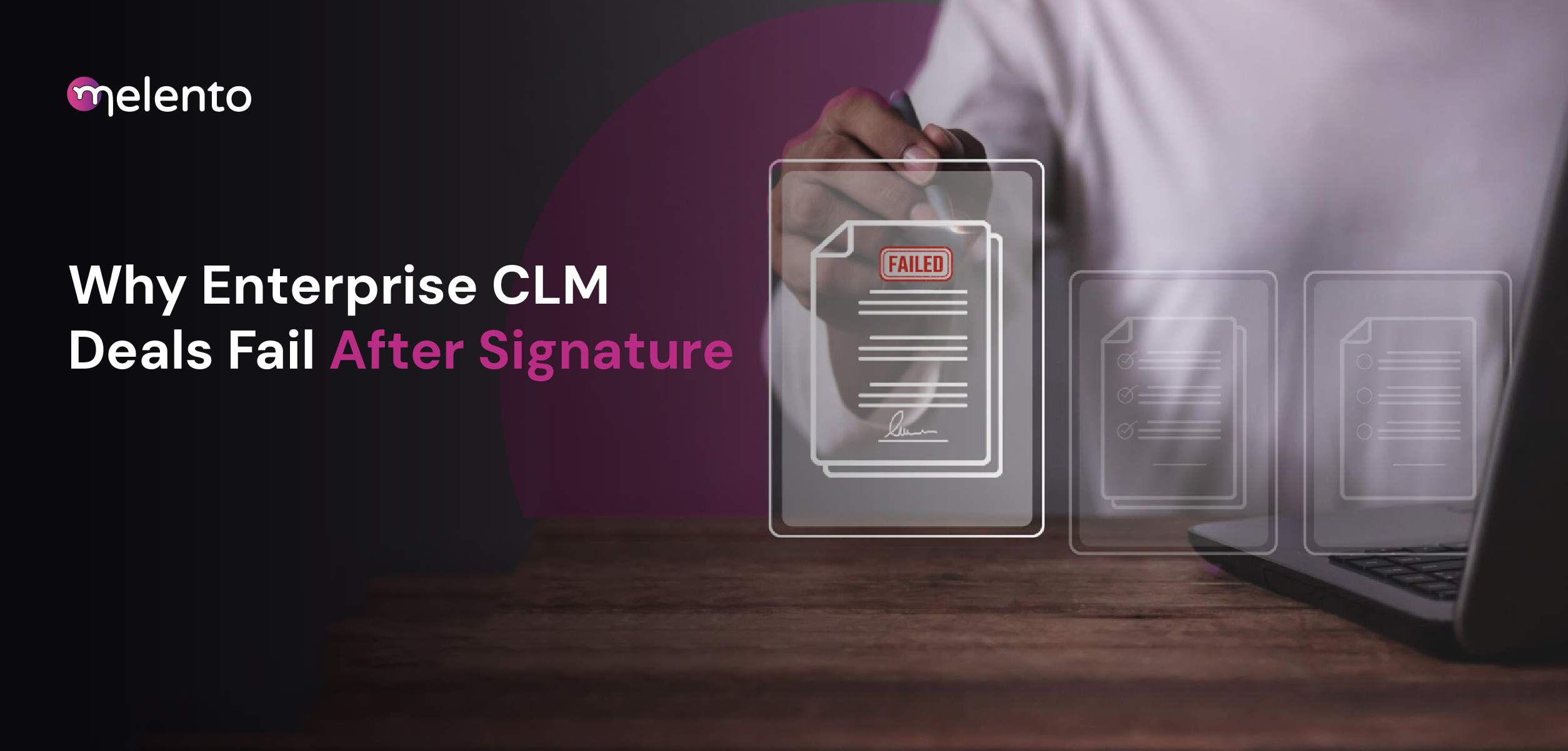

Sales–ops misalignment, scope creep, and missing governance are the real post-sale killers.
The vendor is selected. The contract is signed. Implementation begins with optimism. Then something subtle happens. Sales disengages. Legal adapts workflows manually. Operations improvises around gaps. Leadership stops asking about outcomes. Within a year, the CLM is still “live” but no longer decisive.
This pattern is not anecdotal. Research from World Commerce & Contracting shows that organisations lose an average of 8–10 percent of contract value annually due to poor post-award contract management. The loss does not come from bad negotiations. It comes from breakdowns in management.
Enterprise CLM failures are rarely about missing features. They are about structural weaknesses that appear after signature, when the system must operate inside real organisations.
Three factors dominate these failures: sales–operations misalignment, uncontrolled scope creep, and weak post-execution governance.
Sales–Ops Misalignment Begins Before The Contract Exists
Most CLM implementations inherit a problem they did not create.
Commercial intent is captured informally.
Sales discussions often live in slide decks, emails, and CRM notes. When a deal reaches legal, critical assumptions are implicit rather than explicit. Legal teams are expected to “figure it out.” Operations later inherit agreements that do not fully match what was sold.
Harvard Business Review’s research on cross-functional execution shows that misalignment between commercial and operational teams is one of the strongest predictors of execution failure in complex initiatives. Contracts are no exception.
CLM systems that start at drafting are already too late.
Melento CLM software addresses this by shifting the starting point of the lifecycle. The process begins with structured request initiation, not document creation.
Sales and business teams raise contract requests through governed forms. These forms are not generic. Using configurable form builders, organisations define mandatory inputs such as agreement type, counterparty name, revenue thresholds can be added as a field by the user if they require, and risk flags. Conditional logic ensures relevance rather than volume.
Legal teams act as validation gatekeepers. Requests are reviewed before drafting begins. If inputs are incomplete or inconsistent, the process stops. This removes interpretation from the lifecycle.
The effect is quiet but powerful. Commercial intent becomes structured data. Legal drafts from verified context. Operations later execute against clarity rather than assumptions.
This is not automation. It is alignment engineered into the workflow.
Scope Creep Thrives Where Variation Is Invisible
Scope creep is often blamed on changing requirements. In practice, it is caused by unmanaged variation.
As contracts move through organisations, small deviations accumulate. Clauses are edited to accommodate one deal. Templates are copied rather than governed. Over time, no one is sure which language is standard and which is exceptional.
Research from the International Association for Contract & Commercial Management consistently shows that uncontrolled contract variation increases dispute frequency and operational overhead. What feels flexible early becomes fragile later.
Melento CLM limits scope creep by making variation visible and intentional. Pre-approved clause libraries and templates establish a baseline. Deviations require conscious choice, not convenience.
This reduces unnecessary complexity and prevents accidental expansion of scope.
Importantly, the system does not block exceptions. It surfaces them. That distinction matters. Enterprises need flexibility, but they also need traceability.
When variation is governed, scope stops creeping. It stays contained.
Governance Does Not End When The Ink Dries
One of the most damaging assumptions in CLM adoption is that governance ends at signature. In reality, signature marks the beginning of risk.
PwC’s Global Compliance Study highlights that contractual obligations and third-party commitments are among the most common sources of regulatory exposure. Missed milestones, untracked renewals, and unmanaged penalties rarely stem from negligence. They stem from invisibility.
Post-execution governance requires systems that treat obligations as operational events, not static text.
Melento CLM approaches governance as a continuous function. AI-assisted playbooks perform first-level reviews of incoming and legacy contracts against organisation-defined rules. Deviations are flagged early. Outputs remain explainable and configurable.
Milestones are tracked explicitly. One-time obligations, recurring commitments, and conditional triggers are monitored as live entities. Notifications are issued before deadlines are missed.
Every action is logged. Edits, approvals, overrides, and skips are recorded in a granular activity trail. This creates accountability without surveillance.
Executed contracts reside in a central repository with role-based access. This reduces reliance on email and shared drives, which remain a primary source of document risk according to multiple enterprise audits.
Governance, when designed this way, becomes routine rather than reactive.
Integration Failures Are Usually Ownership Failures
Post-signature breakdowns are often attributed to “integration issues.” The phrase is convenient. It is also misleading.
Systems rarely fail because APIs are missing. They fail because ownership is unclear.
Research from the Standish Group on enterprise system deployments shows that unclear data ownership and workflow handoffs are stronger predictors of failure than technical incompatibility.
Melento CLM treats integration as continuity rather than replacement.
For enterprises using CRM or ERP platforms, Melento’s APIs push contract statuses, executed documents, and metadata into downstream systems. No team is forced to switch tools to stay informed.
This reduces adoption friction and preserves accountability. Systems that respect existing workflows are more likely to be used consistently.
ROI Erodes When Leadership Loses Visibility
A final reason CLM deals fail after signature is quiet neglect.
Leadership approves CLM investments to reduce risk and improve execution. When outcomes are not visible, attention shifts elsewhere. The system becomes optional.
Research from the Corporate Executive Board shows that enterprise initiatives without ongoing executive visibility lose momentum regardless of technical success.
Melento CLM provides performance dashboards that surface stage-wise turnaround times, contract ageing, bottlenecks, and renewal risk. These are not vanity metrics. They are intervention points.
Visibility sustains sponsorship. Sponsorship sustains discipline.
The Real Lesson Of Post-Signature Failure
Enterprise CLM deals do not fail because vendors oversell features. They fail because organisations underestimate the complexity of execution.
Sales–ops misalignment introduces ambiguity. Scope creep introduces fragility. Missing governance introduces risk. Over time, confidence erodes.
CLM systems that succeed do not eliminate complexity. They contain it.
Melento CLM addresses post-signature failure through structure rather than spectacle. Governed requests. Validated drafting. Controlled variation. Continuous oversight. Observable execution.
In enterprise environments, this discipline matters more than novelty.
The true test of a CLM system is not how impressive it looks before signature. It is how quietly it prevents failure long after.
That is where most CLM initiatives are decided.