
Most enterprises do not discover CLM pricing problems during vendor evaluation. They discover them after rollout.
The system works. Contracts flow. Users adopt it. And then, quietly, costs start behaving in ways no one modelled. Licenses expand beyond the legal team. AI usage spikes during migrations. Integrations run continuously. What looked like a contained software purchase begins to resemble an operating expense with moving parts.
CLM pricing only appears simple at the point of entry. Its real complexity emerges once the platform becomes embedded in how the business actually runs.
Pricing models matter because CLM is not a departmental tool. It is a system of record. And systems of record behave very differently at enterprise scale.
This is where pricing stops being a commercial discussion and becomes an operating risk.
Why CLM Pricing Deserves More Scrutiny Than It Gets?
CLM vendors tend to frame pricing as a procurement problem. Enterprises should frame it as a governance problem.
Contracts grow in number, not linearly but structurally. New business units, geographies, compliance needs, workflows. and integrations. Each expansion stresses the pricing model in different ways.
According to Gartner, enterprises that underestimate software scalability costs overshoot their original business case by 30–50% within three years. CLM is particularly vulnerable because usage expands horizontally across roles, not vertically within one team.
The right question is not which pricing model is cheaper today. It is which model remains predictable when usage becomes unavoidable.
The Common CLM Pricing Models and Where They Strain
Most CLM platforms rely on one or a combination of the following approaches. Each has legitimate use cases. Each also carries structural trade-offs that buyers often discover too late.
1. Per-user or seat-based pricing
This is the most familiar model. Charges are based on the number of licensed users.
For small legal teams, this works. For enterprises, it becomes brittle.
Contracts touch far more people than lawyers. Sales managers review terms. Finance validates obligations. Procurement approves suppliers. Executives sign. Operations track renewals. Restricting access to control costs undermines adoption. Expanding access inflates spend.
Seat-based pricing penalises success. The more the organisation embeds CLM into workflows, the more expensive it becomes.
2. Contract volume-based pricing
Here, cost is tied to the number of contracts processed or stored. At low volumes, this appears attractive. At enterprise scale, it becomes volatile.
A single acquisition can double contract counts overnight. A new compliance initiative can require historical ingestion of thousands of agreements. Business units rarely coordinate contract creation to align with licensing thresholds. Volume pricing turns growth into a budgeting problem.
3. Module or feature-based pricing
This model offers a base CLM with add-ons such as eSignature, analytics, or AI extraction. It feels flexible. In practice, it fragments value.
Features that are operationally inseparable are priced separately. AI extraction is sold apart from contract ingestion. Analytics are detached from obligation tracking. Over time, the total cost of ownership expands quietly as teams activate “just one more module.” What starts as configurability ends as bill sprawl.
4. Tiered subscription pricing
Basic, Professional, Enterprise. The tiers are rarely aligned with real enterprise usage patterns. One advanced requirement forces an upgrade of the entire organisation. Buyers pay for features they do not need to unlock the one they do.
This is pricing by packaging, not by value.
5. Usage-based or API pricing
This is common where CLM integrates with CRM, ERP, or procurement systems. Usage-based pricing aligns cost to activity. It also introduces operational uncertainty. API spikes do not always correlate with business value. Batch operations, integrations, and retries can drive unexpected consumption. Finance teams struggle to forecast. IT teams throttle integrations to control cost. Neither outcome improves CLM ROI.
6. Enterprise or custom pricing
Large organisations often end here. Custom pricing can accommodate complexity. It can also obscure accountability. Discounts are negotiated upfront. Escalation clauses are buried in renewals. Transparency decreases as contracts grow more bespoke. Enterprises trade predictability for flexibility, often without realising it.
The Hidden Costs Buyers Consistently Miss
Licensing rarely tells the full story. Several cost drivers surface only after deployment.
- Implementation and setup fees for configuration, clause libraries, and template mapping are often excluded from headline pricing.
- Integration costs for CRM, ERP, identity systems, or eSign tools frequently require custom work or third-party connectors.
- Training and change management are assumed to be internal until adoption stalls.
- AI features are marketed as capabilities but billed as consumption.
- Storage thresholds quietly introduce archival charges.
- Support tiers gate response times behind additional fees.
- Renewals introduce automatic uplifts that compound over time.
- Customisation requests after go-live trigger consulting rates.
- Compliance certifications are sometimes monetised separately.
- Legacy contract migration often requires manual or semi-automated services that were never budgeted.
Individually, these seem manageable. Collectively, they reshape the economics of the platform.
The Real Pricing Question Enterprises Should Ask
The mistake is focusing on which pricing model a vendor uses. The better question is how the system enforces and exposes that pricing in daily operations.
- Does the platform prevent overuse, or merely bill for it later?
- Does it surface cost in real time, or reconcile it after the fact?
- Does it align pricing to organisational behaviour, or fight it?
This is where architectural choices matter more than rate cards.
How Transparent Licensing Changes The Conversation
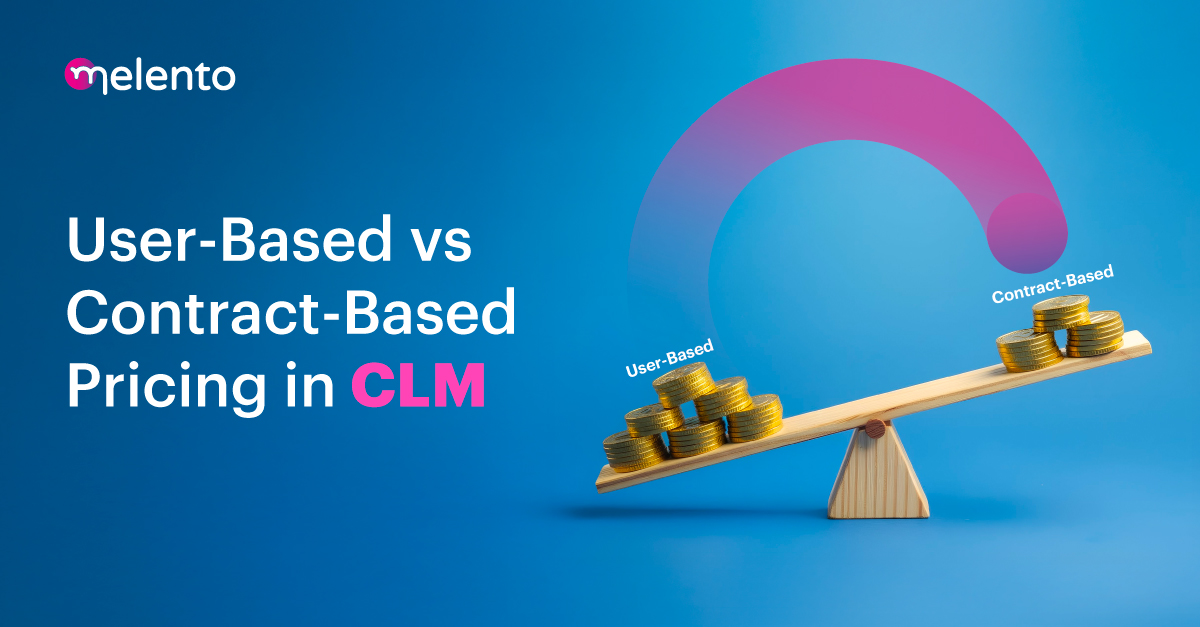
Melento takes a deliberately hybrid approach to pricing because enterprise usage is hybrid by nature. The core platform operates on a user-based licensing model. Advanced AI capabilities operate on a usage-based wallet model. The difference is not the structure. It is the enforcement.
1. Predictable user licensing
Licensing is visible at the point of administration, not buried in invoices.
Admins see assigned versus available licenses in real time. Roles that exceed licensed limits are automatically disabled. During user creation or role changes, the system validates availability before permissions are granted.
This prevents accidental over-provisioning. It also removes ambiguity. Enterprises know exactly how many seats are active, where they are allocated, and when expansion is required.
Crucially, role upgrades are validated against existing dependencies. If a role change would conflict with active contracts, approvals, or templates, the system blocks it. This avoids downstream disruption and unplanned licensing adjustments.
User-based pricing becomes predictable because the platform enforces discipline, not because procurement negotiates harder.
2. AI usage without opacity
AI is where most CLM pricing loses credibility. Melento separates access from consumption. Organisations purchase an AI license to enable advanced capabilities. Actual usage is funded through a central AI wallet at the organisation level.
Every AI action, whether metadata extraction, clause identification, or document analysis, draws from the wallet in real time. Costs are visible as they occur.
There are no bundled assumptions. No retroactive charges. No vague “fair use” clauses.
This design treats AI as an operational resource, not a marketing promise. It allows enterprises to experiment, scale, or pause usage without renegotiating contracts.
From a governance perspective, this matters. Finance teams can forecast. Legal teams can adopt responsibly. IT teams can monitor consumption patterns without policing users.
Pricing and ROI Are Inseparable
Enterprises do not realise CLM ROI through features. They realise it through avoided services and reduced manual effort.
Melento supports bulk uploads of up to 1,000 legacy contracts at a time, using AI to extract structured metadata from PDFs. This allows enterprises to digitise history internally, without paying migration premiums.
Similarly, automated workflows reduce the time and the manpower required to execute the contracts without manual intervention. The contract will flow from one stakeholder to the next as per the pre-set configurations. When signing, stamping, approvals, and stakeholders are captured upfront, contracts move with fewer exceptions.
Administrative simplicity also scales ROI. Default user groups, consolidated permissions, and role clarity reduce ongoing management overhead as adoption spreads.
These are not feature advantages. They are cost containment mechanisms.
The Questions Enterprises Should Ask Vendors
Enterprises evaluating CLM pricing should anchor discussions in operational reality.
- How does the system prevent us from exceeding licensed seats during user creation or role changes?
- Can we see license utilisation in real time, without waiting for reports?
- Are AI costs visible at the point of use, or only after billing cycles close?
- Is there a central wallet or dashboard for AI consumption?
- What happens if usage spikes unexpectedly?
- Can we ingest and correct legacy contract data ourselves without vendor involvement?
- Do workflow changes require consulting hours or configuration rights?
These questions shift pricing conversations from negotiation to design.
Why Pricing Transparency Signals Vendor Maturity?
- Vendors who rely on opacity assume buyers will not notice until switching costs are high.
- Vendors who design for transparency assume buyers will scale usage intelligently.
- This difference reflects maturity, not generosity.
Enterprise buyers are no longer impressed by low entry prices. They are wary of platforms that monetise growth unpredictably.
CLM is a long-term system. Pricing must behave like infrastructure, not like a promotion.
The Quiet Conclusion: Procurement and IT Reach
When pricing aligns with how organisations actually work, adoption accelerates. When it fights organisational behaviour, users route around the system.
The best CLM platforms do not try to be clever with pricing. They try to be explicit.
User-based access is enforced, not assumed. Usage-based AI is tracked, not abstracted. Growth is planned, not penalised.
That is how CLM pricing stops being a risk factor and becomes part of the value proposition. Not by being cheaper. By being predictable.