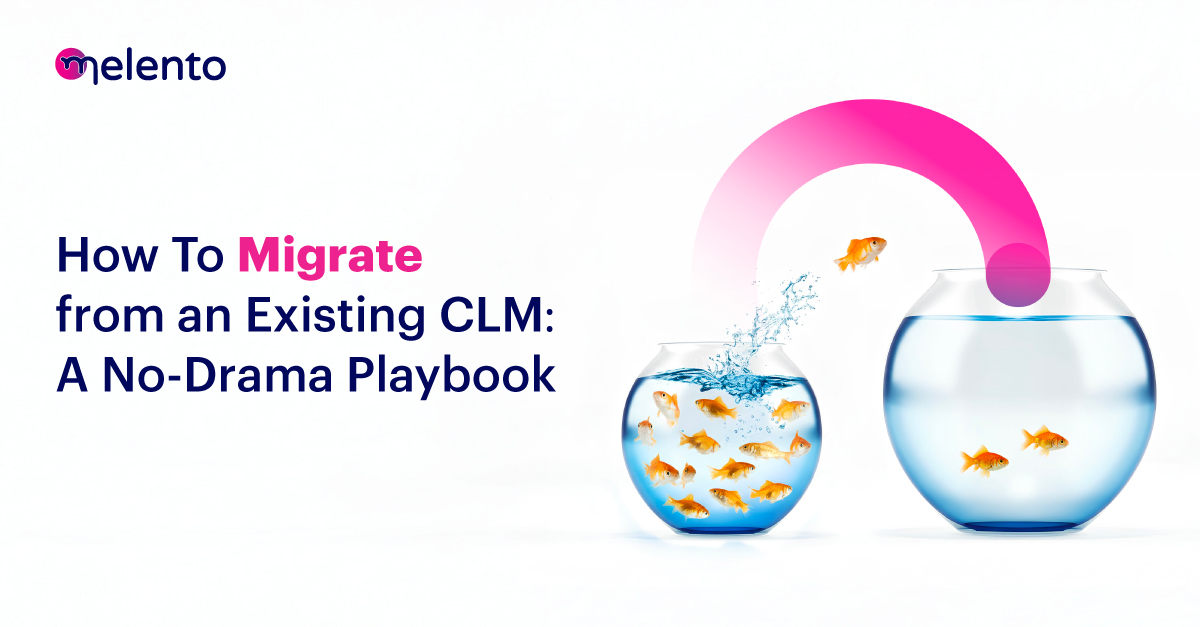

Replacing a CLM is not a software decision. It is a decision that touches every legal, commercial, and operational dependency in the organisation.
Most large organisations already run a CLM. It may be dated, may frustrate legal teams, and may rely on brittle workflows and manual workarounds. But it exists. It holds years of contracts, amendments, and institutional memory. Replacing it feels less like a software upgrade and more like open-heart surgery. That fear is rational.
Contracts sit at the intersection of legal risk, revenue recognition, regulatory exposure, and operational accountability. A broken migration does not show up as a red error message. It shows up months later as a missed renewal, an unenforceable clause, or an audit gap no one can explain.
This is why many enterprises stay put with tools that no longer serve them. Not because they like them. Because the perceived cost of change outweighs the visible pain of staying.
A modern CLM migration, done properly, does not need drama. But it does require discipline. What follows is a practical playbook for enterprises moving off legacy CLMs without disruption, downtime, or internal backlash.
Why Do CLM Migrations Feel Harder Than They Are?
Legacy CLMs were built for a different era. Many assume contracts start digitally, follow rigid templates, and live entirely inside one system. Reality is messier. Enterprises inherit scanned PDFs, negotiated Word files, side letters, and historical agreements that predate any system.
Add to that years of inconsistent metadata, partial uploads, and custom fields no one remembers configuring. The result is a fragile ecosystem where data technically exists, but no one fully trusts it.
Switching fear usually stems from four concerns.
- First, data loss. No enterprise wants to explain why contracts vanished during migration.
- Second, data corruption. Incorrect dates or obligations are worse than missing ones.
- Third, business disruption. Legal and procurement teams cannot stop working for weeks while systems change.
- Fourth, internal resistance. Users burned by past migrations are quick to disengage.
A no-drama migration acknowledges these fears instead of dismissing them.
Step One: Treat Data Mapping As A Business Exercise, Not A Technical Task
Every smooth migration starts before any files move. The foundation is data mapping. Not at the system level, but at the contract level. Enterprises need to decide what actually matters.
Parties. Agreement type. Effective dates. Expiry. Renewal terms. Governing law. Commercial triggers. These are the fields that drive risk and reporting. Everything else is secondary.
Structured CSV becomes the control surface for migration. This is not a crude workaround. It is a deliberate design choice. By consolidating key metadata into a spreadsheet, organisations create visibility before automation begins.
Configurability matters here. Apart from mandatory fields such as agreement type and counterparty, all other columns should reflect how the business operates today, not how the old system forced it to operate years ago.
Validation matters even more. A sample CSV and pre-upload checks surface issues early. Missing fields, inconsistent formats, or outdated values are resolved before ingestion, not after damage is done.
This step is unglamorous. It is also where most migration failures are prevented.
Step Two: Migrate In Phases, Not Heroically
Big-bang migrations look decisive. They are also where things break. Modern CLM platforms support phased migration for a reason. Uploading contracts in controlled batches allows teams to observe system behaviour, validate outputs, and correct issues before scale amplifies them.
Bulk upload capabilities remove manual effort without forcing immediate cutover. High-volume support, often up to thousands of contracts per batch, allows meaningful progress without overwhelming systems or people.
Equally important is auditability. Every bulk action should be logged. Who uploaded what, when and under whose authority. This is not bureaucracy. It is how enterprises maintain trust during transition.
A visible activity trail reassures IT, legal, and compliance teams that migration is controlled, reversible, and accountable.
Step Three: Use AI Where It Removes Toil, Not Judgment
AI is often positioned as the hero of CLM migration. That framing creates unnecessary scepticism. The real value of AI in migration is not intelligence. It is stamina.
Legacy contracts exist as PDFs, scans, and long-forgotten files on shared drives. Manually extracting metadata from them is slow, expensive, and error-prone. This is where AI belongs.
Batch digitisation allows enterprises to upload legacy documents directly and extract defined metadata automatically. The keyword is defined. Organisations decide which fields matter. The system extracts only those.
This keeps automation explainable. Outputs can be reviewed, corrected, and trusted. AI accelerates ingestion without introducing opaque decision-making into legal workflows.
The result is speed without recklessness.
Step Four: Run Systems In Parallel Until Confidence Replaces Fear
A forced cutover is rarely necessary. It is also rarely wise. Parallel runs allow the new CLM to coexist with legacy processes while accuracy is validated. Users compare outputs. Legal teams spot anomalies. IT verifies integrations. Confidence builds organically.
When discrepancies surface, bulk edit capabilities matter. The ability to update metadata across multiple contracts in a single action preserves data integrity without tedious rework.
This is also where deeper insight emerges. Running migrated contracts through AI playbooks can surface compliance gaps that pre-existed the migration. Deviations, missing clauses, or inconsistent terms are identified not because the new system failed, but because it sees more clearly.
Parallel runs shift migration from a leap of faith to a measured transition.
Step Five: Design For Human Adoption, Not Just System Accuracy
Most CLM migrations fail socially, not technically. Legal teams resist systems that force them to abandon familiar tools. Procurement teams disengage when interfaces feel alien. Business users revert to email when workflows slow them down.
Change management must be embedded into the product, not bolted on as training.
Bidirectional Microsoft Word synchronisation is a good example. Lawyers continue drafting and redlining in Word. Contracts can be synchronised with the CLM. No behavioural cliff. No productivity dip.
Navigation matters too. Renaming modules, simplifying labels, and aligning terminology with how users already think reduces friction. Small design decisions compound into adoption.
Standardisation should feel helpful, not punitive. Central clause libraries allow migrated contracts to be updated over time. Old provisions are swapped for approved language as agreements are touched, not all at once in a disruptive clean-up exercise. Adoption follows familiarity.
Step Six: Give IT Clear Lines Of Control
Migration is as much an IT concern as a legal one. Secure integration pathways are non-negotiable. SFTP support allows automated storage and backup. Webhooks provide real-time updates to downstream systems. APIs enable orchestration without custom hacks.
Oversight matters. A super-admin role ensures that migration leads retain visibility and authority across all contracts, regardless of ownership or workflow state. This prevents orphaned data and access blind spots.
From an IT perspective, a good migration does not introduce new uncertainty. It reduces it.
Why Switching Fear Persists and How It Fades
Enterprises fear switching because past experiences taught them caution. Software vendors often oversell simplicity and underspecify risk.
A no-drama migration does the opposite. It assumes complexity, plans for coexistence and values reversibility over speed.
The irony is that modern CLM platforms are far better suited to this approach than legacy systems ever were. Modular architecture, bulk operations, audit trails, and explainable automation exist precisely to support careful change.
The question is whether the vendor respects that reality.
Where Melento Fits In This Playbook
Melento approaches migration as a controlled operational programme, not a sales milestone.
Its architecture supports structured CSV-based data mapping with configurable fields. Bulk uploads allow phased ingestion with full activity tracking. AI-powered digitisation removes manual effort while keeping extraction scope explicit.
Parallel runs are treated as normal, not as hesitation. Bulk edits and AI playbook reviews support refinement without disruption. Legal teams continue working in Microsoft Word while staying synchronised with the system. Clause libraries enable gradual standardisation rather than forced rewrites.
For IT, secure integrations via SFTP and webhooks, combined with super-admin oversight, provide the control expected in enterprise environments.
None of this is flashy. That is the point.
The Quiet Outcome Enterprises Are Really Seeking
A successful CLM migration does not announce itself. It fades into the background.
Contracts are where they should be. Data is more reliable than before. Users trust the system enough to stop keeping side copies. Audits become easier, not louder. No one talks about the migration six months later.
That is the real definition of no drama.
Enterprises do not need a revolution in contract management. They need a transition that respects what is already at stake. The organisations that get this right move not because they are fearless, but because their fear has been addressed methodically.
That is how legacy CLMs are replaced. Quietly. Safely. And for good.